Key Takeaway
A complete, step-by-step guide to safely transitioning any snake species from live prey to frozen-thawed. Covers every technique from basic scenting to the fresh-kill bridge method, with species-specific tips.
Table of Contents
- 1. Why Bother? The Case for Frozen-Thawed Prey
- Safety for Your Snake
- Disease Risk Reduction
- Practical and Economic Benefits
- Humane Considerations
- 2. Understanding How Snakes Detect Prey
- Thermal Detection
- Chemosensory Detection (Jacobson's Organ)
- Visual Detection
- 3. Preparation: Setting the Stage for Success
- 4. The 7 Transition Techniques (Ranked Gentlest to Most Intensive)
- Technique 1: Correct Temperature Only (Start Here)
- Technique 2: Bedding Scenting
- Technique 3: Wiggling with Tongs
- Technique 4: The Cover / Paper Bag Method
- Technique 5: The Brain / Perforation Technique
- Technique 6: The Fresh-Kill Bridge
- Technique 7: Scenting with Amphibians (Hognose Snakes Only)
- 5. Species-Specific Guidance
- Ball Pythons
- Corn Snakes
- Boa Constrictors
- King Snakes & Milk Snakes
- Hognose Snakes
- 6. The Transition Schedule: Patience and Consistency
- 7. After the First Success: Reinforcing the Behavior
- 8. Troubleshooting Common Problems
- "My snake strikes the prey but won't swallow it"
- "My snake starts to swallow but backs off"
- "My snake was eating frozen and suddenly stopped"
- "My snake regurgitated after eating a frozen-thawed prey item"
- Conclusion
- 9. Long-Term Feeding Maintenance After Successful Transition
- 10. Summary: The Transition Toolkit at a Glance
Transitioning a snake from live to frozen-thawed prey is one of the most important skill sets in reptile keeping — and one of the most misunderstood. Too many keepers attempt the transition once, fail, give up, and continue feeding live prey indefinitely, not knowing how close they were to success or which technique they should have tried next.
This guide is the definitive resource on making the live-to-frozen transition work for any snake species. It covers the biology of why snakes hunt, exactly what cues trigger a feeding response, and a complete toolkit of techniques ranked from gentlest to most intensive. By the end, you'll understand not just how to make the switch, but why each technique works — which means you can adapt when one approach doesn't work for your specific animal.
At Loxahatchee Rodents, we have been producing frozen feeders since 2001 and have guided thousands of keepers through this exact transition. We have also worked with species as finicky as hognose snakes and green tree pythons that were fed live prey before reaching our hands. These techniques work.
1. Why Bother? The Case for Frozen-Thawed Prey
Before the techniques, let's establish why this transition matters enough to invest time and effort.
Safety for Your Snake
This is the most compelling reason. Live feeder rodents are capable of inflicting serious injury on snakes in a surprisingly short time. A mouse that lands a bite on a snake's eye can cause permanent blindness. A rat that bites through the trachea can kill a snake within hours. We have seen snakes brought to exotic veterinarians with deep lacerations, broken ribs, and eye infections caused by live prey. Frozen-thawed prey poses zero physical risk to your snake.
Disease Risk Reduction
Live feeder rodents from pet stores may carry Salmonella, Campylobacter, pinworms, mites, and other pathogens. Deep-freezing at -18°C kills the vast majority of external parasites and significantly reduces bacterial loads. When you source frozen prey from a reputable supplier, you dramatically reduce the disease burden you introduce to your snake with each feeding.
Practical and Economic Benefits
Maintaining a supply of live prey requires either frequent pet store trips or managing a live rodent colony — both of which are significantly more demanding than ordering bulk frozen prey. A six-month supply of frozen feeders occupies a small section of a chest freezer and requires no ongoing care. See our frozen rodent storage guide for how to maximize storage life.
Humane Considerations
At Loxahatchee Rodents, our rodents are euthanized using CO₂ — the AVMA-recognized standard for humane death in small mammals. There is no stress, no pain, and no prolonged suffering. Live feeding, by contrast, involves an animal being constricted and asphyxiated — a process that, while natural, is not pain-free. For keepers who care about the welfare of all animals in their care, frozen-thawed is the more ethical choice.
For a comprehensive comparison of all factors, see our full live vs. frozen prey comparison guide.
2. Understanding How Snakes Detect Prey
To successfully make the live-to-frozen transition, you need to understand the sensory channels snakes use to detect and recognize prey. Every technique in this guide is designed to activate one or more of these channels:
Thermal Detection
Snakes (particularly pythons and boas) have thermosensory pit organs that detect the infrared radiation emitted by warm-blooded prey. This is why properly warming frozen prey to 98–102°F is not optional — it is the primary trigger for the feeding response in thermosensing species.
Colubrids (corn snakes, king snakes, milk snakes, rat snakes) have less developed pit organs but still possess thermosensory skin receptors. They are less dependent on thermal cues than pythons but still respond significantly better to properly warmed prey.
Chemosensory Detection (Jacobson's Organ)
All snakes use their forked tongue to collect scent particles from the air and transfer them to the vomeronasal (Jacobson's) organ in the roof of the mouth. This is the primary prey recognition system and the one most targeted by scenting techniques.
The key insight: a frozen-thawed mouse smells different from a live mouse. The scent of a live mouse includes stress pheromones, fresh urine, active saliva, and metabolically active tissue. A frozen-thawed mouse has a "quieter" scent profile. The goal of scenting techniques is to enrich this profile to more closely match the signature of live prey.
Visual Detection
Visual prey recognition is significant for diurnal or crepuscular hunters, and for species that rely heavily on movement cues to trigger strikes. The wiggling technique (detailed below) exploits this channel.
3. Preparation: Setting the Stage for Success
Before attempting the first transition feeding, optimize the conditions:
Timing: Conduct the transition attempt in the evening — most snake species are most active and most likely to feed in low-light conditions.
Last live feeding: Ideally, allow 10–14 days since the snake's last live meal before attempting the first frozen-thawed offering. Increased hunger makes snakes more willing to accept unfamiliar prey presentation.
Environment: Feed in a small, dark container (a plastic storage tub with ventilation holes or a paper bag). A confined, dark space concentrates scent and mimics the burrow-hunting conditions many species prefer.
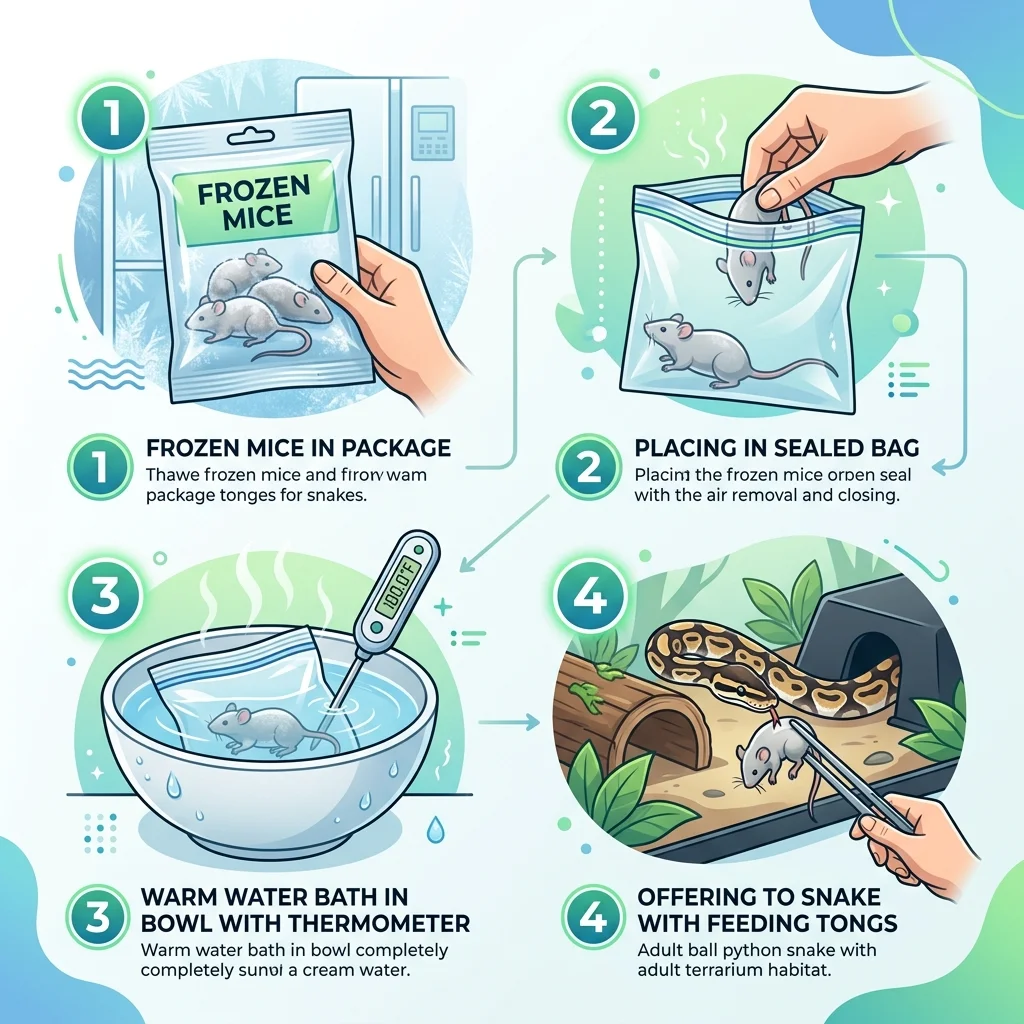
Thawing: Follow the complete thawing protocol to ensure the frozen prey is at 98–102°F. Verify with an infrared temperature gun. This step alone resolves approximately half of all transition refusals. See our how to thaw frozen mice guide for the full protocol.
Tongs: Use stainless steel feeding tongs at all times. Never offer prey from your hands — this creates serious risks of feeding-response bites and conditions the snake to associate human scent with food.
4. The 7 Transition Techniques (Ranked Gentlest to Most Intensive)
Technique 1: Correct Temperature Only (Start Here)
Best for: Snakes that were occasionally fed frozen prey in their previous home but have since become resistant, or any snake that may simply have been offered cold prey in the past.
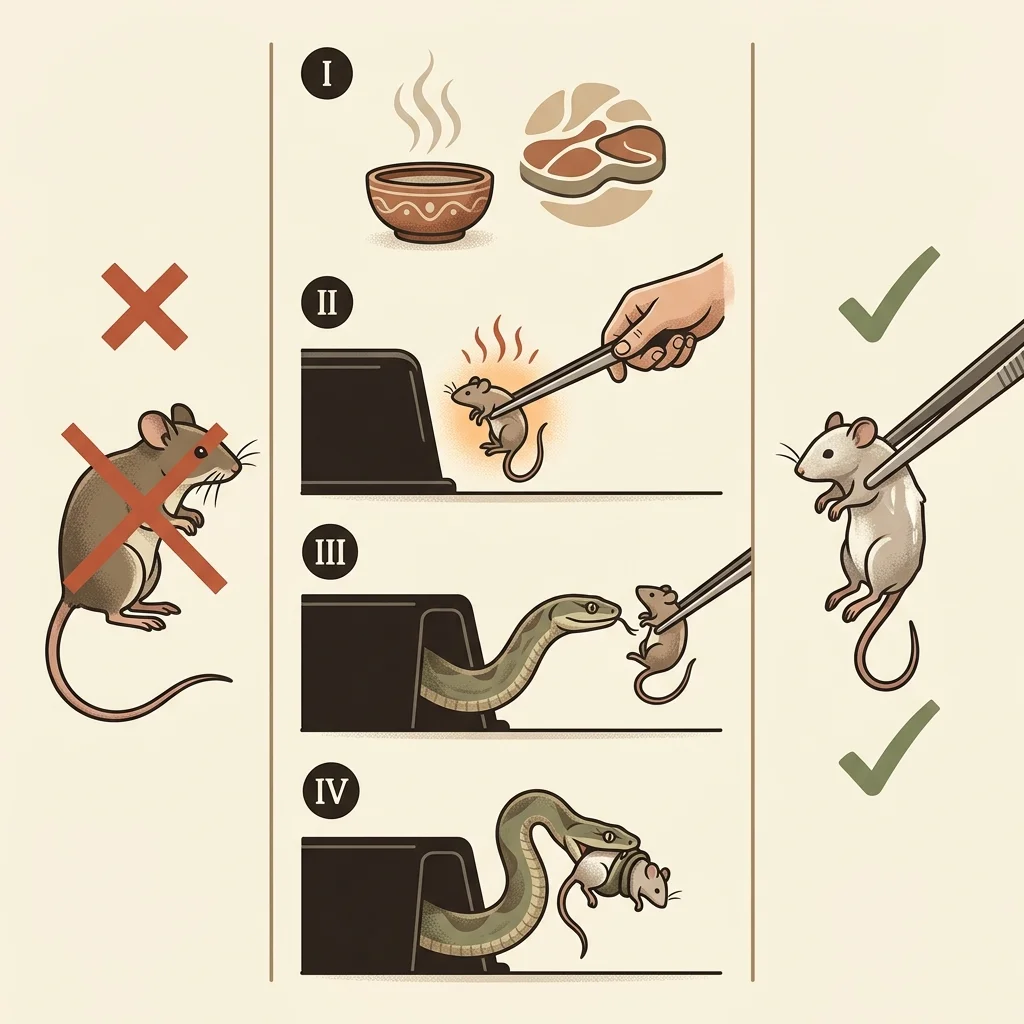
Method: Ensure the thawed prey is at exactly 98–102°F. Present it with tongs, offering it nose-level to the snake from approximately 6 inches away. Hold still for 30 seconds. If no response, gently move the tongs in a slow, undulating pattern for another 30 seconds.
Why it works: Many "live prey" snakes were actually offered improperly warmed frozen prey and never had a true chance to accept it. Correct warming alone resolves approximately 30% of transition cases.
Success rate: Moderate for resistant live-feeders, high for snakes with inconsistent frozen exposure.
Technique 2: Bedding Scenting
Best for: Most colubrid species (corn snakes, king snakes, rat snakes), juvenile ball pythons, hognose snakes.
Method: Obtain a small amount of used bedding from a live mouse enclosure (a pet store will usually provide this if asked politely — it's valueless to them but precious for your transition). Place the warmed thawed mouse in the bedding briefly, or rub the bedding over the mouse's head and body. The scent of a live mouse is now present on the frozen prey.
Why it works: The scent profile of a live mouse — active pheromones, urine, fresh saliva — is the primary trigger for the feeding response in scent-dependent species. This technique bridges the gap between "frozen" and "live" scent profiles without requiring any live prey.
Success rate: High for most colubrid species. Less effective for species that are primarily visual hunters.
Technique 3: Wiggling with Tongs
Best for: Visual hunters and active foragers — corn snakes, king snakes, ratsnakes, hognose snakes.
Method: Hold the warmed, possibly scented prey at nose-level with tongs. Move the prey in a slow, irregular, undulating pattern — mimicking the exploratory movement of a mouse investigating an unfamiliar surface. The key is irregular movement: snakes are triggered by unpredictable movement patterns, not steady locomotion.
Why it works: Visual movement is a secondary but significant prey detection cue for many species. The irregular movement pattern triggers the predatory response in a way that a stationary prey item cannot.
Success rate: High for visual hunters, particularly corn snakes and king snakes.
Technique 4: The Cover / Paper Bag Method
Best for: All species, particularly shy or easily overstimulated snakes.
Method: Place the snake in a small paper bag or dark plastic container. Add the warmed, scented prey. Close the bag or container loosely (ensure ventilation). Place in a dark, quiet room. Do not check or disturb for 30–60 minutes.
Why it works: In an enclosed space, the scent concentration of the prey is significantly higher than in an open enclosure. The darkness removes visual stimulation that can distract some snakes. The small space mimics a burrow, triggering natural tunnel-hunting behavior in many species.
Success rate: Very high across all species when combined with proper warming and scenting.
Technique 5: The Brain / Perforation Technique
Best for: Particularly resistant snakes, hognose snakes imprinted on amphibian prey, ball pythons with strong live prey preferences.
Method: Using a sterilized pin, toothpick, or lancet, make a very small perforation in the top of the skull of the warmed thawed mouse — just enough to expose a tiny amount of brain tissue. The neurochemical compounds released from brain tissue are extraordinarily potent prey recognition triggers for snakes.
Why it works: The neurological tissue of prey animals releases specific chemical compounds that are deeply wired into snake predatory behavior. This technique is particularly effective because it bypasses learned associations and operates on a more instinctual level.
Note: This technique sounds extreme but involves no additional harm to the mouse — it was humanely euthanized before freezing. It is simply a presentation technique.
Success rate: Very high, particularly for ball pythons and hognose snakes that have proved resistant to other methods.
Technique 6: The Fresh-Kill Bridge
Best for: Snakes with long-established live prey histories, particularly adult animals.
Method: Humanely euthanize a live mouse using CO₂ or cervical dislocation (if you are trained and licensed to do so). Offer the freshly killed mouse immediately while it is still at body temperature (approximately 100°F). Once the snake accepts this, at the next feeding session offer a properly warmed frozen-thawed mouse.
Why it works: A freshly killed mouse retains every scent and thermal cue of a live animal. It removes only the movement component. Once a snake has accepted a fresh-killed prey item, most snakes will accept a warmed frozen-thawed item at the next session, as the primary scent and thermal cues are similar.
Success rate: Very high. Most snakes make the full transition to frozen-thawed within 3–5 sessions using this bridge.
Technique 7: Scenting with Amphibians (Hognose Snakes Only)
Best for: Western hognose snakes (Heterodon nasicus) imprinted on toad or amphibian prey.
Method: Rub the warmed thawed mouse against a live, unharmed toad or frog, then offer the mouse immediately using tongs. The amphibian scent transforms the mouse into something that smells like natural hognose prey.
Why it works: Hognose snakes evolved as toad specialists. A mouse that smells like a toad is perceived as prey by even the most resistant toad-imprinted individual.
Success rate: Very high for hognose snakes. See our dedicated hognose snake feeding guide for more hognose-specific techniques.
5. Species-Specific Guidance
Ball Pythons
Ball pythons (Python regius) are heavy-bodied pythons with well-developed pit organs. Thermal cues are extremely important. Begin every transition attempt with perfectly warmed prey. If temperature alone doesn't work, move directly to the brain technique or the fresh-kill bridge — these are the most effective for ball pythons. For detailed ball python feeding troubleshooting, see our ball python not eating guide.
Corn Snakes
Corn snakes (Pantherophis guttatus) are primarily scent-driven. Bedding scenting combined with wiggling tongs resolves the vast majority of corn snake transitions. The paper bag method is particularly effective for newly acquired corn snakes. See our corn snake feeding guide for the complete protocol.
Boa Constrictors
Boas are generally among the easiest snakes to transition — they have both strong thermal detection and strong scent detection. Proper warming alone is often sufficient. If needed, add light bedding scenting. See our boa constrictor feeding chart for sizing reference.
King Snakes & Milk Snakes
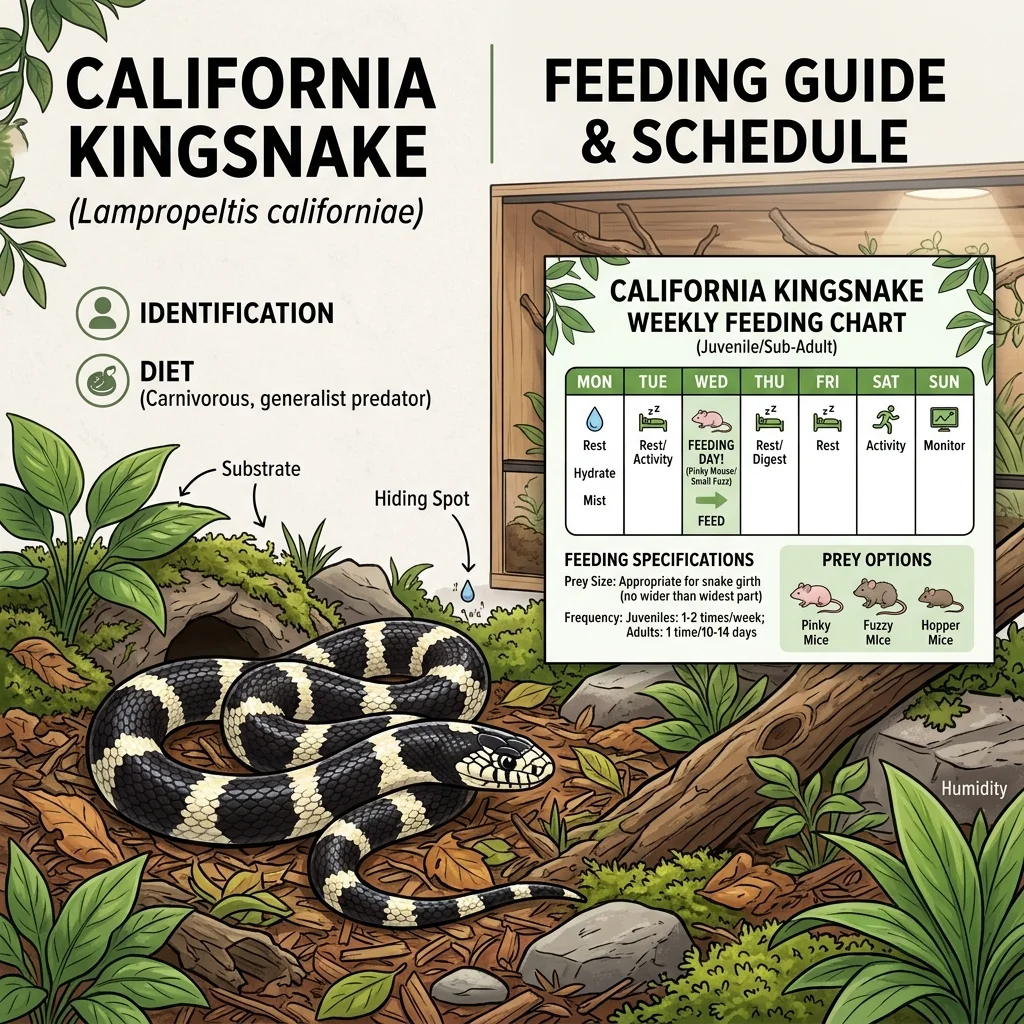
King snakes and milk snakes are enthusiastic, aggressive feeders. Bedding scenting combined with wiggling tongs produces very high success rates. These species rarely require the more intensive techniques. See our king snake feeding guide for species-specific guidance.
Hognose Snakes
Hognose snakes are the most challenging transition case. Use amphibian scenting, the brain technique, or the paper bag method. See our dedicated hognose snake feeding guide for the full hognose-specific transition toolkit.
6. The Transition Schedule: Patience and Consistency
Week 1: Attempt feeding with Technique 1 (correct temperature). If refused, try Technique 2 (scenting) in the same session. If still refused, use Technique 4 (paper bag method) and leave for 45 minutes.
Week 2: If the week 1 attempt failed, try Technique 5 (brain/perforation) with Technique 4 (paper bag).
Week 3: If still refusing, attempt the Fresh-Kill Bridge (Technique 6) with a single live mouse humanely killed. Follow immediately with a warmed frozen-thawed mouse at the next scheduled feeding.
Key rules:
- Do not attempt more than one feeding session per feeding interval — corn snakes every 7 days, ball pythons every 10–14 days
- Remove uneaten prey after 30–60 minutes; never leave it in the enclosure overnight
- Do not handle the snake within 48 hours before a feeding attempt
- Document what you tried and the snake's response — this helps identify patterns
When to give up on a specific technique: After 3 sessions with the same technique producing zero response (not even tongue-flicking at the prey), move to the next technique. Persistence with a failed technique is the most common mistake in the transition process.
7. After the First Success: Reinforcing the Behavior
Getting a snake to accept a frozen-thawed prey item for the first time is the hard part. Maintaining that behavior requires consistent reinforcement:
First 3 sessions: Continue using the same techniques that produced success (scenting, paper bag, etc.). Do not remove any elements that were part of the successful feeding.
Sessions 4–6: Begin gradually reducing the intensity of the technique. If you used heavy scenting, reduce the amount slightly. If you used the paper bag, try the feeding container without the paper bag but in a dark room.
Sessions 7+: Attempt a standard feeding without any special techniques. Many snakes transition completely within 5–10 sessions.
If regression occurs (the snake stops accepting frozen after accepting it for several sessions), simply go back to the last successful technique and repeat the gradual reduction process.
8. Troubleshooting Common Problems
"My snake strikes the prey but won't swallow it"
The prey is likely slightly too cold internally. The snake detects the heat of the surface but the core temperature drops as the snake begins to swallow. Extend the warm water bath by 5 additional minutes and verify core warmth by pressing gently along the prey length before offering.
"My snake starts to swallow but backs off"
The prey may be slightly too large. Try the next size down. Also check that the prey isn't getting too cool during the presentation — if you're taking more than 5 minutes to get a response, rewarm the prey before retrying.
"My snake was eating frozen and suddenly stopped"
This is very common and usually indicates pre-shed (check the eyes), a seasonal response, or a husbandry change. This is not a "transition reversal" — it is a normal feeding pause. Work through the standard troubleshooting from our ball python not eating guide or corn snake won't eat frozen mice guide as appropriate for your species.
"My snake regurgitated after eating a frozen-thawed prey item"
Implement the 14-day rest protocol from our snake regurgitation guide immediately. The most common causes are: prey warmed unevenly (cold core), prey that is too large, or handling within 48 hours of the meal.
Conclusion
The live-to-frozen transition is a commitment that pays dividends for the entire life of your snake — in reduced injury risk, reduced disease burden, lower feeding cost, and greater convenience. With the 7-technique toolkit in this guide and the patience to work through them systematically, virtually any snake can be transitioned to frozen-thawed prey.
Explore our complete reptile feeding guides for more expert resources on every aspect of snake care, and visit our home page to learn about Loxahatchee Rodents' commitment to quality frozen feeder production. For specific species guides, see our corn snake feeding guide, ball python not eating guide, hognose snake feeding guide, and king snake feeding guide.
Written by Bill Galloway, Former Assistant Curator at Palm Beach Zoo and co-founder of Loxahatchee Rodents.
9. Long-Term Feeding Maintenance After Successful Transition
Once your snake has been accepting frozen-thawed prey consistently for 8–10 sessions, the transition is essentially complete. But maintaining that reliable feeding behavior requires ongoing consistency.
The Four Pillars of Long-Term Frozen Feeding Success:
1. Temperature Consistency Maintain your thawing and warming protocol with the same precision at session 100 as you did at session 1. The most common cause of "regression" — a snake that was eating frozen and suddenly stops — is a keeper who has become casual about warming temperatures. Re-establish the infrared gun check as a non-negotiable step, not an optional one.
2. Prey Quality Consistency Source from the same quality supplier consistently. The scent profile your snake has learned to associate with "prey" is specific to that supplier's product — the diet of the breeding colony, the euthanasia method, the flash-freezing timing. Abrupt supplier changes can confuse a snake that has recently transitioned, producing temporary refusals. If you must change suppliers, transition gradually by mixing old and new supplier stock.
3. Schedule Consistency A snake that has been fed on a consistent schedule develops what can be described as a feeding "expectation." Disrupting that schedule — feeding too early, delaying significantly, or feeding at very different times of day — can disrupt this expectation and create temporary refusals. Keep feeding days consistent.
4. Handling Protocol Never let the 48-hour handling blackout window slip. This is one of the most frequently violated rules by experienced keepers who have become comfortable with their snakes. The stress suppression effect on appetite is physiological — it doesn't diminish as the snake becomes more tame.
For additional guidance on maintaining feeding schedules by species, see our how often to feed your snake guide and our ball python feeding schedule guide.
10. Summary: The Transition Toolkit at a Glance
| Technique | Best Species | Success Rate | When to Use |
|---|---|---|---|
| Temperature only (98–102°F) | All species | Moderate | Always start here |
| Bedding scenting | Colubrids, hognose | High | After temp confirmed correct |
| Tong wiggling | Corn/king/rat snakes | High | Visual hunters |
| Paper bag method | All species | Very High | Shy feeders, new snakes |
| Brain/perforation | Ball pythons, hognose | Very High | After 2+ failed sessions |
| Fresh-kill bridge | All species | Very High | Long-established live feeders |
| Amphibian scenting | Hognose only | Very High | Toad-imprinted hognose |
The key rule: one technique at a time, three sessions before switching. Document your results and follow the progression systematically rather than trying everything at once.
Written by Bill Galloway, Former Assistant Curator at Palm Beach Zoo and co-founder of Loxahatchee Rodents.