Key Takeaway
A complete expert guide to feeding corn snakes at every life stage. Correct prey sizing, feeding frequency, and how to transition from live to frozen-thawed prey.
Table of Contents
- 1. Understanding the Corn Snake's Natural Diet
- 2. The Complete Prey Size Guide for Corn Snakes
- Corn Snake Prey Size Chart by Life Stage
- 3. Feeding Frequency: How Often to Feed a Corn Snake
- Recommended Feeding Schedule
- Monitoring Body Condition
- 4. Frozen-Thawed vs. Live Prey: Why Frozen Is Always Better
- Safety for Your Snake
- Disease Prevention
- Storage Convenience
- Humane Production
- 5. How to Transition a Corn Snake from Live to Frozen-Thawed
- Step 1: Properly Thaw the Prey
- Step 2: Wiggle the Prey with Tongs
- Step 3: Scenting
- Step 4: Cover and Leave Method
- Step 5: The Fresh Kill Trick
- 6. Creating the Optimal Feeding Environment
- Use a Separate Feeding Container
- Temperature During Feeding
- Feeding Tools
- 7. Common Feeding Problems and Solutions
- My Corn Snake Won't Eat — What Do I Do?
- 8. Understanding Corn Snake Nutrition
- 9. Buying Quality Frozen Feeder Mice
- What to Look For
- 10. Corn Snake Feeding FAQ
- Conclusion
Corn snakes (Pantherophis guttatus) are one of the most popular pet snakes in the world, and for good reason. They are docile, manageable in size, and relatively straightforward to feed. At Loxahatchee Rodents, we've been producing feeder rodents since 2001 and have helped thousands of corn snake keepers get their feeding routines right.
This guide covers everything you need to know about feeding your corn snake, from hatchling through adulthood, including prey sizing, feeding schedules, transitioning to frozen-thawed prey, and troubleshooting the most common refusal problems.
1. Understanding the Corn Snake's Natural Diet
Before discussing captive feeding, it's essential to understand what corn snakes eat in the wild. Found throughout the southeastern United States, wild corn snakes are opportunistic predators that consume:
- Small rodents: Mice are their primary prey, consumed whole
- Nestling birds and bird eggs: Opportunistically consumed
- Small lizards: Particularly common in younger snakes
- Frogs and small amphibians: Less common but part of their varied diet
In captivity, we replicate this diet with feeder mice — from pinky mice for hatchlings to adult mice for large adults. Rats are generally not recommended for corn snakes due to their higher fat content. Understanding the wild diet helps us appreciate why frozen-thawed mice are the gold standard in captive corn snake husbandry.
2. The Complete Prey Size Guide for Corn Snakes
The most important rule in corn snake feeding is correct prey sizing. The prey item should be approximately the same diameter as the widest part of the snake's body — or no more than 1.5x that diameter.
Feeding prey that is too large causes regurgitation, stress, and repeated refusals. Feeding prey that is too small leads to under-nourishment and stunted growth. See our detailed frozen rodent size chart for a complete visual reference.
Corn Snake Prey Size Chart by Life Stage
| Age | Snake Weight | Recommended Prey | Prey Weight |
|---|---|---|---|
| Hatchling (0–3 months) | 8–15g | Pinky Mouse | 2–4g |
| Juvenile (3–9 months) | 15–50g | Fuzzy Mouse | 4–7g |
| Sub-Adult (9–18 months) | 50–150g | Hopper Mouse | 7–12g |
| Adult (18 months+) | 150–500g | Adult Mouse S/M | 15–28g |
| Large Adult (3+ years) | 400–900g | Large Adult Mouse | 28–45g |
Pro Tip: When in doubt, size down. A corn snake that eats a slightly small pinky will thrive. A corn snake that regurgitates is set back significantly in growth and health.
3. Feeding Frequency: How Often to Feed a Corn Snake
Corn snakes have a faster metabolism than species like ball pythons, meaning they need to be fed more frequently — especially as juveniles.
Recommended Feeding Schedule
Hatchlings (0–6 months): Feed every 5–7 days. Rapid growth mode requires consistent nutrition. Monitor body weight weekly.
Juveniles (6–18 months): Feed every 7 days (once per week). Still growing rapidly. Transition prey sizes as the snake's girth increases.
Sub-Adults (18 months – 3 years): Feed every 7–10 days. Slow the frequency slightly to prevent obesity onset.
Adults (3+ years): Feed every 10–14 days. Mature adult corn snakes do not need weekly feeding. In the wild, adults may go weeks between successful hunts.
Monitoring Body Condition
A healthy corn snake should have:
- A round, cylindrical body when viewed from above — not flat or concave
- A spine that is NOT visible or prominent through the skin
- A tail that tapers smoothly rather than dropping off sharply
- Consistent weight gain in juveniles (weigh monthly with a digital kitchen scale)
4. Frozen-Thawed vs. Live Prey: Why Frozen Is Always Better
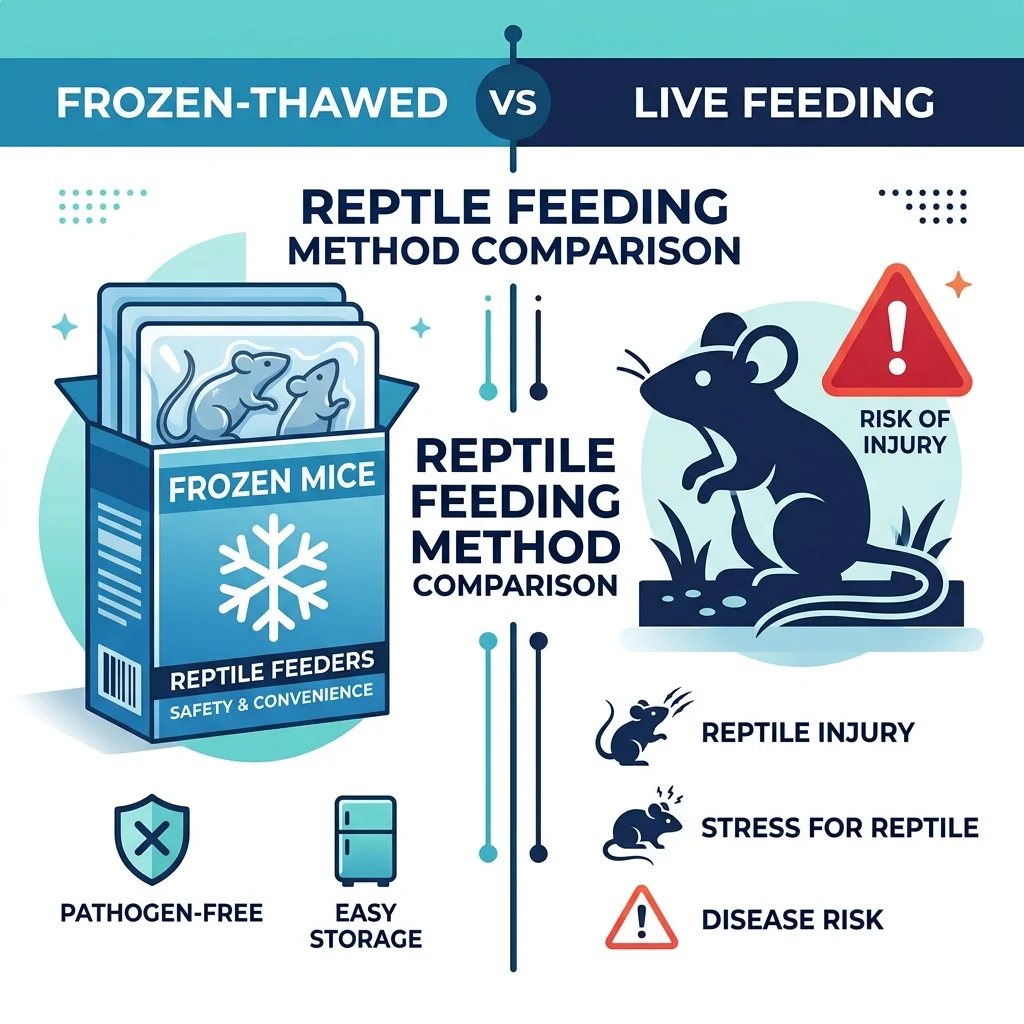
At Loxahatchee Rodents, our position is unambiguous: frozen-thawed prey is superior to live prey in every measurable way.
Safety for Your Snake
Live feeder rodents are capable of inflicting serious injury. A frightened mouse will bite and scratch, causing deep wounds, eye injuries, and infections. We have seen snakes suffer severe bite wounds and even eye loss from live prey. A frozen-thawed mouse poses zero physical risk to your snake.
Disease Prevention
Wild-caught rodents and poorly managed colonies carry pathogens including Salmonella spp., Campylobacter spp., and parasites. Deep-freezing at -18°C kills the vast majority of pathogens. When you buy frozen mice from a reputable supplier, you dramatically reduce disease transmission risk.
Storage Convenience
Frozen feeders can be purchased in bulk and stored for up to 12 months in a dedicated freezer. You never run out of food and can maintain a consistent schedule. See our complete frozen rodent storage guide for best practices.
Humane Production
At Loxahatchee Rodents, we use CO₂ euthanasia — the recognized AVMA standard for humane death for feeder animals. This eliminates the stress and suffering associated with live feeding.
5. How to Transition a Corn Snake from Live to Frozen-Thawed
If your corn snake was previously fed live prey, transitioning to frozen-thawed requires patience. Here is our proven methodology developed over 25 years.
Step 1: Properly Thaw the Prey
The number one reason corn snakes reject frozen-thawed prey is improper thawing. Follow our complete thawing protocol:
- Move frozen prey from freezer to refrigerator 12–24 hours before feeding
- Once thawed, warm the prey in a 100–105°F water bath inside a sealed bag for 15 minutes
- Verify surface temperature with an infrared gun — target 98°F–102°F
Step 2: Wiggle the Prey with Tongs
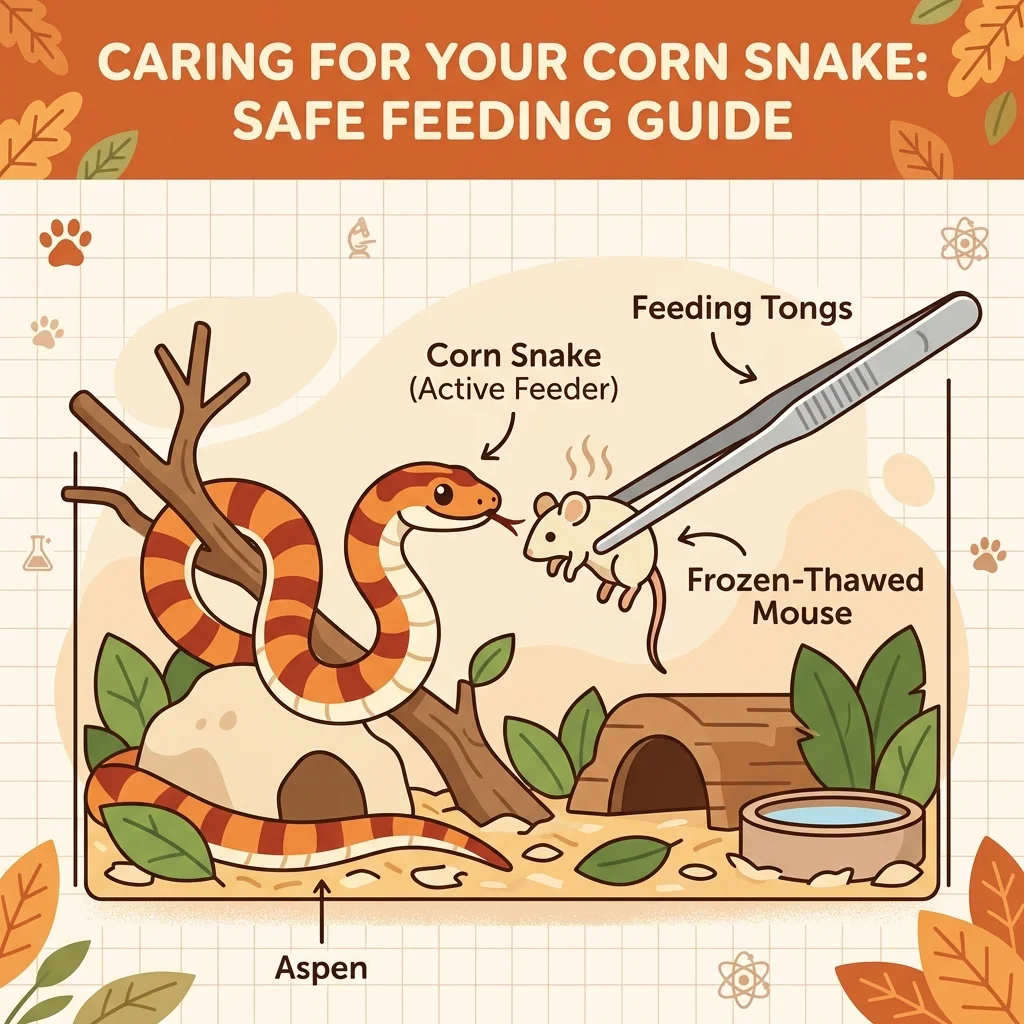
Corn snakes are visual hunters that rely on movement cues. Use feeding tongs (never your hands — this teaches the snake to associate warmth/skin with food) and gently wiggle the thawed mouse with slow, undulating movement.
Step 3: Scenting
If the snake refuses, rub the warmed thawed mouse with soiled bedding from a live mouse enclosure. The scent of a live mouse on warm prey often triggers an immediate feeding response.
Step 4: Cover and Leave Method
Place the snake and the prey together in a small paper bag or dark feeding container. Leave them in a dark, quiet room for 30–60 minutes. The enclosed space simulates a burrow and triggers natural hunting instincts.
Step 5: The Fresh Kill Trick
As a last resort, euthanize a live mouse and offer it immediately while still warm. Once the snake accepts this, offer a freshly warmed thawed mouse at the next feeding. Gradually extend the time until the snake accepts fully frozen-thawed.
6. Creating the Optimal Feeding Environment
Where and how you feed your corn snake matters significantly.
Use a Separate Feeding Container
Feed in a separate plastic tub rather than the main enclosure. Benefits include:
- Prevents cage aggression: The snake won't associate your hand opening the lid with food
- Eliminates substrate ingestion: No risk of swallowing bedding material with prey
- Reduces enclosure stress: The snake's home remains a "safe zone," not a hunting ground
Temperature During Feeding
Ensure the feeding room is between 72°F–80°F. A cold corn snake cannot digest properly and will refuse food. Place the feeding container on a low-setting heating pad if necessary.
Feeding Tools
Always use stainless steel feeding tongs with a smooth, rounded tip. A length of at least 10 inches is recommended to keep your hand away from the strike zone. This also protects the snake from accidentally striking solid objects.
7. Common Feeding Problems and Solutions
My Corn Snake Won't Eat — What Do I Do?
Corn snakes are generally excellent feeders. A corn snake that stops eating is usually experiencing one of these issues:
Shedding (Pre-Ecdysis): When a corn snake prepares to shed, their eyes turn milky blue-grey. During this "opaque phase," they almost always refuse food. This is completely normal. Wait until after the shed is complete, then offer food 3–5 days later.
Seasonal Brumation: Wild corn snakes brumate during cooler months. Some captive-bred individuals retain this instinct and may go off feed from October through February. As long as the snake maintains a healthy weight, this is not a cause for concern.
Inadequate Hides: A stressed corn snake refuses food. Ensure the enclosure has at least two opaque hides — one on the warm side, one on the cool side. The snake should fit its entire body inside the hide.
Incorrect Temperatures: If the basking area is too cool, the snake cannot digest and will refuse food. Verify:
- Warm side: 85°F–88°F
- Cool side: 72°F–76°F
For more detailed troubleshooting, many of the same principles in our ball python feeding guide apply to corn snakes as well.
8. Understanding Corn Snake Nutrition
When you feed your corn snake a whole feeder mouse, you're providing a biologically complete meal. Whole prey contains:
- Protein: Essential for growth and tissue repair
- Fat: Required for energy and fat-soluble vitamin absorption
- Calcium and Phosphorus from bones: The Ca:P ratio in a whole mouse (~1.3:1) is ideal for snakes
- Pre-formed vitamins: Vitamin A from liver, Vitamin D, and B vitamins from muscle tissue
- Gut content: Beneficial fiber, gut flora, and micronutrients
This is why whole-prey feeding is nutritionally complete — no vitamin supplements needed when feeding high-quality frozen feeders. For a detailed nutritional comparison between feeder species, see our feeder rodent nutrition comparison.
9. Buying Quality Frozen Feeder Mice
Not all frozen feeder mice are equal. Quality impacts your snake's health directly.
What to Look For
Breeding conditions: High-quality suppliers breed in clean, temperature-controlled facilities. At Loxahatchee Rodents, our colony has been managed since 2001 according to standards developed from Bill Galloway's experience as an Assistant Curator at Palm Beach Zoo.
Flash-freezing: Rapid freezing at very low temperatures preserves cellular structure better than slow-freezing. Less ice crystal damage means better scent and more natural texture upon thawing.
Packaging integrity: Properly packaged feeders should arrive completely frozen, with no frost burn, no foul odor upon thawing, and in sealed, individual bags or vacuum packaging.
10. Corn Snake Feeding FAQ
Q: Can I feed my corn snake anything other than mice? A: Feeder mice are the standard for a complete, balanced diet. Do not feed insects, fish, or other non-rodent items.
Q: My corn snake ate but then regurgitated. What do I do? A: Follow the 14-day fasting protocol immediately. Read our complete snake regurgitation emergency guide.
Q: Can I feed my corn snake in its enclosure? A: It is possible but not recommended. A separate feeding container prevents cage aggression and substrate ingestion.
Q: How long can my corn snake go without eating? A: A healthy adult can fast for several weeks. However, a hatchling or juvenile should not fast for more than 2–3 weeks without veterinary consultation.
Q: When should I start feeding frozen-thawed? A: Always start frozen-thawed from the very first feeding. It is far easier to start correctly than to transition a snake already conditioned to live prey.
Conclusion
Feeding a corn snake correctly is one of the most rewarding aspects of keeping this species. By following the correct prey sizing, maintaining a consistent schedule, and always using quality frozen-thawed feeders, you will give your corn snake the foundation for a healthy life of 15–20 years.
At Loxahatchee Rodents, everything we do starts with over 25 years of commitment to safe, humane, high-quality feeder production. Explore our complete reptile feeding guides for more expert resources, or visit our home page to learn more about our team and facility.
Written by Bill Galloway, Former Assistant Curator at Palm Beach Zoo and co-founder of Loxahatchee Rodents.