Key Takeaway
The comprehensive guide to snake regurgitation — causes, the critical difference between regurgitation and vomiting, the 14-day recovery protocol, how to restart feeding, and proven prevention strategies.
Table of Contents
- 1. Regurgitation vs. Vomiting: The Critical Distinction
- Regurgitation
- Vomiting
- 2. The Most Common Causes of Snake Regurgitation
- Cause 1: Incorrect Enclosure Temperatures
- Cause 2: Handling Within 48 Hours of Feeding
- Cause 3: Prey Item Too Large
- Cause 4: Cold Core in Thawed Prey
- Cause 5: Post-Purchase Stress (New Snakes)
- Cause 6: Respiratory Infection
- Cause 7: Internal Parasites
- 3. The Immediate Emergency Protocol
- Step 1: Stay Calm and Put the Snake Down
- Step 2: Remove the Regurgitated Prey
- Step 3: Clean and Disinfect the Affected Area
- Step 4: Verify and Correct Temperatures
- Step 5: Do Not Feed Again for 14 Days
- 4. The Test Meal: Restarting Feeding After 14 Days
- The Reintroduction Protocol
- 5. Preventing Regurgitation: The Complete Checklist
- Before Every Feeding Session
- After Every Feeding Session
- Enclosure Maintenance Timing
- Handling Protocol
- 6. Monitoring for Recurrence
- 7. Species-Specific Regurgitation Notes
- Ball Pythons
- Boa Constrictors
- Corn Snakes
- Hognose Snakes
- 8. The Long-Term Recovery Mindset
- Frequently Asked Questions
- Conclusion
Seeing your snake regurgitate a meal ranks among the most alarming moments in reptile keeping. The prey item appears intact, covered in mucus, seemingly rejected by an animal you've been carefully feeding and monitoring for months. Your first instinct may be to re-feed immediately, or to panic, or both. Both instincts are wrong — and acting on either can be life-threatening for your snake.
Regurgitation in snakes is a serious medical event, but it is manageable and fully recoverable from in the vast majority of cases — IF you follow the correct emergency protocol immediately after it occurs and make the husbandry corrections that prevent recurrence. This guide gives you everything you need to handle a regurgitation event correctly from the moment it happens through full recovery and safe resumption of feeding.
At Loxahatchee Rodents, with over 25 years of breeding experience and Bill Galloway's background as an Assistant Curator at Palm Beach Zoo, we have managed regurgitation events in numerous species and have developed a protocol that we share here in full.
1. Regurgitation vs. Vomiting: The Critical Distinction
Before anything else, you need to determine which event has actually occurred. The two are often conflated but represent very different medical situations with different urgency levels.
Regurgitation
Regurgitation is the passive expulsion of prey before significant digestion has begun. The food is forced back up the esophagus before reaching or being meaningfully processed by the stomach.
Characteristics:
- Usually occurs within 12–48 hours of feeding, occasionally up to 72 hours
- The prey item appears relatively intact — recognizable shape, largely undigested
- Covered in thick, clear to slightly white mucus (esophageal secretions)
- The snake shows relatively normal behavior otherwise — responsive, alert
- Usually no blood and no partially digested tissue
Most common causes: Husbandry issues (incorrect temperature, oversized prey, handling too soon after feeding). Self-correctable with proper protocol.
Vomiting
Vomiting is the active expulsion of partially digested stomach contents. This indicates the food reached the stomach and digestion began before being rejected.
Characteristics:
- Usually occurs 3–7 days after feeding
- The prey is partially digested — significantly altered in appearance, soft, possibly unrecognizable
- Strong foul, acidic smell — stomach acid has been working on the material
- May contain bile — yellow-green coloration in the fluid
- The snake may appear lethargic, stressed, or ill beyond the immediate event
- Sometimes accompanied by blood in the ejected material
Most common causes: Systemic illness (parasites, infection, organ disease), severe husbandry failure over time. Requires immediate veterinary consultation — do not wait.
Critical rule: If you observe vomiting (partially digested, foul-smelling, bile-stained material), contact an exotic veterinarian immediately. The 14-day rest protocol below applies to regurgitation; vomiting requires veterinary diagnosis and treatment.
2. The Most Common Causes of Snake Regurgitation
Understanding why regurgitation happened is essential to preventing recurrence. Here are the documented causes in order of frequency:
Cause 1: Incorrect Enclosure Temperatures
Frequency: Very high. This is the single most common cause of snake regurgitation across all species.
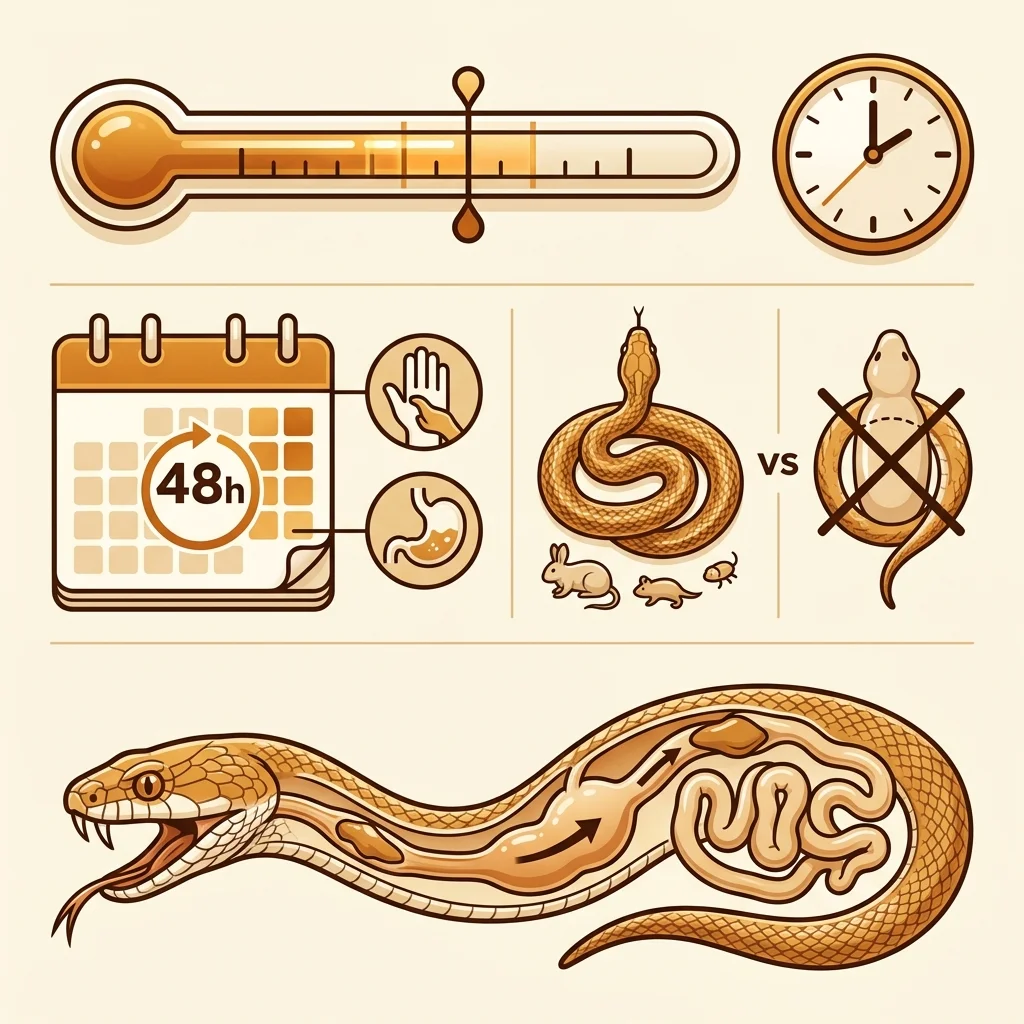
Snakes are ectotherms. Every stage of digestion — from the production of digestive enzymes to the muscular contractions that move food through the GI tract — is temperature-dependent. When the enclosure is too cold:
- Digestive enzyme production is insufficient to break down the prey
- GI motility (the muscle contractions that move food through the system) slows dramatically
- The unprocessed prey begins to decompose in the stomach
- The snake's system responds by expelling the decomposing material to prevent systemic infection
Required temperatures by species:
| Species | Warm Side | Cool Side |
|---|---|---|
| Ball Python | 88–92°F | 76–80°F |
| Boa Constrictor | 88–92°F | 78–82°F |
| Corn Snake | 85–88°F | 72–76°F |
| King Snake | 85–90°F | 75–80°F |
| Hognose Snake | 85–90°F | 75–80°F |
How to verify: Use a digital infrared temperature gun at the snake's level on the warm side. Stick-on analog thermometers are notoriously inaccurate — do not trust them for post-regurgitation diagnosis. Check multiple points on the warm side surface — thermostats can fail in ways that create cold spots even when the display reads correctly.
After-hours equipment failure: A thermostat that fails overnight can drop enclosure temperatures below safe thresholds without your knowledge. If your snake regurgitated in the early morning and you suspect overnight temperatures dropped, check your equipment thoroughly before resuming the feeding program.
Cause 2: Handling Within 48 Hours of Feeding
Frequency: High, particularly among new keepers without an established handling protocol.
After swallowing prey, a snake's digestive system is maximally active and the snake is physiologically in a vulnerable state. In the wild, a snake that has just eaten is slower to escape predation and takes significant risks by remaining stationary to digest. Evolution has built in a powerful defensive mechanism: if the snake feels threatened while digesting, it expels the meal so it can move freely.
Picking up a digesting snake simulates a predation event and can trigger this reflex — regardless of how tame the snake normally is. The meal is expelled not out of illness but as a survival response.
The rule: Do not handle your snake within 48 hours before or 48 hours after a feeding session. For larger prey items (large rats, jumbo-sized feeders), extend this to 72 hours.
Cause 3: Prey Item Too Large
Frequency: High.
Feeding prey that exceeds the snake's safe swallowing capacity is a common cause of mechanical regurgitation — the GI tract simply cannot accommodate and pass the prey. Signs that the prey may have been too large:
- Unusually long or difficult swallowing process (normal is 15–30 minutes for appropriately-sized prey)
- Obvious visible bulge much larger than the snake's normal body diameter
- Snake shows discomfort or unusual movement patterns in the 24–48 hours after feeding
- Regurgitation occurs with an intact, barely-slimed prey item within 12 hours
Correct sizing rule: Prey should equal the diameter of the widest part of the snake's body. For a weight-based approach, use 5–10% of the snake's body weight. See our rat size chart by weight in grams and frozen mice size chart for reference.
Cause 4: Cold Core in Thawed Prey
Frequency: Moderate.
This is one of the most insidious causes of regurgitation because it looks like everything was done correctly. The frozen prey was warmed in a water bath, the surface temperature registered 98–102°F on the IR gun — but the core of the prey item remained frozen or very cold.
When a snake swallows prey with a cold, still-frozen core, the cold mass causes a rapid internal temperature drop in the snake's esophagus and stomach. This temperature shock triggers an immediate regurgitation response — often within minutes of the prey being fully swallowed.
Prevention: After the warm water bath, press firmly along the entire length of the prey body. The interior should feel uniformly warm — no hard, cold spots. For large prey items (medium rats and above), the water bath should be at least 20–25 minutes, and the core should be checked by feel before offering.
See our complete thawing protocol for step-by-step guidance on ensuring even thawing.
Cause 5: Post-Purchase Stress (New Snakes)
Frequency: Moderate for newly acquired snakes.
A newly acquired snake that has not yet settled into its new environment is under significant chronic stress. Stress hormones (corticosterone) inhibit the normal digestive process and make regurgitation significantly more likely. The common mistake: attempting to feed a newly acquired snake before it has had adequate time to settle.
Prevention: Allow all newly acquired snakes a minimum of 14 days in their new enclosure without feeding. No handling during this period. After 14 days, attempt the first feeding with a prey item slightly smaller than the snake's normal size. If successful, continue with normal sizing at the next session.
Cause 6: Respiratory Infection
Frequency: Lower than husbandry causes, but important to identify.
A snake with a respiratory infection (RI) may regurgitate due to the increased mucus production and reduced lung capacity affecting the mechanics of swallowing. Signs of RI alongside regurgitation:
- Wheezing, crackling, or bubbling sounds during breathing
- Mucus visible at the nostril or mouth
- Abnormally frequent yawning or mouth-opening
- Lethargic behavior independent of feeding
If RI is suspected, veterinary consultation is required before resuming the feeding program.
Cause 7: Internal Parasites
Frequency: Lower, but should be on the differential list for unexplained chronic regurgitation.
Cryptosporidium infection (Crypto) in ball pythons specifically is a significant cause of chronic regurgitation that cannot be resolved with husbandry correction alone. It is a protozoan parasite that infects the GI lining and causes progressive wasting and chronic regurgitation. Crypto requires veterinary diagnosis via fecal testing and has no reliable treatment — it is ultimately fatal in most cases.
If your snake has regurgitated multiple times after all husbandry corrections, consult an exotic veterinarian for fecal testing before assuming it's a husbandry issue.
3. The Immediate Emergency Protocol
When you discover your snake has regurgitated, the next 30 minutes of action set the stage for the recovery outcome. Follow these steps precisely and in order:
Step 1: Stay Calm and Put the Snake Down
Do not handle the snake unnecessarily. Immediately and gently place the snake back in its enclosure if it is not already there. The snake's body has just undergone significant physiological stress — additional handling adds to that stress.
Step 2: Remove the Regurgitated Prey
Using gloves (the regurgitated material is potentially contaminated with stomach acid and bacteria), remove the prey item immediately. Do not leave it in the enclosure — it will rapidly decompose and create a bacterial hazard.
Step 3: Clean and Disinfect the Affected Area
Using a reptile-safe disinfectant (chlorhexidine solution at 0.05% concentration, or a diluted F10SC solution), clean and disinfect the area where the regurgitation occurred. Stomach acid and digestive enzymes in the regurgitated material can damage both enclosure materials and introduce harmful bacterial blooms if not removed promptly.
Rinse with clean water after disinfecting. If substrate is heavily contaminated, replace the affected section.
Step 4: Verify and Correct Temperatures
Immediately take temperature readings at multiple points in the enclosure using an IR gun. Compare to the required ranges for your species (see Cause 1 above). If temperatures are below target:
- Check thermostat function (test with a spare thermostat if available)
- Check that heating equipment is functioning
- Check for external factors (drafts, room temperature drop)
Correct any temperature deficits before proceeding.
Step 5: Do Not Feed Again for 14 Days
This is the most critical rule of the protocol and the one most commonly violated: you must wait at minimum 14 days before the next feeding attempt.
Here is why this matters physiologically:
When a snake regurgitates, the prey and stomach acid are forced through the esophagus in the wrong direction. Gastric acid (which is highly concentrated and caustic in snakes — pH 1–2) burns the esophageal lining on the way up. The resulting mucosal damage takes 7–10 days to heal.
Additionally, the regurgitation event completely depletes the snake's stomach acid reserves and disrupts the gut flora balance. The digestive system needs time to re-establish normal function before it can safely process another meal.
Feeding within the 14-day window:
- Introduces food to a damaged, acid-depleted esophagus
- The snake regurgitates again — now with even less acid and even more damage
- A cascade of repeated regurgitation can develop that is increasingly difficult to break and can be fatal
The 14-day wait is non-negotiable. Not 10 days. Not "as soon as the snake seems interested." Fourteen days minimum.
4. The Test Meal: Restarting Feeding After 14 Days
When the 14-day waiting period is complete, do not immediately return to the previous feeding schedule with the same prey size. The digestive system needs a gradual reintroduction.
The Reintroduction Protocol
Day 14 (First Post-Regurgitation Meal):
- Offer a prey item 50% smaller than the usual size
- Example: If your ball python was eating medium rats (90–100g), offer a small rat (50–60g)
- Ensure perfect prey temperature (98–102°F surface, warm core)
- Ensure enclosure temperatures are correct
- No handling within 72 hours of this feeding (extend the window for the first three post-regurgitation meals)
If the test meal is kept down: Wait 14 days again before the second post-regurgitation meal. Use a slightly larger prey item — approximately 75% of the original size.
Day 28 (Second Post-Regurgitation Meal):
- Offer a prey item at 75% of the original size
- If kept down, you can return to normal frequency (for the species) at the next scheduled feeding
Day 28 + Normal Interval (Third Post-Regurgitation Meal):
- Return to the original prey size if both previous meals were kept down without incident
- Resume normal feeding frequency and monitoring
If a second regurgitation occurs during reintroduction: Return to Day 1 of the protocol (14-day wait, then restart with an even smaller test meal). If two consecutive reintroduction attempts fail, consult an exotic veterinarian.
5. Preventing Regurgitation: The Complete Checklist
Prevention is always preferable to treatment. Here is the complete regurgitation prevention protocol:
Before Every Feeding Session
- Verify warm side temperature with IR gun: species-appropriate warm zone temperature
- Check that thermostat is functioning correctly
- Confirm you have not handled the snake in the past 48 hours
- Confirm the prey size is correct for the snake's current body weight
- Verify prey is fully thawed — no cold core — using the water bath protocol
- Verify prey surface temperature is 98–102°F with IR gun
After Every Feeding Session
- Return the snake to the enclosure without handling
- Do not disturb the enclosure for 48–72 hours
- Do not perform enclosure maintenance, water changes, or any other disturbance
- Monitor the snake's digestion progress — the prey lump should diminish over 3–7 days
- Record the feeding date, prey size, and any observations in your feeding log
Enclosure Maintenance Timing
Plan all enclosure maintenance (substrate changes, decoration cleaning, water dish changes) for the day before a scheduled feeding day — never after. This ensures the snake has the quietest possible environment during the critical 72-hour digestion window.
Handling Protocol
Establish a firm schedule:
- Handling sessions: No more than 3–4 times per week, maximum 20 minutes per session
- Feeding day: No handling
- Day before feeding: No handling
- Days 1 and 2 after feeding: No handling
- Day 3 post-feeding and beyond: Normal handling can resume
6. Monitoring for Recurrence
One regurgitation event that is corrected through the 14-day protocol and husbandry adjustment is not cause for ongoing concern — it happens to experienced keepers. However, patterns of regurgitation require attention:
Monitor closely if:
- Your snake has regurgitated twice in one month
- Regurgitation is occurring despite correct husbandry
- Each regurgitation is occurring with less stimulus (smaller prey, less disturbance) than the last
- The snake is showing weight loss in addition to regurgitation
Seek veterinary care if:
- Three or more regurgitation events have occurred in a 60-day period
- Regurgitation is accompanied by weight loss, lethargy, or respiratory symptoms
- The prey item shows signs of partial digestion at the time of regurgitation (suggesting vomiting rather than regurgitation)
- The reintroduction protocol has been followed twice and regurgitation continues
An ARAV-certified exotic veterinarian can perform fecal testing (for Cryptosporidium and other parasites), blood work to assess organ function, and physical examination to rule out structural causes of regurgitation.
7. Species-Specific Regurgitation Notes
Ball Pythons
Ball pythons are heavy-bodied pythons that can go months without eating during seasonal fasts. They are, however, susceptible to Cryptosporidium — a protozoan parasite that causes chronic regurgitation. If your ball python is regurgitating despite correct husbandry, Crypto testing is a priority. For the complete ball python feeding guide, see our ball python not eating guide.
Boa Constrictors
Boas are particularly sensitive to handling disruption during digestion due to their heavy body mass — the prey item represents a more significant proportion of their total body weight. Extend the handling blackout to 72 hours for all boa feedings. See our boa constrictor feeding chart for sizing reference.
Corn Snakes
Corn snakes regurgitate most commonly from oversized prey or cold core issues. They have faster GI transit than pythons and typically regurgitate within 12 hours of an issue rather than the full 24–48 hours. See our corn snake feeding guide and corn snake won't eat frozen mice guide for additional guidance.
Hognose Snakes
Hognose snakes are prone to regurgitation when stressed. They are more likely than most species to regurgitate in response to being observed during the feeding/swallowing process. Give hognoses complete privacy during and immediately after feeding — step away and do not watch. See our hognose snake feeding guide.
8. The Long-Term Recovery Mindset
A snake that has regurgitated once is not permanently damaged if the event is handled correctly. The esophageal lining regenerates within 10–14 days, the gut flora re-establishes, and the snake can return to a normal, healthy feeding program with no lasting effects.
What does lasting damage is:
- Re-feeding too soon (causing cascade regurgitation)
- Continuing the same husbandry errors that caused the original event
- Stress during the recovery period from excessive handling or enclosure disturbance
With proper adherence to the 14-day protocol, the reintroduction schedule, and the prevention checklist above, the vast majority of snakes recover completely from a single regurgitation event and go on to feed normally for years.
Frequently Asked Questions
Q: My snake regurgitated and immediately tried to re-swallow the prey. Should I let it? A: Absolutely not. Remove the prey immediately. A snake that immediately re-swallows regurgitated material will almost certainly regurgitate it again, and each additional regurgitation event is more damaging than the last. The 14-day wait begins from the moment of regurgitation, not from when you removed the prey.
Q: Is it normal for a little mucus to come out with the prey? A: Some mucus on regurgitated prey is normal — it is esophageal secretion. However, if the mucus is brown, blood-tinged, or extremely voluminous, or if the prey is significantly digested, treat as vomiting and seek veterinary care.
Q: My snake regurgitated but seems completely normal and wants to eat. Should I feed it? A: No. The 14-day wait is required regardless of how the snake appears after regurgitation. Normal behavior does not indicate the esophageal lining has healed. The snake's hunger drive operates independently of its ability to safely digest food.
Q: How do I prevent my snake from regurgitating during shipping or relocation? A: Do not feed your snake within 7 days before any planned relocation, shipping, or significant disturbance. A snake with a full stomach and the stress of transit is at high risk for regurgitation.
Conclusion
Snake regurgitation is one of the most stressful events in reptile keeping — but it is manageable, preventable, and fully recoverable with the correct response. The 14-day protocol exists for a physiological reason, and following it precisely is what separates a single, recovered regurgitation event from a cascade of repeated events that can threaten your snake's life.
For more expert resources, explore our complete reptile feeding guides. For species-specific feeding protocols that minimize regurgitation risk, see our guides for ball pythons, corn snakes, boa constrictors, king snakes, and hognose snakes. For prey sizing reference to prevent oversized prey regurgitation, see our rat size chart by weight in grams and frozen mice size chart.
Written by Bill Galloway, Former Assistant Curator at Palm Beach Zoo and co-founder of Loxahatchee Rodents.