Key Takeaway
Learn the correct temperature, packaging, and organization methods to store frozen feeder mice and rats for up to 12 months without quality loss or freezer burn.
Table of Contents
- 1. Why Proper Storage of Frozen Feeder Rodents Matters
- 2. The Ideal Freezer Temperature for Feeder Rodents
- Why Chest Freezers Are Superior to Upright Freezers
- 3. Packaging: The Key to Preventing Freezer Burn
- If Your Feeders Arrived in Plastic Bags
- If Re-Packaging is Needed
- Label Everything
- 4. Organizing Your Freezer for Easy Access
- Use Rigid Containers with Lids
- Organize by Size, Then by Date (FIFO)
- 5. The Defrost Cycle Problem with Auto-Defrost Freezers
- 6. How Long Can Frozen Feeders Be Stored?
- 7. Recognizing Freezer Burn and Degradation
- 8. Thawing Correctly After Proper Storage
- 9. Emergency Protocol: Freezer Failure
- 10. Buying Strategy: How Much to Buy and When
- Calculate Your Monthly Consumption
- Order Ahead of Seasonal Shipping Slowdowns
- Keep a 30-Day Buffer
- Conclusion
Buying frozen feeder rodents in bulk is one of the smartest things a reptile keeper can do. It saves money, ensures you're never caught without food, and means you can order from high-quality suppliers like Loxahatchee Rodents in larger quantities, reducing shipping costs per unit. But bulk buying only pays off if you know how to store frozen feeders correctly.
Poor storage leads to freezer burn, nutritional degradation, off-putting smells upon thawing, and snakes that begin refusing food. At Loxahatchee Rodents, we store and ship hundreds of thousands of frozen feeders per year. This guide shares everything we know about keeping frozen rodents in perfect condition for 6–12 months.
1. Why Proper Storage of Frozen Feeder Rodents Matters
Unlike human food, frozen feeder rodents are not preserved with salts, sugars, or artificial preservatives. They are simply the whole, frozen animal. This means they are entirely dependent on the cold chain — from our freezer, through shipping, and into your home freezer — remaining unbroken.
When the cold chain breaks, several things happen:
Bacterial proliferation: While deep-freezing inhibits bacterial growth, it does not sterilize. If frozen feeders are thawed even partially and then re-frozen, bacteria present in the gut and skin can begin multiplying. The resulting prey item can cause serious gastrointestinal infections in your reptile.
Fat oxidation (rancidity): The fatty acids in rodent tissue begin to oxidize when exposed to air or temperature fluctuations. This produces the characteristic "rancid" smell associated with old frozen feeders and significantly reduces their palatability to picky snakes.
Protein denaturation: Repeated freeze-thaw cycles damage cell walls in muscle tissue, causing a loss of moisture upon thawing and a deterioration in texture and scent — two qualities that are essential to triggering a snake's feeding response.
Freezer burn: The most visible form of damage — the formation of large ice crystals that damage cellular structure and leave dry, discolored patches on the skin of the rodent.
Understanding why storage matters helps us store smarter.
2. The Ideal Freezer Temperature for Feeder Rodents
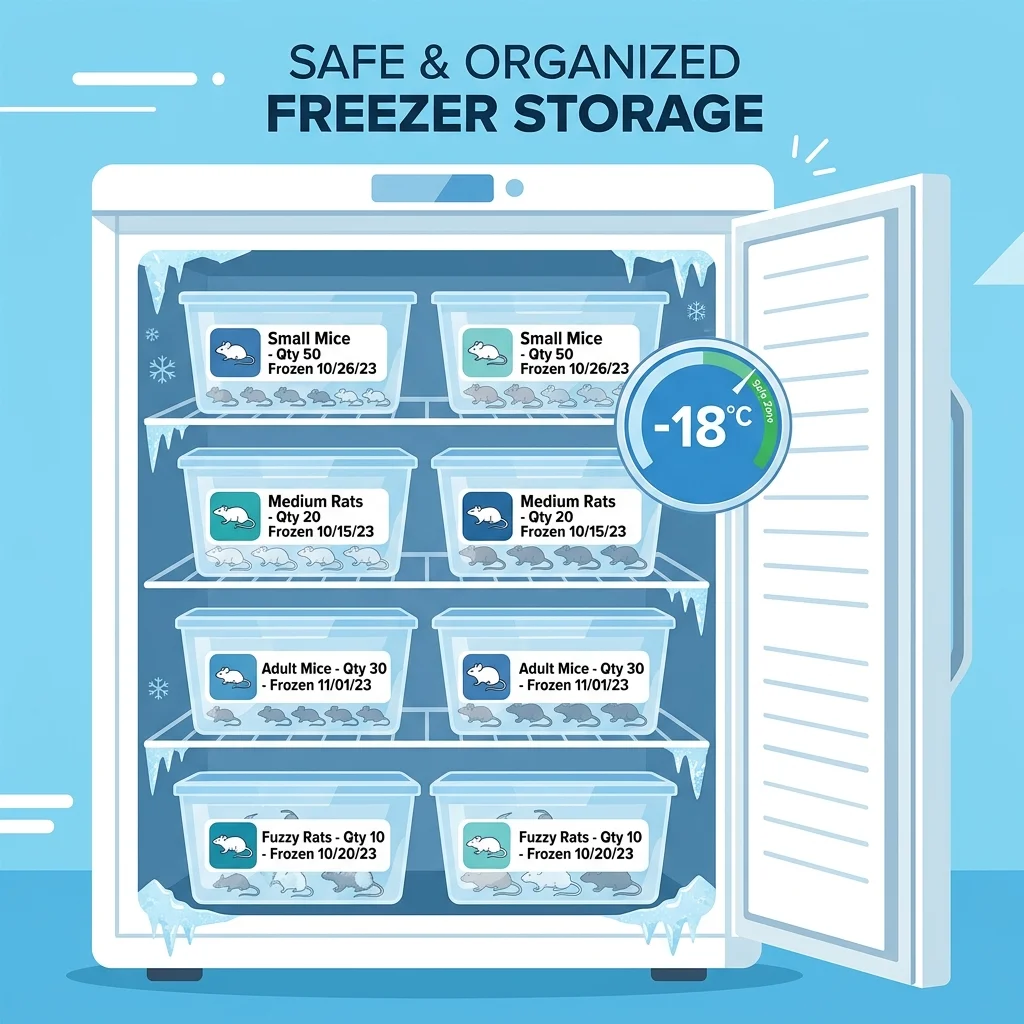
The target storage temperature for frozen feeder rodents is -18°C (0°F) or colder. At this temperature:
- Bacterial growth is effectively halted
- Enzymatic activity is near zero
- Fat oxidation is extremely slow
- The product can be safely stored for 6–12 months
Many standard household refrigerator-freezer combos struggle to maintain -18°C consistently, especially during the summer months or when the freezer door is opened frequently. We strongly recommend purchasing a dedicated chest freezer for bulk feeder storage.
Why Chest Freezers Are Superior to Upright Freezers
| Feature | Chest Freezer | Upright Freezer |
|---|---|---|
| Temperature consistency | Excellent (cold air doesn't fall out when opened) | Poor (cold air falls out every time door opens) |
| Energy efficiency | 10–25% more efficient | Less efficient |
| Defrost cycles | Manual defrost (less temperature fluctuation) | Auto-defrost (causes temperature spikes) |
| Organization | Requires baskets/containers | Built-in shelves easier to organize |
| Footprint | Requires floor space | Uses vertical space |
A dedicated 5-cubic-foot chest freezer is sufficient for most single-keeper setups with 1–3 snakes. If you run a larger collection or breeding operation, a 10–15 cubic foot model gives you plenty of room to organize by size and species.
3. Packaging: The Key to Preventing Freezer Burn
The single most important factor in preventing freezer burn is eliminating air contact with the rodent. Ice crystals form when water molecules in the tissue migrate to the surface and sublimate (turn from ice to vapor) and then redeposit as frost on a colder surface.
If Your Feeders Arrived in Plastic Bags
Most quality suppliers, including Loxahatchee Rodents, package frozen feeders in sealed plastic bags. If the seals are intact and the bags show no signs of air pockets, you can store them as-is. Simply place the bags directly into your dedicated freezer.
If Re-Packaging is Needed
If you need to repackage or you've received feeders with compromised packaging:
- Use vacuum-sealed bags: A vacuum sealer is the gold standard. Removing all air virtually eliminates freezer burn for 12+ months.
- Use freezer-grade zip-lock bags: If no vacuum sealer, use heavy-duty freezer bags (not regular storage bags). Press out as much air as possible before sealing. Double-bag for extra protection.
- Avoid using thin produce bags or sandwich bags: These are too porous and allow moisture transfer.
Label Everything
Every package of frozen feeders should be labeled with:
- Species: Mice vs. Rats vs. ASF
- Size category: Pinky, Fuzzy, Hopper, Weaned, Adult Small, Adult Medium, Adult Large, Jumbo
- Quantity: How many per bag
- Date frozen/received: Critical for FIFO rotation
A simple permanent marker on a piece of masking tape applied to the bag is sufficient.
4. Organizing Your Freezer for Easy Access
A well-organized freezer means you spend less time digging and keep the freezer closed for longer, reducing temperature fluctuations.
Use Rigid Containers with Lids
Place bags of the same size category inside labeled rigid plastic containers. This prevents the bags from getting jumbled, makes finding the right size easy, and protects the packaging from being punctured by sharp edges in the freezer.
Recommended container types:
- Rectangular plastic storage containers with snap-on lids
- Wire basket inserts designed for chest freezers
- Stackable bins with clear sides for easy visual identification
Organize by Size, Then by Date (FIFO)
FIFO = First In, First Out. Place newer stock at the back or bottom, and use older stock first. This ensures no bag is forgotten in the back of the freezer for 18+ months.
Suggested organization layout for a chest freezer with divider baskets:
- Basket 1: Pinky mice, Fuzzy mice (smallest sizes)
- Basket 2: Hopper mice, Weaned mice, Small adult mice
- Basket 3: Medium and Large adult mice
- Basket 4: Weanling rats, Small rats
- Basket 5: Medium rats, Large rats, Jumbo rats
This structure makes it instantly clear what you have and what you're running low on.
5. The Defrost Cycle Problem with Auto-Defrost Freezers
If you use an upright freezer or a freezer-section of a combination refrigerator-freezer, you are almost certainly dealing with automatic defrost cycles. This is one of the biggest hidden threats to frozen feeder quality.
Auto-defrost freezers periodically heat their interior coils to melt accumulated frost, typically once or twice every 24 hours. During this cycle, the interior temperature can rise by 5–15°F — sometimes briefly above freezing at the coil surfaces.
Over months of storage, these repeated micro-thaw events cause:
- Progressive cell damage from ice crystal formation and melting
- Gradual loss of moisture content in the tissue
- Increased fat oxidation
- Surface discoloration and texture changes
Solution: Use a dedicated manual-defrost chest freezer for bulk feeder storage. You will need to manually defrost it roughly once per year (or when frost buildup approaches 1/4 inch thickness), but the consistent temperature it maintains is far superior for long-term feeder quality.
6. How Long Can Frozen Feeders Be Stored?
| Storage Conditions | Maximum Safe Storage Time |
|---|---|
| -18°C (0°F), vacuum sealed | Up to 12 months |
| -18°C (0°F), standard freezer bags | 6–9 months |
| -18°C (0°F), original packaging (intact) | 6–12 months |
| Standard combo fridge-freezer (-15°C) | 3–5 months |
| Partial thaw and re-frozen | Discard — do not use |
These timelines assume continuous storage at the target temperature. If your power goes out, or your freezer malfunctions, see Section 9 on handling emergencies.
7. Recognizing Freezer Burn and Degradation
Before feeding any frozen rodent, inspect it visually and by smell after thawing. Signs of quality issues include:
Freezer Burn Indicators:
- Dry, grayish-white or brownish discolored patches on the skin
- Hard, leathery texture in affected areas
- Very little moisture released upon thawing (normally, a gentle squirt of fluid is released)
- Large, visible ice crystals on the surface prior to thawing
Spoilage Indicators (Do Not Feed):
- Foul or putrid smell upon thawing (distinct from the mild, musky smell of a healthy feeder)
- Slimy or unusually soft texture upon thawing
- Greenish or dark discoloration of the skin or exposed tissue
- Evidence of partial thawing and re-freezing (ice crystal patterns, frost clumping)
If you detect any of these signs, discard the feeder immediately. Feeding a spoiled or heavily freezer-burned rodent to your snake can cause serious gastrointestinal illness and potentially fatal infections.
See our detailed guide on how to identify spoiled frozen rodents for a full visual inspection protocol.
8. Thawing Correctly After Proper Storage
Even perfectly stored frozen feeders can become problematic if thawed incorrectly. Always follow our complete frozen rodent thawing protocol which involves:
- Moving the feeder from the freezer to the refrigerator 12–24 hours before feeding
- Warming in a sealed plastic bag in 100–105°F water for 15 minutes
- Verifying surface temperature of 98°F–102°F before offering
Never thaw at room temperature (bacterial growth risk), in a microwave (destroys proteins and creates hot spots), or in boiling water (cooks the prey). These methods are covered in detail in our how long to thaw frozen rodents guide.
9. Emergency Protocol: Freezer Failure
If your freezer fails and your frozen feeders begin to thaw, act quickly:
Within 2 hours of power loss: Feeders are likely still safe. Transfer to a cooler with ice or dry ice immediately. Contact your reptile-keeping network to see if anyone can store them temporarily.
Partially thawed (soft but still cold): Can be fed immediately (follow thawing protocol to warm to correct temperature), but cannot be refrozen safely.
Fully thawed but still cold (below 40°F/4°C): Feed immediately to your snakes only if the feeders show no signs of spoilage (no foul smell, no discoloration). Do not refreeze.
Thawed and warm (above 40°F/4°C for more than 2 hours): Discard all feeders. The risk of serious bacterial contamination is too high.
10. Buying Strategy: How Much to Buy and When
Buying in bulk maximizes value but requires smart planning. Here is our recommended buying strategy based on 25 years of operational experience at Loxahatchee Rodents.
Calculate Your Monthly Consumption
Count your snakes, their feeding frequency, and the prey size they require. For example:
- 3 adult ball pythons eating every 10 days each = roughly 9 feeders per month
- 2 juvenile corn snakes eating every 7 days each = roughly 9 feeders per month
- Total: ~18 medium/large adult mice per month
At this rate, a 6-month supply would be approximately 108 feeders — a medium bulk order that provides significant savings.
Order Ahead of Seasonal Shipping Slowdowns
Frozen feeder shipping can be delayed by extreme summer heat (dry ice evaporates faster) or winter storms. Place your bulk orders in spring and fall when shipping conditions are most favorable for maintaining the cold chain during transit. See our frozen rodent shipping guide for tips on evaluating supplier shipping quality.
Keep a 30-Day Buffer
Always maintain at least a 30-day supply in your freezer. This protects you from shipping delays, supplier stock issues, and unexpected increases in feeding demand from growing snakes.
Conclusion
Properly storing your frozen feeder rodents is not complicated, but it requires attention to temperature, packaging, organization, and rotation. By investing in a dedicated chest freezer, using quality packaging, organizing by size and date, and performing regular quality checks, you can maintain a 6–12 month supply of feeders in perfect condition.
At Loxahatchee Rodents, proper storage starts with us — our feeders are flash-frozen immediately after humane euthanasia and maintained at -18°C throughout our entire storage and shipping process. Visit our home page to learn more about our facility and browse our complete feeding guides for more expert resources on keeping your reptile collection healthy and well-fed.
Written by Jim Galloway, Senior Environmental Scientist and co-founder of Loxahatchee Rodents.