Key Takeaway
A science-backed nutritional breakdown comparing feeder mice, rats, and African Soft Fur rats. Learn which prey species best meets your reptile's dietary needs at every life stage.
Table of Contents
- 1. Why Feeder Species Selection Matters
- 2. Feeder Mice (Mus musculus): The Universal Standard
- Nutritional Profile of Whole Feeder Mice (Dry Matter Basis)
- Strengths of Feeder Mice
- Weaknesses of Feeder Mice
- 3. Feeder Rats (Rattus norvegicus): The High-Protein Choice for Large Snakes
- Nutritional Profile of Whole Feeder Rats (Dry Matter Basis)
- Strengths of Feeder Rats
- Weaknesses of Feeder Rats
- 4. African Soft Fur Rats (Mastomys coucha): The Low-Fat Alternative
- Nutritional Profile of African Soft Fur Rats (Dry Matter Basis)
- Strengths of African Soft Fur Rats
- Weaknesses of African Soft Fur Rats
- 5. Head-to-Head Comparison Summary
- 6. Which Feeder Should You Choose?
- For Corn Snakes, King Snakes, and Small Colubrids
- For Ball Pythons (Weight Management Focus)
- For Ball Pythons (Picky Eaters)
- For Boa Constrictors
- For Large Pythons (Burmese, Reticulated, Ball over 3kg)
- 7. The Impact of Feeder Diet on Nutritional Quality
- 8. Supplementation: Is It Needed with Whole Prey Feeding?
- 9. Transitioning Between Feeder Species
- Mice to Rats
- Mice to ASF Rats
- Conclusion
Choosing the right feeder species is one of the most impactful nutritional decisions you'll make for your reptile. While most keepers default to mice for smaller snakes and rats for larger ones, the rise of African Soft Fur (ASF) rats (Mastomys coucha) has created a genuinely important three-way comparison for serious herpeticulturists.
At Loxahatchee Rodents, with over 25 years of breeding all three species, we've tracked body composition data, palatability patterns, and health outcomes across thousands of animals. This guide provides the most thorough, honest nutritional comparison available for feeder mice, rats, and ASF rats.
1. Why Feeder Species Selection Matters
Not all rodents are nutritionally identical. The species, age, and body condition of a feeder animal at the time of euthanasia, along with the integrity of the cold chain during storage, significantly impacts what your snake actually receives from each meal. Key nutritional variables include:
- Crude protein percentage (muscle mass)
- Crude fat percentage (adipose tissue)
- Calcium and phosphorus (bone density and ratio)
- Water content (affects palatability and hydration contribution)
- Vitamin A (liver concentration)
- Gut content micronutrients (from the feeder's diet)
For a reptile eating whole prey 26–52 times per year, even small differences in these values compound into measurable health outcomes over a 15–25 year lifespan.
2. Feeder Mice (Mus musculus): The Universal Standard
Domestic feeder mice are the most widely available, most extensively studied, and most universally accepted feeder rodent. Their nutritional profile has been the benchmark against which all other feeders are measured.
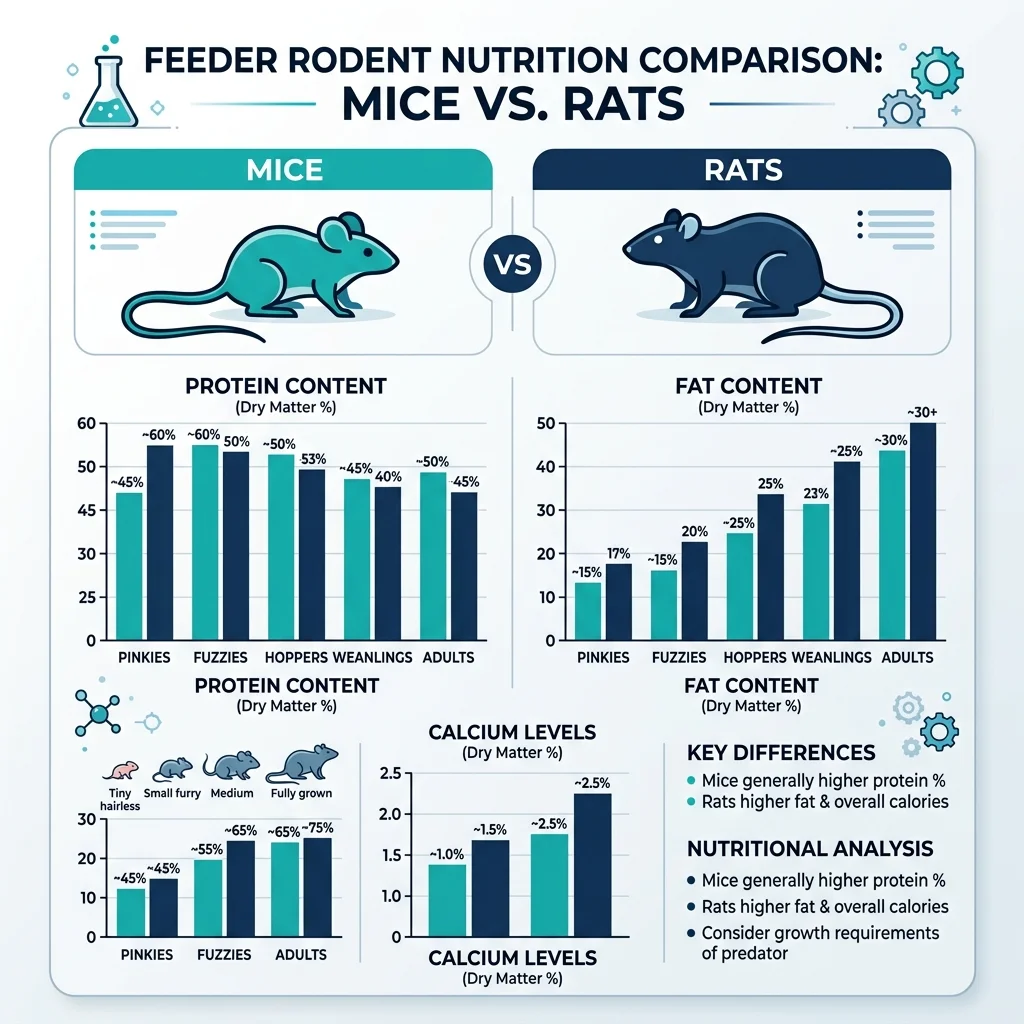
Nutritional Profile of Whole Feeder Mice (Dry Matter Basis)
| Nutrient | Pinky Mouse | Adult Mouse |
|---|---|---|
| Crude Protein | 55–60% | 50–58% |
| Crude Fat | 12–15% | 16–22% |
| Calcium | 1.3–1.7% | 1.2–1.5% |
| Phosphorus | 0.8–1.0% | 0.9–1.1% |
| Ca:P Ratio | ~1.4:1 | ~1.3:1 |
| Moisture | 80–85% | 70–75% |
Strengths of Feeder Mice
- Ideal Ca:P ratio: The calcium-to-phosphorus ratio of a whole mouse (~1.3:1) is very close to the 1.5:1 ratio recommended for reptiles by the Association of Reptile and Amphibian Veterinarians.
- High protein: Adult mice provide 50–58% crude protein on a dry matter basis, supporting muscle development and immune function.
- Widely available: Available from hatchling (pinky) through large adult, covering the full size spectrum from small colubrids to adult ball pythons.
- Universally accepted: The vast majority of captive-bred snakes recognize mice as food from their first feeding.
Weaknesses of Feeder Mice
- Relatively high fat in adults: Adult mice can be 16–22% fat on a dry matter basis. For species prone to obesity (like ball pythons and boa constrictors), overfeeding large adult mice can contribute to fatty liver disease.
- Size ceiling: Even jumbo adult mice top out at approximately 60–80g. For large adult pythons and boas over 1.5kg, mice become impractically small and require feeding multiple prey items per session.
For our sizing guide on matching mouse size to your snake's needs, see our frozen rat and mouse size chart.
3. Feeder Rats (Rattus norvegicus): The High-Protein Choice for Large Snakes
Domestic feeder rats are the standard prey item for medium to large snakes once they outgrow mice. They are available in a wide range of sizes from "pinky rat" (weanling) to "jumbo rat" (600g+).
Nutritional Profile of Whole Feeder Rats (Dry Matter Basis)
| Nutrient | Weanling Rat | Large Adult Rat |
|---|---|---|
| Crude Protein | 58–65% | 55–62% |
| Crude Fat | 10–14% | 14–18% |
| Calcium | 1.5–2.0% | 1.8–2.2% |
| Phosphorus | 1.0–1.2% | 1.1–1.3% |
| Ca:P Ratio | ~1.5:1 | ~1.6:1 |
| Moisture | 78–82% | 60–68% |
Strengths of Feeder Rats
- Higher protein, lower fat than adult mice: Weanling and young adult rats are leaner than comparably-sized mice, making them an excellent choice for species with obesity tendencies.
- Superior calcium content: Rats have denser bones than mice, resulting in higher calcium content on a weight basis — particularly beneficial for species prone to metabolic bone disease.
- Wide size range: Available from 15g weanlings to 600g+ jumbos, covering all snake sizes from juvenile ball pythons through adult Burmese pythons and green tree pythons.
- More nutritious per meal: Because a rat is larger and denser than a mouse, a snake obtains more complete nutrition per feeding event, which is important for species fed every 14–21 days.
Weaknesses of Feeder Rats
- Strong scent: Some snakes, particularly corn snakes and younger colubrids, find the musky scent of rats less appealing than mice. A scenting protocol may be needed for the transition.
- Higher fat in large adults: Jumbo adult rats, particularly females, can be very high in fat due to reproductive adipose tissue. For snakes already at healthy weight, alternating between medium and large rats is often better than feeding jumbo rats exclusively.
- Not available in pinky sizes: The smallest feeder rat ("pinky rat") is still larger than a fuzzy mouse, meaning they are not appropriate for hatchling snakes.
4. African Soft Fur Rats (Mastomys coucha): The Low-Fat Alternative
African Soft Fur rats, commonly called ASFs or "multimammate mice," are a species native to sub-Saharan Africa. They have exploded in popularity in the reptile community over the past decade, particularly among ball python breeders, for one primary reason: they are significantly leaner than domestic mice or rats while still being accepted by most snakes as food.
Nutritional Profile of African Soft Fur Rats (Dry Matter Basis)
| Nutrient | Small ASF | Adult ASF |
|---|---|---|
| Crude Protein | 60–68% | 58–65% |
| Crude Fat | 6–9% | 8–12% |
| Calcium | 1.4–1.8% | 1.5–2.0% |
| Phosphorus | 0.9–1.1% | 1.0–1.2% |
| Ca:P Ratio | ~1.5:1 | ~1.5:1 |
| Moisture | 76–80% | 72–78% |
Strengths of African Soft Fur Rats
- Dramatically lower fat: ASFs can be 40–60% lower in fat than comparable domestic mice. This makes them an exceptional choice for ball pythons, which are extremely prone to obesity and fatty liver disease in captivity.
- High protein: ASFs have among the highest crude protein percentages of any commonly available feeder rodent.
- Natural prey item for ball pythons: In West Africa, wild ball pythons (Python regius) naturally prey on Mastomys species. Feeding ASFs is therefore the closest thing to a wild-type diet available in captivity. Many ball python breeders report that previously "picky" feeders will immediately accept ASFs.
- Excellent Ca:P ratio: Consistently around 1.5:1, which is optimal for snake health.
Weaknesses of African Soft Fur Rats
- Less widely available: ASFs are not sold at most pet stores and must be ordered from specialty suppliers. They are also typically more expensive than domestic mice.
- Size ceiling: ASFs rarely exceed 40–60g for full adults, meaning they are not suitable as the primary prey for large constrictors.
- Require dedicated breeding colony if producing your own: ASFs breed prolifically but have specific husbandry requirements distinct from domestic mice.
- Some snakes won't accept them: Despite being a natural prey item for ball pythons, some individual snakes conditioned exclusively to domestic mice will refuse ASFs initially.
5. Head-to-Head Comparison Summary
| Category | Feeder Mice | Feeder Rats | ASF Rats |
|---|---|---|---|
| Protein (dry matter) | 50–60% | 55–65% | 58–68% |
| Fat (dry matter) | 12–22% | 10–18% | 6–12% |
| Calcium | 1.2–1.7% | 1.5–2.2% | 1.4–2.0% |
| Ca:P ratio | ~1.3:1 | ~1.5:1 | ~1.5:1 |
| Size availability | Pinky to Jumbo | Weanling to Jumbo | Small to Adult (40–60g max) |
| Palatability | Universal | Excellent | Excellent for ball pythons |
| Cost | Lowest | Low-Medium | Highest |
| Availability | Widely available | Widely available | Specialty suppliers |
6. Which Feeder Should You Choose?
The answer depends on your species, the individual snake's size, and your goals:
For Corn Snakes, King Snakes, and Small Colubrids
Recommendation: Feeder Mice (Pinky through Large Adult) Mice are appropriately sized, widely available, and provide an excellent nutritional profile for active, fast-metabolizing colubrids. See our corn snake feeding guide for specific sizing and schedule recommendations.
For Ball Pythons (Weight Management Focus)
Recommendation: ASF Rats or Lean Weanling Rats Ball pythons are highly prone to obesity. ASFs or weanling/small adult rats provide superior lean protein with significantly less fat than adult mice. If your ball python is already at a healthy weight, transitioning to ASFs can be one of the most impactful dietary changes you make. See our ball python feeding guide.
For Ball Pythons (Picky Eaters)
Recommendation: Try ASF Rats First Because wild ball pythons prey on Mastomys species, the scent of an ASF can trigger feeding responses in snakes that stubbornly refuse domestic mice. This is a well-documented phenomenon in the breeding community.
For Boa Constrictors
Recommendation: Feeder Rats (Weanling through Large Adult) Boa constrictors grow to 6–10 feet and require the large size range that rats provide. Avoid jumbo adult rats for boas that are already at a healthy weight — the fat content is very high.
For Large Pythons (Burmese, Reticulated, Ball over 3kg)
Recommendation: Large to Jumbo Feeder Rats Only rats provide the size range needed for large pythons. Stick to medium and large rats rather than jumping to jumbos to avoid excessive fat intake.
7. The Impact of Feeder Diet on Nutritional Quality
An often-overlooked factor in feeder nutrition is what the feeder was eating before it was processed. A feeder rodent that was fed a high-quality, balanced lab chow diet will have a dramatically different nutritional profile than one fed poor-quality grain or scratch.
At Loxahatchee Rodents, our breeding colonies are fed a nutritionally optimized lab-grade diet. This ensures:
- Consistent vitamin and mineral profiles in our frozen feeders
- Higher vitamin A content in the liver (critical for reptile health)
- Better omega-3 to omega-6 fatty acid ratios
- Healthier gut microbiome content
This is why buying from a reputable supplier matters so much. When comparing options, see our where to buy frozen mice review for a full analysis of supplier quality factors.
8. Supplementation: Is It Needed with Whole Prey Feeding?
In most cases, no supplementation is needed when feeding high-quality whole prey items. The whole prey model provides:
- Complete amino acid profiles from muscle and organ tissue
- Fat-soluble vitamins (A, D, E, K) from liver and fat stores
- Water-soluble B vitamins from muscle
- Calcium and phosphorus in near-ideal ratios from bone
- Gut content micronutrients
However, there are specific situations where supplementation may be warranted:
- Reproductively active female snakes: Higher calcium demands during follicle development and egg production. Consider supplementing with calcium powder on alternate feeders.
- Snakes in recovery: Post-illness or post-surgery animals may benefit from temporary supplementation as directed by an exotic veterinarian.
- Wild-caught animals: May have pre-existing deficiencies that need correction before transitioning to a whole-prey diet.
9. Transitioning Between Feeder Species
Sometimes you need to switch your snake from mice to rats, or from mice to ASFs. Here is how to make the transition successfully:
Mice to Rats
- Offer a weanling rat (smallest rat size) in place of an adult mouse
- Scent the rat with soiled mouse bedding if the snake hesitates
- If refused, rub a freshly thawed mouse across the surface of the rat before offering
- Once the snake accepts 3–4 weanling rats without hesitation, gradually increase rat size
Mice to ASF Rats
- Start with the smallest available ASF
- Most ball pythons accept ASFs readily due to the natural scent match
- For snakes that hesitate, scent the ASF with mouse bedding or use the drag-and-swap method (briefly touch a mouse to the ASF, then remove the mouse)
- Never force feed — patience during a 2–4 week transition period is always the right approach
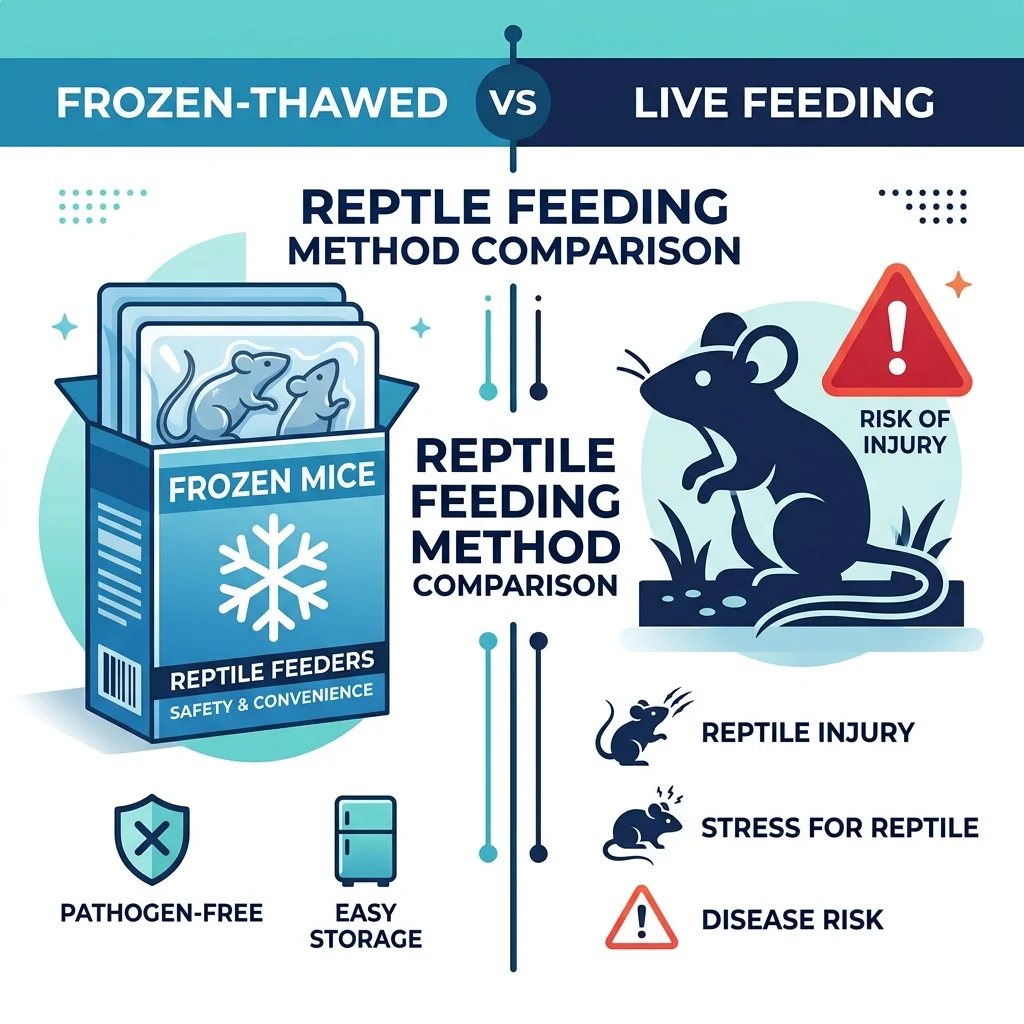
For full transition protocols and troubleshooting, see our complete guide on frozen-thawed vs. live feeding.
Conclusion
The choice between feeder mice, rats, and ASF rats is not arbitrary — it should be a deliberate, evidence-based decision rooted in your snake's species, size, age, and health status. Mice are the universal standard for small snakes. Rats are the essential prey for medium to large constrictors. ASF rats represent the cutting edge of nutritional optimization, particularly for ball pythons.
Whatever feeder species you choose, quality production matters. Visit our home page to learn more about how Loxahatchee Rodents produces the highest-quality frozen feeders available, and explore our full library of feeding guides for science-backed reptile care resources.
Written by Jim Galloway, Senior Environmental Scientist and co-founder of Loxahatchee Rodents.