Key Takeaway
The complete king snake feeding guide for all common species. Correct prey sizing charts, feeding schedules by age, and expert tips for maintaining these voracious, rewarding feeders on frozen-thawed prey.
Table of Contents
- 1. King Snake Species and Their Differences
- California Kingsnake (Lampropeltis californiae)
- Eastern Kingsnake (Lampropeltis getula)
- Florida Kingsnake (Lampropeltis floridana)
- Black Kingsnake (Lampropeltis nigra)
- Desert Kingsnake (Lampropeltis splendida)
- Prairie/Gray-banded Kingsnake (Lampropeltis alterna and relatives)
- 2. The King Snake Prey Size Chart
- California Kingsnake Prey Size Chart
- Eastern Kingsnake Prey Size Chart
- 3. Feeding Frequency for King Snakes
- Recommended Feeding Schedule
- 4. Frozen-Thawed Prey: King Snakes Are the Easy Case
- The King Snake Feeding Response
- 5. Enclosure Requirements That Affect Feeding
- Temperature Gradient
- Enclosure Size and Hides
- Substrate
- 6. Seasonal Behavior and Feeding
- 7. Common King Snake Feeding Problems
- "My king snake keeps trying to eat through the enclosure glass when I approach"
- "My king snake ate another snake in my collection"
- "My king snake regurgitated after eating"
- "My king snake suddenly stopped eating after months of reliable feeding"
- 8. Nutrition: What King Snakes Need from Their Prey
- 9. Sourcing Quality Frozen Prey for King Snakes
- King Snake Feeding FAQ
- Conclusion
- 10. The First Feeding: Getting New King Snakes Started
- 11. Advanced Feeding: Multiple King Snakes and Feeding Safety
- 12. King Snake Buying Guide: What to Look for to Ensure a Good Feeder
- 13. King Snake and Corn Snake: Head-to-Head Comparison for New Keepers
King snakes (Lampropeltis spp.) are legendary feeders. In a hobby where feeding strikes, picky preferences, and seasonal fasts are common complaints, king snakes stand out as reliably voracious, opportunistic hunters that will eat almost anything moving — or, with the right presentation, anything warmed and presented on tongs. They are an excellent first snake for keepers who want a rewarding feeding experience, and they are the species we most frequently recommend to keepers frustrated with their ball python's refusal streak.
But "easy to feed" doesn't mean "feed anything however you like." King snakes, like all snakes, require correct prey sizing, appropriate feeding frequency, and quality frozen-thawed prey to thrive long-term. Getting these details right is what separates a king snake that lives 15–20 healthy years from one that develops obesity-related health problems at 8.
This guide covers all the commonly kept king snake species and subspecies, with specific prey size charts and feeding schedules for each.
1. King Snake Species and Their Differences
The genus Lampropeltis contains approximately 45 recognized species and subspecies, but the commonly kept pet trade species share broadly similar care requirements. Key species covered in this guide:
California Kingsnake (Lampropeltis californiae)
The most commonly kept kingsnake. Black and white banded or striped pattern. Adults reach 3–5 feet, typically 300–900g. Aggressive feeders from hatchling stage. Most California kings will eat frozen-thawed prey without any transition techniques.
Eastern Kingsnake (Lampropeltis getula)
Robust, heavy-bodied kingsnake. Black with white or yellow chainlink pattern. Adults reach 4–6 feet, 500g–1.5kg. Excellent feeders. Slightly heavier body compared to California kings means slightly larger prey sizing.
Florida Kingsnake (Lampropeltis floridana)
A subspecies or closely related species. Very similar to Eastern Kingsnake in size and feeding behavior. Adults reach 4–5 feet.
Black Kingsnake (Lampropeltis nigra)
Smaller than Eastern Kingsnake, uniform glossy black coloration. Adults reach 3–4 feet, 200–700g. Same feeding recommendations as California kingsnake at comparable sizes.
Desert Kingsnake (Lampropeltis splendida)
Smaller, high-altitude-adapted species. Adults reach 3–4 feet. Same feeding recommendations as California kingsnake.
Prairie/Gray-banded Kingsnake (Lampropeltis alterna and relatives)
Smaller species with striking color patterns. Adults reach 20–40 inches. Require smaller prey than the larger eastern species. Can be more finicky than their cousins.
2. The King Snake Prey Size Chart
The fundamental rule applies to all king snake species: prey diameter should equal the widest diameter of the snake's body at mid-length. King snakes are slightly heavier-bodied than corn snakes of comparable length, meaning they can typically accept slightly larger prey.
California Kingsnake Prey Size Chart
| Life Stage | Length | Weight | Recommended Prey | Prey Weight |
|---|---|---|---|---|
| Hatchling (0–3 months) | 10–14 inches | 10–25g | Pinky Mouse | 2–4g |
| Juvenile (3–9 months) | 14–24 inches | 25–100g | Fuzzy to Hopper Mouse | 5–15g |
| Sub-Adult (9–24 months) | 24–36 inches | 100–350g | Hopper to Adult Small Mouse | 12–28g |
| Adult (2+ years) | 36–60 inches | 300–900g | Adult Small to Medium Mouse | 25–45g |
Eastern Kingsnake Prey Size Chart
| Life Stage | Length | Weight | Recommended Prey | Prey Weight |
|---|---|---|---|---|
| Hatchling (0–3 months) | 10–16 inches | 15–30g | Pinky Mouse | 2–4g |
| Juvenile (3–9 months) | 16–28 inches | 30–150g | Fuzzy to Hopper Mouse | 5–18g |
| Sub-Adult (9–24 months) | 28–42 inches | 150–500g | Hopper to Adult Small Mouse | 12–30g |
| Adult (2+ years) | 42–72 inches | 500g–1.5kg | Adult Small to Adult Large Mouse | 25–60g |
For complete mouse sizing reference, see our frozen mice size chart.
Pro tip: King snakes are capable of eating prey significantly larger than their body diameter — they are constricting predators that regularly take prey larger than corn snakes would manage. However, consistently feeding prey at the upper limit of the recommended range will lead to regurgitation and GI stress over time. Stick to the guidelines even when your king snake enthusiastically attempts something larger.
3. Feeding Frequency for King Snakes
King snakes have a faster metabolism than pythons and a similar metabolism to corn snakes. They need to be fed more frequently than boas or ball pythons, particularly as juveniles.
Recommended Feeding Schedule
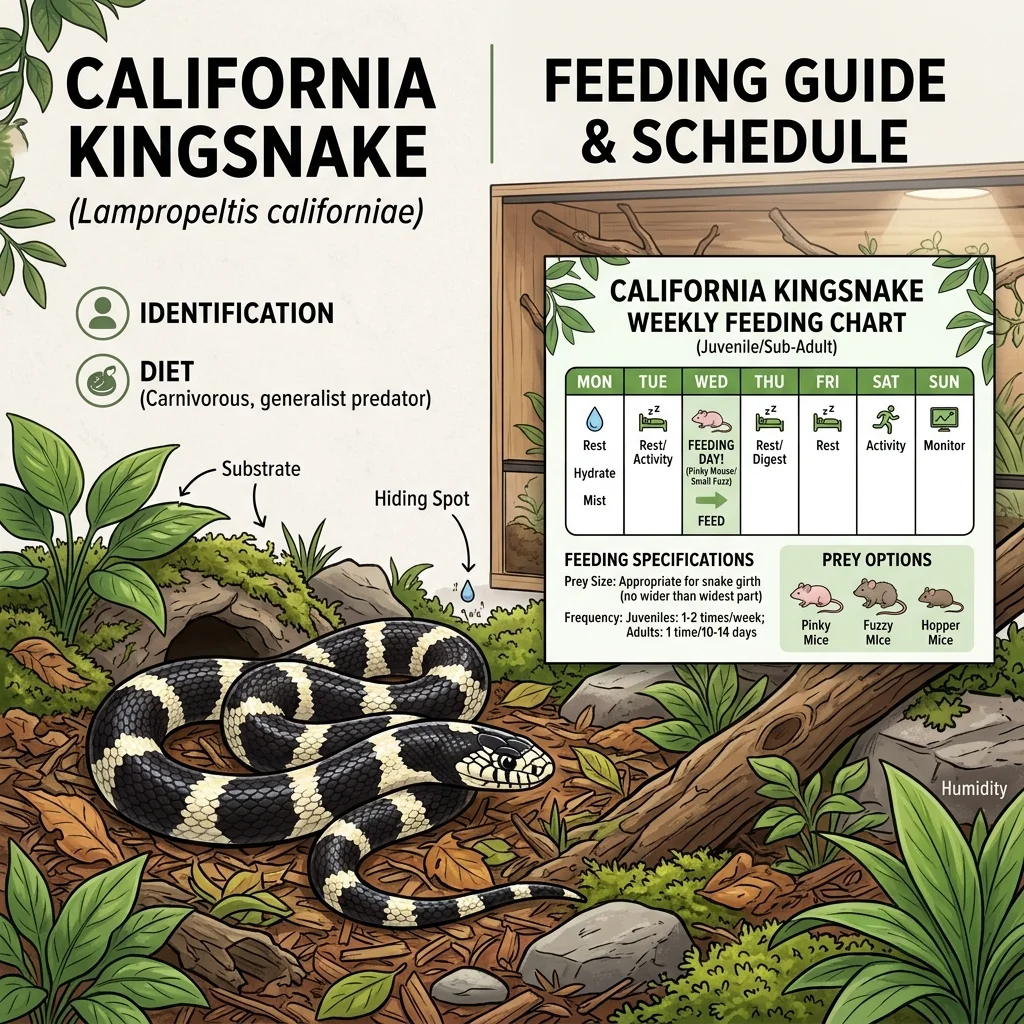
Hatchlings (0–6 months): Feed every 5–7 days. Rapid growth requires consistent nutrition. A hatchling king snake that misses multiple feedings early in its life will show stunted growth that can be difficult to recover.
Juveniles (6–18 months): Feed every 7 days (once per week). Continue consistent weekly feeding to support active growth.
Sub-Adults (18 months – 3 years): Feed every 7–10 days. As growth slows, begin spacing feedings slightly to prevent obesity onset.
Adults (3+ years): Feed every 10–14 days. Mature adult king snakes do not require weekly feeding. Continuing to feed weekly into adulthood is a common cause of obesity in these species.
Important caveat for aggressive feeders: King snakes are so enthusiastic about food that they will eat every time an opportunity is presented — even when they don't need to. The keeper's job is to set appropriate limits based on the schedule above, not to feed every time the snake appears interested.
4. Frozen-Thawed Prey: King Snakes Are the Easy Case
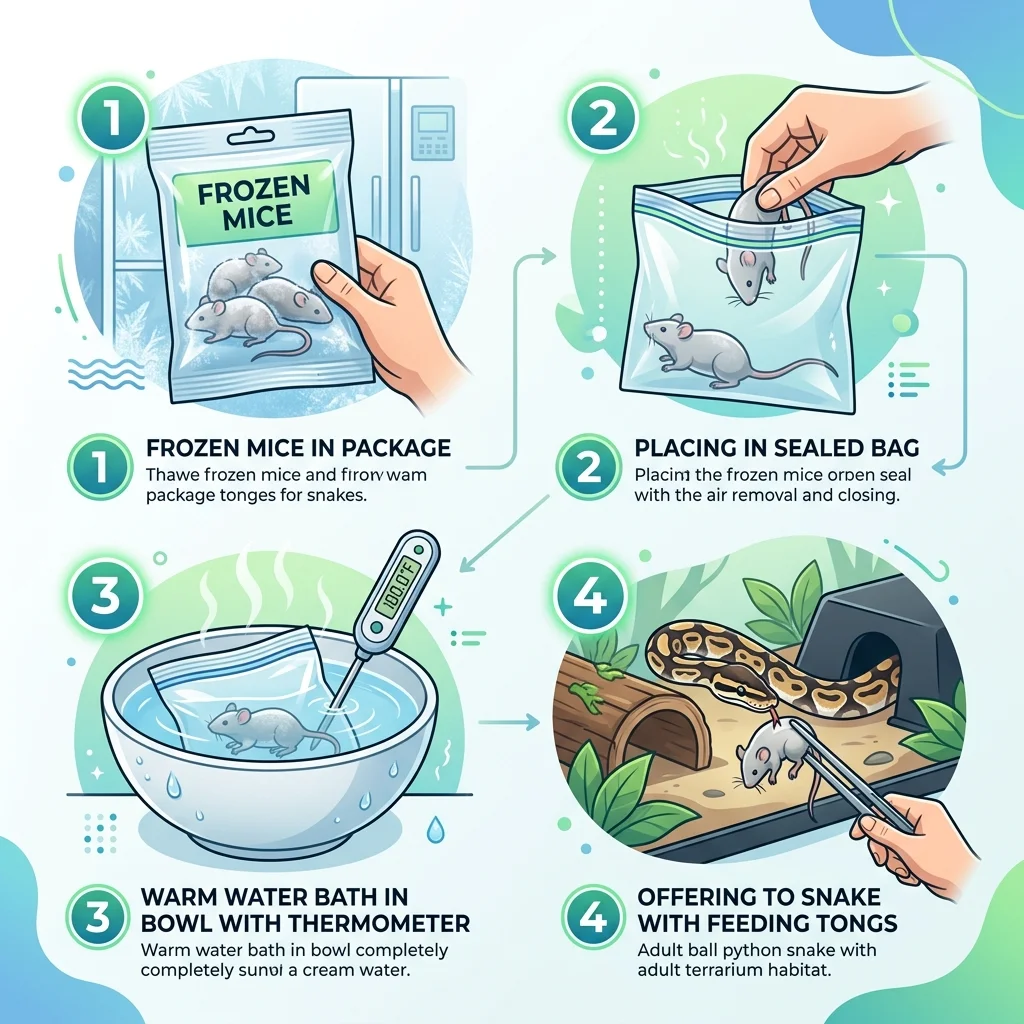
King snakes are typically among the easiest snakes to transition to frozen-thawed prey. Most captive-bred king snake hatchlings will accept frozen-thawed pinky mice from their first feeding without any transition techniques. Even wild-caught adults can often be transitioned within 3–5 sessions.
If your king snake is resistant to frozen-thawed prey, see our complete live-to-frozen transition guide. For king snakes specifically, the techniques with highest success rates are:
- Correct temperature (98–102°F): Most king snake refusals of frozen prey are simply a temperature issue
- Wiggling with tongs: King snakes are visual hunters — movement triggers an immediate strike response
- Bedding scenting: If temperature and movement don't work, add scent from live mouse bedding
For most king snakes, Steps 1 and 2 alone will resolve any frozen prey reluctance.
The King Snake Feeding Response
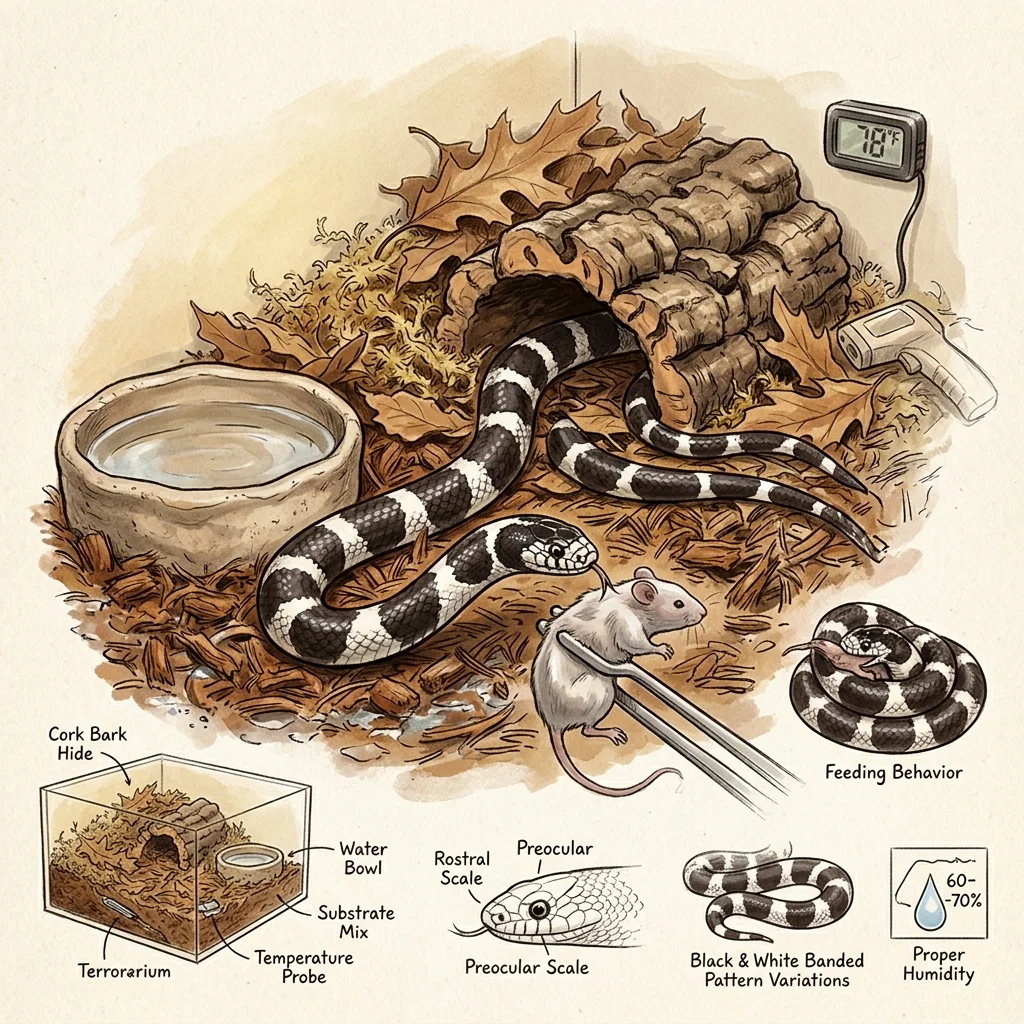
King snakes have one of the most dramatic, unambiguous feeding responses of any pet snake. When a correctly warmed prey item is presented on tongs, most king snakes will:
- Rapidly tongue-flick in the direction of the prey
- Begin moving toward the prey with the head raised slightly
- Strike with speed and force, then immediately constrict
- After constriction, begin working the prey headfirst for swallowing
This sequence is one of the most impressive behaviors in reptile keeping and one of the reasons king snake keepers are so enthusiastic about their animals.
5. Enclosure Requirements That Affect Feeding
A king snake in a suboptimal enclosure is a king snake that won't perform at its best. Temperature and hide quality directly affect feeding behavior.
Temperature Gradient
| Zone | Temperature |
|---|---|
| Warm side | 85–90°F |
| Cool side | 75–80°F |
| Night drop | 65–75°F acceptable |
King snakes are more tolerant of temperature variation than many species, but consistent warm-side access is still essential for normal digestion. After eating, your king snake should spend 2–3 days primarily on the warm side.
Enclosure Size and Hides
King snakes are active explorers. An adult California kingsnake is comfortable in a 40-gallon equivalent enclosure (36"×18"×12" minimum), though larger is always better for active species.
Critically, king snakes need at least two opaque hides — one on the warm side, one on the cool side. A hide-less king snake is a stressed king snake, and a stressed king snake may refuse food even though it's normally a reliable feeder.
The hide test: your king snake should be able to fit its entire body inside the hide, with sides making contact on all sides when coiled. A hide that is too large provides no security benefit.
Substrate
King snakes do well on aspen shavings, eco earth, or ReptiChip. Avoid cedar and pine — the aromatic oils are respiratory irritants. Substrate depth of at least 2–3 inches allows for burrowing behavior that many king snakes exhibit.
6. Seasonal Behavior and Feeding
Wild king snakes brumate (hibernate) during cooler months in most of their range. Captive king snakes often retain seasonal instincts even in a consistently heated, lit enclosure.
October–February: Many adult king snakes reduce feeding frequency or go off feed entirely. This is normal. Offer food on schedule but accept refusals without concern. As long as the snake maintains healthy body weight (visible spine is the key warning sign), a seasonal fast is not dangerous.
March–April: Most king snakes resume enthusiastic feeding after their seasonal pause. This is often the period when they are most voracious — take advantage of it to size up prey if the snake has been growing.
Breeding behavior: Male king snakes during breeding season (typically spring) may temporarily reduce feeding interest. This is brief and self-resolving. Female king snakes may go off feed in the weeks before laying eggs if gravid.
7. Common King Snake Feeding Problems
"My king snake keeps trying to eat through the enclosure glass when I approach"
This is food imprinting — your king snake has learned to associate your approach with feeding. It means your feeding response is very strong, which is good! But it also means you should:
- Use a separate feeding container to avoid cage aggression
- Never open the enclosure for handling immediately after a feeding attempt
- Consider covering the lower portion of the glass to reduce visual triggering
"My king snake ate another snake in my collection"
King snakes are famous ophiophagous (snake-eating) predators. Never house king snakes with other snakes of any species. Not even temporarily. A king snake will actively hunt and consume other snakes, including those significantly larger than itself. This is hardwired predatory behavior that cannot be trained away.
"My king snake regurgitated after eating"
Implement the 14-day rest protocol immediately. See our snake regurgitation guide for the full protocol. For king snakes, the most common regurgitation causes are: prey warmed at the wrong temperature (cold core), prey too large, or handling within 48 hours of feeding.
"My king snake suddenly stopped eating after months of reliable feeding"
Check for pre-shed first (cloudy eyes). Then check temperatures. If the fast coincides with October–February, this is normal seasonal behavior. If none of these apply, consult an exotic veterinarian — sudden refusal after an established feeding history can indicate respiratory infection or internal parasites.
8. Nutrition: What King Snakes Need from Their Prey
King snakes eating whole frozen-thawed mice receive a complete, balanced nutritional profile:
Protein (approximately 22–25% of fresh prey weight): Essential for growth, tissue repair, and immune function. Whole prey provides complete amino acid profiles that cannot be replicated with supplementation.
Fat (approximately 3–10% depending on mouse age and size): Adult mice have higher fat content than pinkies. This is appropriate for adult king snakes with higher energy reserves. For snakes prone to obesity, selecting prey at the lower end of the age/size range keeps fat content more moderate.
Calcium and Phosphorus (bones): The calcium-to-phosphorus ratio in whole prey mice (approximately 1.3:1) is ideal for reptile bone health. This is why whole-prey feeding doesn't require calcium supplementation, unlike insect-based diets.
Vitamins: Liver tissue provides Vitamin A. Muscle tissue provides B vitamins. The gut contents provide beneficial microbiome transfer. See our feeder rodent nutrition comparison for a detailed breakdown.
9. Sourcing Quality Frozen Prey for King Snakes
King snakes eat mice throughout most of their lives, meaning you will be purchasing large quantities of feeder mice over a 15–20 year animal lifespan. Sourcing from a quality, consistent supplier matters significantly.
What distinguishes quality suppliers:
- Flash-freezing at -18°C immediately after humane euthanasia
- CO₂ euthanasia — the AVMA standard for minimal suffering
- Consistent sizing by weight — not visual estimation
- Clean breeding facilities with biosecurity protocols
King snakes eating hopper through adult mice from a quality supplier will receive consistently better nutrition — better scent profiles, better cellular integrity, better moisture content — than those fed from discount sources with inconsistent quality control.
For our complete supplier comparison, see our where to buy frozen mice guide.
King Snake Feeding FAQ
Q: Can king snakes eat rats instead of mice? A: Yes, but it's generally unnecessary. King snakes are slim enough bodied that adult mice meet their nutritional needs efficiently. Very large Eastern kingsnakes (over 1kg) might benefit from small rats for feeding efficiency, but mice remain the appropriate staple for most individuals.
Q: My king snake is incredibly aggressive when feeding — is this normal? A: Yes, entirely. King snakes are among the most aggressive feeders in the hobby. The feeding response is hardwired and fast. Always use tongs. Never reach into the enclosure with your hand when the snake is in a feeding posture. Many keepers use a hook to reposition the snake before any enclosure entry after a feeding session.
Q: How long can a king snake go without eating? A: A healthy adult can fast for 6–8 weeks, particularly during seasonal transitions. Hatchlings and juveniles should not go more than 2–3 weeks without eating. Any fast accompanied by weight loss, respiratory symptoms, or behavioral changes warrants veterinary consultation.
Q: Can I feed my king snake in its main enclosure? A: It's possible, but using a separate feeding container is better practice. Feeding in the main enclosure can create cage aggression and substrate ingestion risk.
Conclusion
King snakes are among the most rewarding snakes in the hobby precisely because of their feeding behavior — reliable, enthusiastic, and visually impressive. By following the correct prey sizing charts, maintaining appropriate feeding intervals, and sourcing quality frozen-thawed prey, you set your king snake up for a 15–20 year healthy life.
Explore our complete reptile feeding guides for more species-specific guidance. For related species, see our corn snake feeding guide and milk snake feeding guide. For prey sizing reference, see our frozen mice size chart.
Written by Bill Galloway, Former Assistant Curator at Palm Beach Zoo and co-founder of Loxahatchee Rodents.
10. The First Feeding: Getting New King Snakes Started
One of the most common questions from new king snake keepers: how to get their hatchling or recently acquired animal to eat for the first time.
For hatchlings from reputable breeders: Most captive-bred king snake hatchlings have been started on frozen-thawed pinkies by the breeder before sale. Confirm this before purchase. A hatchling that has eaten once at the breeder will almost always eat again with minimal technique required — just offer a correctly warmed pinky with tongs and step back.
For hatchlings that haven't eaten yet: Allow 10–14 days to settle in the new enclosure before the first feeding attempt. After settling, offer a properly warmed pinky in a dark container using tongs. If no response in 20 minutes, try the paper bag method. Most king snake hatchlings that have never eaten will strike within the first 2–3 attempts with correct protocol.
For adults from unknown or pet-store backgrounds: Assume live prey exposure and apply the transition techniques from our live-to-frozen transition guide. King snakes are among the easiest species to transition — bedding scenting plus tong wiggling produces very high success rates within 1–3 sessions.
11. Advanced Feeding: Multiple King Snakes and Feeding Safety
The ophiophagy (snake-eating) imperative: Never house king snakes with other snakes of any species, ever. Even temporarily. Even with a divider that seems secure. King snakes are hardwired to hunt, recognize, and eat other snakes — including species significantly larger than themselves. A king snake in the same enclosure as another snake is a risk no husbandry safeguard can fully eliminate.
Feeding in a collection of multiple king snakes: Feed each king snake in a separate, isolated container — not just separated in the same room. King snakes respond strongly to the scent of prey and can become agitated and aggressive when they detect feeding activity nearby. Feeding one snake while another is in an adjacent enclosure can create cage aggression and stress-related feeding refusals.
Cage aggression management: King snakes in feeding mode (recently offered prey or while a prey item is cooking in adjacent enclosures) can strike defensively when you open their enclosure. Always use a hook to gently reposition the snake before any enclosure entry after feeding sessions. Give the snake 24 hours before attempting non-feeding handling after a meal — not just to prevent regurgitation, but because feeding-response aggression can last several hours.
For complete feeding schedules and species comparisons, see our how often to feed your snake guide. For more colubrid feeding resources, see our corn snake feeding guide and milk snake feeding guide.
Written by Bill Galloway, Former Assistant Curator at Palm Beach Zoo and co-founder of Loxahatchee Rodents.
12. King Snake Buying Guide: What to Look for to Ensure a Good Feeder
Since feeding reliability is one of the primary attractions of king snakes, evaluating feeding history before purchase is important:
When buying from a breeder:
- Ask for the feeding history record: how many consecutive times the snake has eaten, what prey it accepts, and whether it has ever refused a meal
- Ask whether the snake has been started on frozen-thawed or live prey — frozen from the start is preferable
- Ask the age and weight of the snake at time of first feeding and current weight to assess growth rate
- A king snake that has eaten 5+ consecutive frozen-thawed meals from a breeder is an excellent specimen
When buying from a pet store:
- Ask when the snake last ate and on what type of prey
- Observe the snake's behavior — a king snake that tongue-flicks actively when approached and shows interest in movement is likely a good feeder
- A king snake that is lethargic, has concave sides, or shows a visible spine needs veterinary attention before purchase
- Pet store king snakes are often fed live prey — budget for a 3–5 session transition period using our techniques
Key health signs of a well-fed king snake:
- Rounded, smooth body profile without visible ribs
- Clear, bright eyes (not in pre-shed)
- Smooth, complete scale coverage
- Alert, active behavior when the enclosure is approached
- Tongue-flicking consistently when stimulated
13. King Snake and Corn Snake: Head-to-Head Comparison for New Keepers
Both king snakes and corn snakes are excellent first snakes, but they have meaningful differences that affect feeding management:
| Factor | California King Snake | Corn Snake |
|---|---|---|
| Feeding enthusiasm | Very high — rarely refuses | High — occasionally picky |
| Prey size acceptance | Will attempt prey larger than recommended | Prefers precise sizing |
| Frozen prey acceptance | Very easy | Easy to moderate |
| Seasonal fasting | Moderate | Mild |
| Cage aggression | Can be significant during feeding | Rare |
| Other snakes in collection | NEVER housed together | Can be housed with corn snakes (not recommended with king snakes) |
| Feeding technique | Tongs essential — fast striker | Tongs recommended |
For the corn snake equivalent of this guide, see our corn snake feeding guide. For the milk snake equivalent (closely related to king snakes), see our milk snake feeding guide.
Written by Bill Galloway, Former Assistant Curator at Palm Beach Zoo and co-founder of Loxahatchee Rodents.