Key Takeaway
The definitive guide to thawing frozen mice for snakes safely. Step-by-step instructions for the warm water bath method, refrigerator thawing, and troubleshooting why your snake won't eat thawed prey. Covers all rodent sizes and snake species.
Table of Contents
- 1. Why Proper Thawing Technique Matters
- Safety: Bacterial Growth and Temperature
- Feeding Response: Temperature Is the Trigger
- Nutrition: Preventing Freezer Burn and Degradation
- 2. Method 1: The Warm Water Bath (Recommended)
- What You Need
- Step-by-Step Instructions
- 3. Method 2: Overnight Refrigerator Thaw
- When to Use This Method
- Refrigerator Thaw Instructions
- 4. Method 3: The Warm Water Quick-Thaw (No Bag)
- When This Method Is Acceptable
- Precautions for Direct Water Thawing
- 5. What NOT to Do: Thawing Mistakes That Cause Feeding Refusals
- Never Microwave Frozen Rodents
- Never Thaw at Room Temperature
- Never Offer Prey That Is Still Partially Frozen
- Never Refreeze Thawed Prey
- Never Use Boiling Water
- 6. Troubleshooting: Why Won't My Snake Eat Thawed Mice?
- Prey Temperature
- Prey Scent (Colubrid Species)
- Pre-Shed Condition
- Handling Too Recently
- Prey Size Issues
- Species-Specific Scent Preferences
- Novel Prey Type
- 7. Special Situations
- Thawing for Multiple Snakes
- Very Large Prey (Adult Rats, Rabbit Kittens)
- Thawing Pinky Mice for Hatchlings
- Thawing During Power Outages
- 8. Food Safety and Hygiene
- Handling Precautions
- Recognizing Spoiled Frozen Prey
- 9. Optimizing the Complete Feeding Session
- Pre-Feeding Checklist
- Thawing Protocol (Warm Water Method)
- Offering Protocol
- Post-Feeding
- 10. Frequently Asked Questions
- How long does it take to thaw a frozen mouse?
- Can I thaw frozen mice in the microwave?
- How do I know the mouse is fully thawed?
- My snake won't eat thawed mice. What should I do?
- How long can thawed mice be stored before feeding?
- Summary
Thawing frozen feeder rodents correctly is one of the most undervalued skills in reptile keeping. It seems trivially simple — take frozen mouse, make it not frozen — but the details of how you thaw, to what temperature, with what timing, and with what precautions determine whether your snake:
- Accepts the prey on first presentation
- Receives nutritionally sound, bacteriologically safe food
- Avoids the feeding problems that keepers misattribute to "picky eating" when the real cause is improperly prepared prey
This guide covers every method of thawing frozen mice for snakes, with specific step-by-step instructions, timing charts by prey size, troubleshooting for common problems, and the science behind why these details matter.
1. Why Proper Thawing Technique Matters
Before the how, let's establish the why — because understanding the reasons behind correct technique will help you apply the principles correctly even in situations this guide doesn't specifically address.
Safety: Bacterial Growth and Temperature
Frozen feeder rodents are generally pathogen-free when properly stored. The thawing process, if done incorrectly, can rapidly change that. When frozen prey is thawed at room temperature (a common but risky approach), the exterior surfaces reach bacterial growth temperature (above 40°F) well before the interior is thawed.
The core problem: bacterial growth on prey surfaces follows an exponential curve. At room temperature (68–72°F), bacteria double approximately every 20 minutes. A frozen mouse left on a counter for 2 hours has spent an extended period with its exterior surface at bacterial growth temperatures — long enough for significant bacterial proliferation even starting from a low baseline.
What happens when a snake eats prey with elevated bacterial load? Depending on the bacteria present, the consequences range from nothing (if the snake's gastric acid handles the contamination) to gastrointestinal upset, to rare systemic infection in immunocompromised individuals. It's a preventable risk.
Feeding Response: Temperature Is the Trigger
Ball pythons and other pit-bearing snakes (pythons, boas) locate prey using specialized loreal pit organs that detect infrared radiation — heat. When they strike at prey, they're responding to the heat signature of what their brain interprets as a living animal.
Prey offered at room temperature (68–72°F) presents a fundamentally different heat signature than live prey (approximately 100–104°F). Many ball pythons will not reliably strike at prey that hasn't been warmed to a temperature approaching live prey — not because they're being difficult, but because their infrared-sensing system literally does not classify the cool object as prey.
The practical implication: Warming frozen/thawed prey to 98–102°F surface temperature is not optional for reliable feeding with pit-sensing species. It is the biological trigger that causes them to feed.
Nutrition: Preventing Freezer Burn and Degradation
Improper thawing can also affect prey nutritional quality. Freezer burn (ice crystal damage to cell membranes leading to fluid loss and lipid oxidation) is primarily a storage issue, but rapid freeze-thaw cycles exacerbate it. Each time prey is partially thawed and refrozen, the cell damage accumulates and fat quality degrades.
For this reason: never refreeze prey once thawed. Thaw only what you plan to feed immediately.
2. Method 1: The Warm Water Bath (Recommended)
The warm water bath method is the gold standard for thawing frozen feeder rodents. It combines the speed of active thawing with the safety advantage of controlled external temperature and the functional benefit of warming prey to live-prey-equivalent temperature.
What You Need
- A bowl or container large enough to fully submerge the prey item
- Warm water (not hot — target 105–110°F, which will cool to ~100°F during the thaw process)
- A sealed plastic bag (zip-lock or similar)
- A laser thermometer or instant-read thermometer (strongly recommended)
- Feeding tongs (never handle thawed prey with bare hands when offering to snakes)
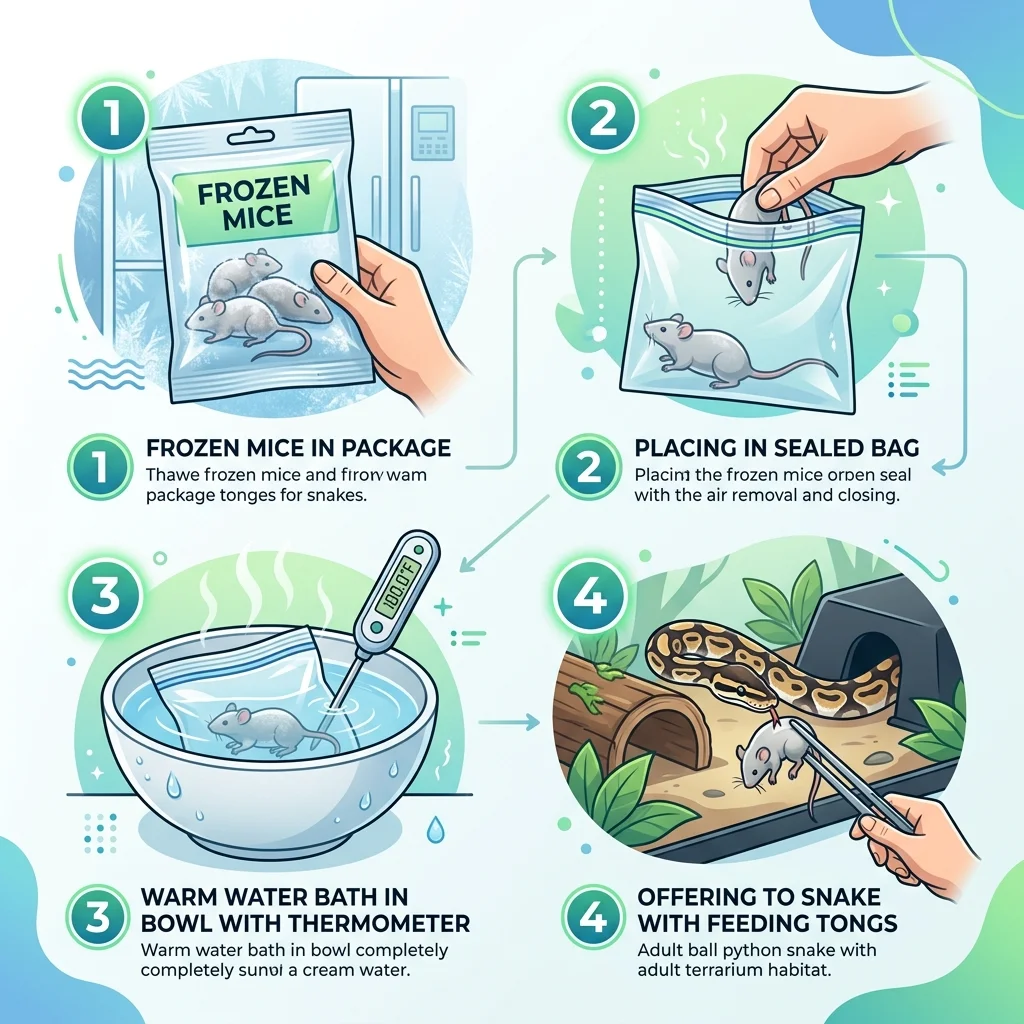
Step-by-Step Instructions
Step 1: Remove the prey from frozen storage
Take out only the prey items you plan to feed at this session. Do not thaw more than you'll use — discard any unused thawed prey after 2 hours.
If your prey is vacuum-sealed (as quality frozen feeders should be), do not remove it from its vacuum bag before placing it in the zip-lock. You can thaw it in the vacuum bag directly, then open the bag just before offering.
Step 2: Place the prey in a sealed zip-lock bag
This step is frequently skipped and frequently causes problems. Submerging frozen prey directly in water — even warm water — causes the fur/skin to absorb water. This:
- Dilutes the surface scent profile that triggers feeding in chemoreceptive species (corn snakes, king snakes)
- Creates a wet, "wrong-textured" prey item that some snakes refuse
- Causes waterlogged fur that takes longer to warm uniformly
Placing the prey in a zip-lock bag before submerging protects the surface while allowing the water bath to transfer heat efficiently through the bag.
Step 3: Prepare the warm water bath
Fill a bowl with water at approximately 105–110°F. A kitchen thermometer makes this easy. Water from the hot tap is usually in this range, but hot tap temperatures vary considerably by household — always verify.
Why 105–110°F rather than lower? Because the water temperature will drop during the thawing process as the frozen prey absorbs heat. Starting at 105–110°F ensures the water remains warm throughout the thaw period and that the prey reaches target temperature by the end.
Step 4: Submerge and wait
Place the bagged prey item fully in the water bath. The item should be completely submerged — if it floats, weigh it down with a spoon or cup. Thawing time depends on prey size:
| Prey Size | Weight | Thaw Time |
|---|---|---|
| Pinky mouse | 2–4g | 10–15 minutes |
| Fuzzy mouse | 5–9g | 12–18 minutes |
| Hopper mouse | 10–18g | 15–22 minutes |
| Weaned/small adult mouse | 19–28g | 20–28 minutes |
| Adult small mouse | 29–39g | 25–32 minutes |
| Adult medium mouse | 40–54g | 28–38 minutes |
| Adult large mouse | 55–75g | 35–45 minutes |
| Jumbo mouse | 76–100g | 40–55 minutes |
| Small rat pup | 15–30g | 18–25 minutes |
| Medium rat pup | 30–60g | 25–35 minutes |
| Large rat | 60–120g | 35–50 minutes |
| Extra-large rat | 120–250g | 50–70 minutes |
Note: These times are for starting water temperature of 105–110°F. If your water is cooler, add time accordingly.
Step 5: Verify temperature before offering
Remove the prey from the water bath and the zip-lock bag. Using a laser thermometer or instant-read probe, verify surface temperature:
- Target surface temperature: 98–102°F (approximately live-prey body temperature)
- If surface temperature is below 95°F, return to warm water for 5 more minutes
- If surface temperature is above 106°F, allow to cool for 2 minutes before offering
Step 6: Offer with feeding tongs
Place the warmed prey item in the enclosure using feeding tongs — either directly in front of the snake or lightly touching the snake's snout to stimulate a feeding response. Do not drop prey from a height (the impact can cause prey to bounce unnaturally, which may startle some individuals). For species that respond to movement, use the tongs to gently "walk" the prey item near the snake.
3. Method 2: Overnight Refrigerator Thaw
For keepers who plan feedings in advance, the refrigerator thaw method is an alternative that eliminates bacterial growth risk by keeping prey below 40°F throughout the thaw process.
When to Use This Method
- When you prefer to prepare prey the night before a morning feeding
- For large prey items (adult rats, rabbit kittens) where warm-water thawing is slower
- As a first step before the warm-water bath finish
Refrigerator Thaw Instructions
- Remove frozen prey from freezer the evening before feeding
- Place in a sealed zip-lock bag (prevents odor contamination of other refrigerator contents)
- Leave in refrigerator at 35–40°F for 8–12 hours:
- Small mice (pinky–hopper): 6–8 hours
- Adult mice: 8–10 hours
- Small rats: 8–12 hours
- Large rats: 12–16 hours
- Remove from refrigerator 30 minutes before planned feeding
- Finish with a 10-minute warm water bath to bring prey to feeding temperature (98–102°F)
The refrigerator thaw alone does not bring prey to feeding temperature — you will still need the warm water bath final step. The refrigerator thaw is a convenience method for timing, not a replacement for warming.
4. Method 3: The Warm Water Quick-Thaw (No Bag)
For keepers who don't have zip-lock bags immediately available, direct warm water thawing is possible but requires care.
When This Method Is Acceptable
- For colubrid species where scent is less critical (the water exposure may actually distribute scent differently, which some colubrids respond to neutrally)
- When time is limited and the quick-soak method is the only option
- When prey is being thawed for species that don't rely heavily on chemoreception
Precautions for Direct Water Thawing
- Use warm (not hot) water — 105°F maximum to prevent cooking the outer surface
- Monitor closely — do not leave prey submerged longer than necessary
- Pat prey dry with a paper towel before offering to remove excess moisture
- For ball pythons especially, dry prey is important — wet fur may not register as prey to their pit organs as reliably
5. What NOT to Do: Thawing Mistakes That Cause Feeding Refusals
Never Microwave Frozen Rodents
This is the most common dangerous mistake, and it deserves clear treatment.
Microwaves heat unevenly. They excite water molecules selectively, creating hot spots around blood and fluid-rich tissues (organs, especially) while leaving denser tissues (muscle, bone) cooler. The result is prey that may be partially cooked on the inside while still frozen or only slightly thawed on the outside.
The specific dangers of microwaving feeder rodents:
-
Explosion risk: Internal steam can build up in organs and body cavities, causing the prey item to rupture during thawing or even after. This can contaminate the enclosure and injure the snake.
-
Cooked prey rejection: Snakes reliably detect when prey has been cooked — the denatured proteins produce a fundamentally different scent profile that triggers refusal in many individuals.
-
Burned internal temperature: An interior temperature that exceeds 110°F is high enough to begin protein denaturation — the prey is being cooked, not thawed. The snake may reject it or, if it accepts, is eating altered-protein prey.
-
Thermal injury risk to the snake: Prey with cooked-hot interior pockets can cause thermal burns to the snake's oral tissues, esophagus, or stomach.
Never Thaw at Room Temperature
As covered in Section 1, room temperature thawing puts prey through extended bacterial growth temperature exposure. This is particularly problematic in warm environments (summer, or kitchens near stoves) where room temperature may be 75–80°F — accelerating bacterial growth further.
The bacterial growth concern is especially significant for young snakes, snakes that are immunocompromised from illness or stress, and hatchlings whose gastric acid may not be as robustly acidic as adults.
Never Offer Prey That Is Still Partially Frozen
A prey item with a frozen core will not warm to live-prey-equivalent temperature throughout. The snake's pit organs detect the overall heat signature of the item — a prey item with a frozen core averages lower than an acceptable temperature. Many ball pythons will refuse partially-frozen prey for this exact reason.
Additionally, a frozen core means digestive enzymes will encounter poorly prepared tissue — the ice crystals in the frozen tissue disrupt the cellular structure in ways that can affect digestion time and nutritional availability.
Never Refreeze Thawed Prey
Once frozen prey has been thawed (whether partially or completely), it must be either offered to the snake immediately or discarded. Do not refreeze and re-offer at a later feeding.
Each freeze-thaw cycle:
- Further ruptures cell membranes (the ice crystals have already damaged them once)
- Increases oxidation of fats in the prey tissue
- Accumulates bacterial load from the thaw exposure period
- Degrades the prey's scent profile and texture
Never Use Boiling Water
Some keepers use boiling or very hot water to speed thawing. This will begin cooking the outer surface of the prey item — protein denaturation begins around 140°F — while the interior remains frozen. The cooked exterior produces a changed scent profile that many snakes refuse.
Use warm (105–110°F) water, not hot.
6. Troubleshooting: Why Won't My Snake Eat Thawed Mice?
If your snake refuses frozen/thawed prey after correct preparation, the following troubleshooting checklist addresses the most common causes:
Prey Temperature
The most frequent cause of refusal, especially in ball pythons and other pit-sensing species.
Check: Verify surface temperature with a laser thermometer. Target: 98–102°F.
If prey is below 95°F: It is "cool" to the snake's heat pits and may not register as prey. Return to warm water for 5 minutes.
If prey is above 106°F: Some individuals refuse prey that is too hot (the heat signature is atypical for live prey). Allow to cool 2 minutes and re-offer.
Prey Scent (Colubrid Species)
Corn snakes, king snakes, and other colubrids use chemoreception (Jacobson's organ/tongue-flicking) more than heat pits for prey location. Waterlogged prey (thawed without a protective bag) has a diluted scent profile.
Solution: Use a zip-lock bag during thawing. Pat dry before offering. For particularly scent-sensitive individuals, allow thawed prey to air-dry for 2–3 minutes before offering to concentrate surface volatiles.
Pre-Shed Condition
Snakes in shed are physiologically compromised — their spectacles (eye caps) are clouded, reducing visual acuity. Many snakes refuse food during the shed cycle (from the point when they "go blue" to several days after shedding).
Check: Look at your snake's eyes. Blue-gray cloudiness indicates pre-shed. Do not force feeding during this period — wait until the shed is complete and eyes are clear.
Handling Too Recently
As established elsewhere, handling within 48 hours of a feeding attempt elevates cortisol, suppressing feeding drive. This is a behavioral/hormonal effect and cannot be overcome by prey preparation technique.
Solution: Implement a strict 48-hour no-handling rule before all feeding attempts.
Prey Size Issues
Prey that is significantly undersized (less than half the snake's body diameter at the widest point) may not trigger the feeding response. Prey that is oversized may be approached but not struck.
Solution: Use the girth rule — prey should match the snake's widest body diameter. Our frozen mice size chart and rat size chart provide weight-based guidance for all common species.
Species-Specific Scent Preferences
Ball pythons, particularly those from West African lineages, frequently have a strong preference for rat scent over mouse scent. A ball python that reliably ate mice as a juvenile may begin refusing mice as an adult while readily accepting same-sized rats.
Solution: Transition to frozen/thawed rats. Use scent transfer if needed during the transition (rub frozen rat prey against a thawed mouse to transfer mouse scent, then offer the rat).
Novel Prey Type
If you've recently changed suppliers or are offering a different prey species than the snake previously accepted, the novel scent profile may cause initial hesitation.
Solution: Offer one prey item of the new type in a separate feeding container. If refused, use scent transfer from the previous prey type. For more detail on scent transfer techniques, see our guide to switching snakes from live to frozen prey.
7. Special Situations
Thawing for Multiple Snakes
For collections of multiple animals, thaw prey in batches using a larger container. Organize prey by size in separate bags labeled by intended snake. Never put prey for different animals in the same bag — cross-contamination of individual microbiome signatures can occasionally affect feeding responses in highly sensitive individuals.
Very Large Prey (Adult Rats, Rabbit Kittens)
Large prey items for adult boas, retics, and large pythons require adjusted thawing:
- Use a larger container (bucket or stock pot)
- Use more water volume (temperature drops more slowly with higher water volume)
- Start water at 108–112°F (slightly hotter than standard, to compensate for the longer thawing duration)
- Expect 50–75 minutes for extra-large items
- Check temperature by pressing gently on the thickest part of the prey — it should feel uniformly soft and warm, not firm or cool in the center
Thawing Pinky Mice for Hatchlings
Pinky mice for hatchling snakes are the smallest and most delicate prey items. Be careful not to overdo the warm water bath:
- Pinkies reach target temperature very quickly (10–12 minutes maximum)
- Over-warming can begin surface tissue breakdown in such small, delicate prey items
- Test temperature at 10 minutes — do not leave in warm water for extended periods
Thawing During Power Outages
If your freezer loses power, check prey within 24 hours. If prey is still firm (partially frozen or refrigerator-temperature cold), it can be thawed and used. If prey has reached room temperature and has been there for more than 2 hours, it should be discarded — the bacterial growth risk is unacceptable.
8. Food Safety and Hygiene
Handling Precautions
While CO2-euthanized frozen feeder rodents from quality suppliers present very low pathogen risk, standard food-safety hygiene applies:
- Wash hands thoroughly before and after handling thawed prey
- Do not prepare thawed prey on the same surfaces used for human food preparation without sanitizing first
- Do not let children handle thawed prey items without supervision
- Store frozen prey separately from human food in a labeled container
Recognizing Spoiled Frozen Prey
Quality frozen prey that has been properly stored will not be spoiled, but here are signs that prey should not be fed:
- Severe freezer burn: Large white or gray patches of crystallized, dried-out fur. Minor surface freezer burn is cosmetic; severe cases indicate significant fat degradation.
- Unusual odor after thawing: Properly thawed prey has a neutral-to-slightly-gamey odor. A strong, sharp, sour, or rotten odor indicates bacterial spoilage.
- Discoloration of tissues: Internal flesh visible through the skin should be pink-red. Gray, green, or black discoloration indicates spoilage.
- Physical damage: Prey that arrived damaged (torn, crushed) should be inspected — damaged packaging may have allowed contamination during storage.
For more on identifying spoiled feeder rodents, see our guide to recognizing spoiled frozen rodents.
9. Optimizing the Complete Feeding Session
The thawing process is one component of a complete feeding session. Here's how it integrates into the full protocol:
Pre-Feeding Checklist
- No handling for past 48 hours
- Enclosure warm end temperature verified at species-appropriate level (82–88°F)
- Prey selected at correct size for snake's current weight (girth rule or 10–15% body weight)
- Feeding tongs ready
- Optional: separate feeding container prepared (particularly useful for new feeders, hatchlings, and reluctant individuals)
Thawing Protocol (Warm Water Method)
- Prey in zip-lock bag and submerged in 105–110°F water
- Timer set for appropriate duration by prey size
- Surface temperature verified at 98–102°F before offering
Offering Protocol
- Approach enclosure calmly — do not startle the snake
- Offer prey with tongs, holding at the body (not the tail — dangling prey by the tail is unnatural and may be refused)
- For ball pythons: touch snout gently with prey if snake doesn't notice it; allow snake to strike and constrict without interference
- For colubrids: drag prey gently with tongs to simulate movement; allow snake to strike and swallow without disturbance
Post-Feeding
- Remove uneaten prey immediately if not accepted within 20 minutes
- Record feeding date, prey size, and acceptance/refusal
- No handling for 48–72 hours minimum
10. Frequently Asked Questions
How long does it take to thaw a frozen mouse?
Using the warm water bath method at 105–110°F: 10–15 minutes for pinkies, 15–22 minutes for hoppers, 25–35 minutes for adult mice, 35–50 minutes for adult large mice and small rats. Always verify surface temperature at 98–102°F before offering regardless of time elapsed.
Can I thaw frozen mice in the microwave?
No. Microwaving creates uneven heating, can cause prey items to rupture from steam pressure, begins cooking outer tissues (changing scent profile and causing refusals), and creates thermal injury risk for the snake. Use the warm water bath method instead.
How do I know the mouse is fully thawed?
The mouse should be uniformly soft and pliable when gently squeezed — no firm, cold spots in the center. Surface temperature at 98–102°F is a strong indicator of full thaw, though for large prey items, also verify by pressing on the thickest part (the torso, not the head). A fully thawed prey item at 100°F surface temperature has an interior temperature of approximately 95–98°F — adequate for feeding.
My snake won't eat thawed mice. What should I do?
First, verify that surface temperature is at 98–102°F with a thermometer — this single factor explains the majority of frozen/thawed refusals. Next, check for pre-shed signs (cloudy eyes). Ensure no handling occurred in the past 48 hours. If all conditions are correct and refusal continues, try offering in a separate feeding container, try wiggling the prey with tongs, or try scenting the prey with a mouse-fur rubdown. For ball pythons refusing mice, try switching to an appropriately sized rat.
How long can thawed mice be stored before feeding?
Thawed prey should be offered within 2 hours of reaching full thaw temperature. Do not store thawed prey at room temperature — bacterial growth begins immediately. If you've thawed prey but the snake refuses, discard the prey after 2 hours rather than attempting to refreeze.
Summary
The correct technique for thawing frozen mice for snakes is the warm water bath method:
- Place frozen prey in a sealed zip-lock bag
- Submerge in 105–110°F water for the appropriate time based on prey size
- Verify surface temperature at 98–102°F with a thermometer
- Offer with feeding tongs, never by hand
Avoid microwaving, room-temperature thawing, boiling water, and refreezing. These common mistakes cause the majority of feeding refusals that keepers mistakenly attribute to "picky" snakes.
For more on why frozen/thawed prey is the preferred standard and how to transition snakes from live to frozen, see our complete frozen vs live rodents guide. For proper prey sizing at every life stage, see our frozen mice size chart.