Key Takeaway
The definitive king snake feeding schedule guide covering all Lampropeltis species. Includes exact feeding frequencies, prey sizes, frozen/thawed protocols, seasonal adjustments, and troubleshooting common feeding problems.
Table of Contents
- 1. King Snake Biology: What Shapes the Feeding Schedule
- Metabolic Rate and Digestive Efficiency
- Ophiophagy and Behavioral Drives
- Thermoregulation and Seasonal Activity
- 2. King Snake Feeding Schedule by Life Stage
- Hatchling King Snakes (0–3 months, Under 40g)
- Juvenile King Snakes (3–12 months, 40–200g)
- Sub-Adult King Snakes (12–24 months, 200–500g)
- Adult King Snakes (2+ years, 500g–1,000g+)
- 3. The Complete King Snake Feeding Schedule Reference
- 4. Frozen/Thawed Feeding Protocol for King Snakes
- Standard Thawing Protocol
- King Snake-Specific Presentation Tips
- 5. Seasonal Feeding Adjustment
- The Brumation Signal
- Temperature-Based Feeding Triggers
- The Spring Feeding Surge
- 6. The Obesity Problem: King Snake's Biggest Health Risk
- Why King Snakes Overeat
- Body Condition Scoring for King Snakes
- Recovery from Obesity
- 7. Troubleshooting King Snake Feeding Problems
- Refusal in a Previously Reliable Feeder
- The Double Strike Problem
- When a King Snake Won't Accept Frozen
- 8. Prey Size Chart by Snake Length (Alternative Method)
- 9. Diet Variety and Supplementary Prey
- 10. Frequently Asked Questions
- How often should I feed my California kingsnake?
- What size mouse for my kingsnake?
- My king snake used to eat every week but now refuses. What's wrong?
- Can I feed my king snake too much?
- Should I handle my kingsnake before or after feeding?
- Summary: King Snake Feeding Schedule at a Glance
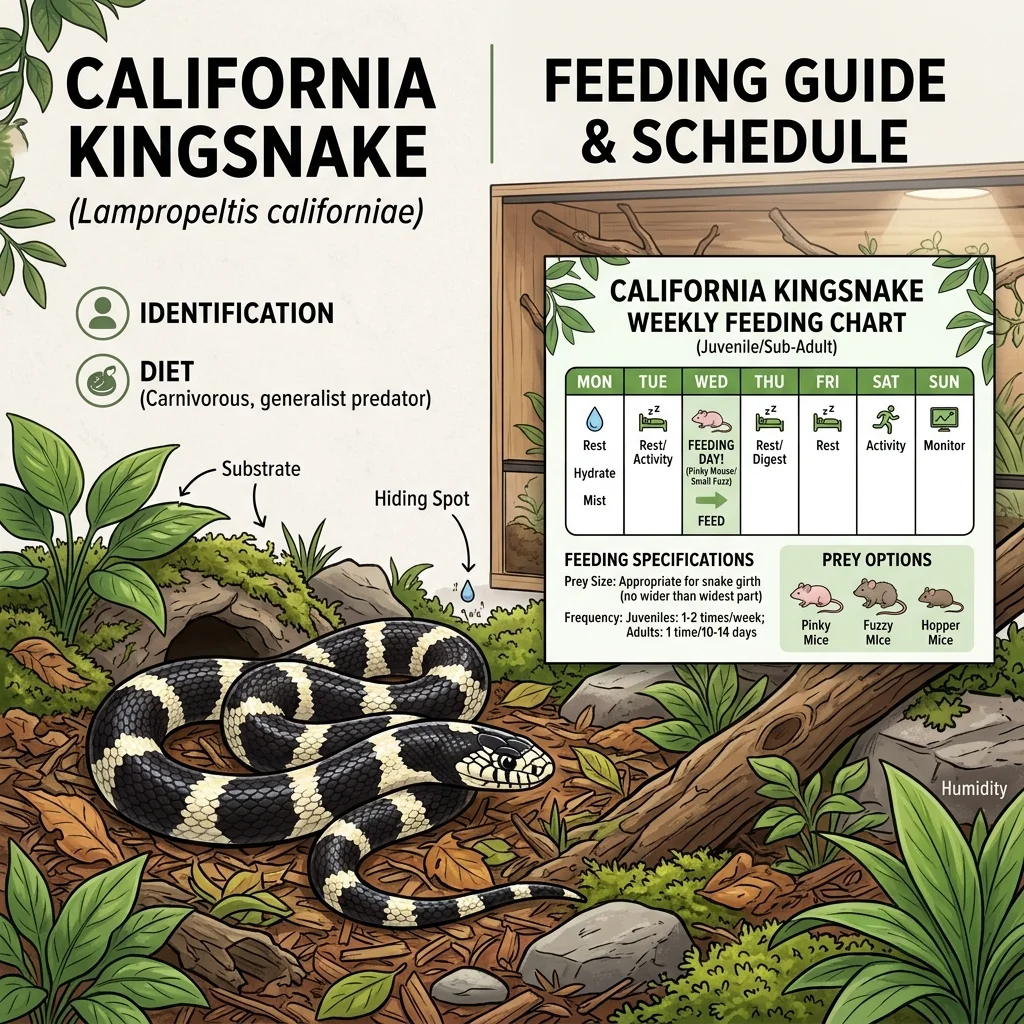
King snakes are among the most rewarding snakes to keep precisely because they are, for the most part, enthusiastic feeders. Unlike the notoriously fussy ball python or the seasonally reluctant hognose snake, a well-established kingsnake on a proper feeding schedule will strike at appropriately-sized frozen/thawed prey with a reliability that new keepers find almost surprising after reading all the feeding-refusal content that dominates reptile forums.
But "enthusiastic feeder" is not a synonym for "easy feeder." King snakes have their own biology, their own dietary needs, and their own quirks — and a feeding schedule that ignores these will produce an animal that is either chronically overfed (a surprisingly common problem with kings), undertransitioned in prey size, or occasionally developing refusal behaviors that keepers mistake for a serious health issue.
This guide covers the complete king snake feeding schedule, covering the genus Lampropeltis and including species-specific notes for the California kingsnake, Eastern kingsnake, Speckled kingsnake, and Desert kingsnake. It addresses prey sizing, feeding frequency by life stage, frozen/thawed protocols, seasonal behavior, and the troubleshooting you'll need when the expected feeding response doesn't materialize.
1. King Snake Biology: What Shapes the Feeding Schedule
Understanding the biology underpinning king snake feeding behavior is essential for building a schedule that works with the animal's physiology rather than against it.
Metabolic Rate and Digestive Efficiency
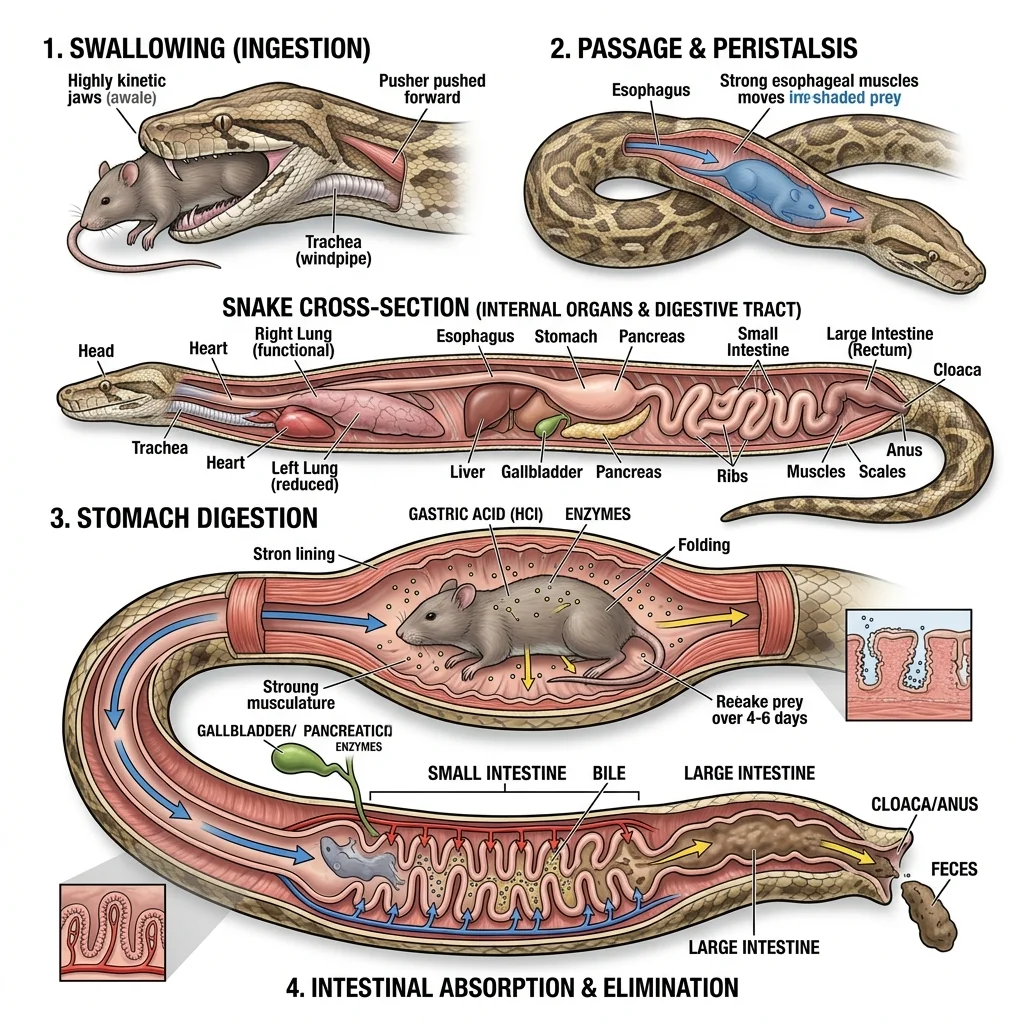
King snakes are ectotherms with metabolic rates that vary significantly with ambient temperature. At optimal temperatures (80–85°F warm end, 70–75°F cool end), a king snake's digestive system processes prey efficiently: a complete SDA (Specific Dynamic Action) cycle for a single appropriately-sized meal takes approximately 3–5 days.
This shorter SDA cycle compared to large pythons means kingsnakes can be fed more frequently — every 5–7 days for juveniles and every 7–10 days for adults without the long digestive windows that constrain ball python feeding schedules.
Practical implication: If your king snake is fed on a 7-day schedule but still has a visible food lump at feeding time, either the prey is too large or your enclosure temperatures are suboptimal. Both problems are solvable with the information in this guide.
Ophiophagy and Behavioral Drives
Lampropeltis species are famous for ophiophagy — the ability and propensity to eat other snakes, including venomous species. This dietary flexibility is accompanied by a behavioral feeding drive that is generally more robust than that of obligate rodent specialists.
The practical consequence: king snakes tend to be more responsive to a wider range of prey items, more likely to accept frozen/thawed prey without conditioning, and less prone to the extended seasonal food strikes that affect pythons. Their greater dietary flexibility also means they can be offered a broader range of supplementary prey items when dietary variety is desired.
Thermoregulation and Seasonal Activity
In the wild, California kingsnakes (Lampropeltis californiae) brumate (the reptile equivalent of hibernation) during winter months. Eastern kingsnakes (L. getula) show similar seasonal inactivity in the northern parts of their range.
In captivity, this brumation tendency can manifest as reduced feeding interest during November–February even when no deliberate temperature reduction is provided. Some captive-bred king snakes show no seasonal reduction at all; others show it reliably. Understanding your individual animal's seasonal pattern — and not panicking when it occurs — is part of a well-designed feeding schedule.
2. King Snake Feeding Schedule by Life Stage
Hatchling King Snakes (0–3 months, Under 40g)
Recommended prey: Pinky mouse (2–4g)
Feeding frequency: Every 5–7 days
| Life Stage | Snake Weight | Prey Size | Frequency |
|---|---|---|---|
| Hatchling | 20–40g | Pinky mouse (2–4g) | Every 5–7 days |
Hatchling king snakes typically measure 8–12 inches and weigh 15–35g depending on species. California kingsnakes tend to hatch slightly larger than Eastern kingsnakes.
Key points for hatchlings:
- Most captive-bred hatchlings will accept frozen/thawed pinkies from the first feeding, which is a major advantage of the species
- If a hatchling refuses at first, try scenting the frozen pinky with a small amount of gecko or lizard (kingsnakes frequently key on lizard scent in the wild during the earliest life stage)
- A feeding container separate from the main enclosure dramatically increases first-feeding acceptance rates for hatchlings that initially hesitate
- Some hatchlings show a specific "gape" response to very small prey — if a pinky is too large for the hatchling to get its mouth around comfortably, offer a "pre-eaten" or freshly warmed pinky that is freshly killed and still limp (not yet stiff from rigor)
Juvenile King Snakes (3–12 months, 40–200g)
Recommended prey: Pinky to hopper mouse
Feeding frequency: Every 5–7 days
| Life Stage | Snake Weight | Prey Size | Frequency |
|---|---|---|---|
| Early juvenile | 40–80g | Fuzzy mouse (5–9g) | Every 5–7 days |
| Mid juvenile | 80–150g | Hopper mouse (10–18g) | Every 7 days |
| Late juvenile | 150–200g | Weaned/small adult mouse (19–28g) | Every 7 days |
Juvenile king snakes grow rapidly on a consistent feeding schedule. California kingsnakes particularly will often reach 200g within 6–8 months on a weekly feeding regimen with appropriately sized prey.
Prey size escalation guide: Increase prey size when the current prey item produces no visible body-girth bulge post-feeding. If you can see the snake swallow the prey with no visible expansion of the midsection at all, the prey is likely too small. If the midsection shows a hard, dramatic lump, the prey is too large. The correct appearance is a smooth, modest elongated bulge in the midsection that reduces to invisible within 2–3 days.
Sub-Adult King Snakes (12–24 months, 200–500g)
Recommended prey: Weaned to adult medium mouse
Feeding frequency: Every 7–10 days
| Life Stage | Snake Weight | Prey Size | Frequency |
|---|---|---|---|
| Sub-adult | 200–300g | Adult small mouse (29–39g) | Every 7 days |
| Sub-adult | 300–400g | Adult medium mouse (40–54g) | Every 7–10 days |
| Sub-adult | 400–500g | Adult medium to adult large mouse (40–75g) | Every 10 days |
The sub-adult stage is critical because this is when most keepers begin overfeeding. Kingsnakes are enthusiastic feeders that will accept food well beyond their caloric needs if given the opportunity. Obesity in king snakes is common and causes significant long-term health problems — fatty liver disease, reproductive failure, and reduced lifespan being the most serious.
The signs of an overfed king snake:
- Visible "rolls" or "folds" of fat tissue in the neck region
- Circular cross-section (a healthy snake should be slightly oval/D-shaped, not round)
- Inability to extend fully when moving
- Reduced activity level
If your king snake is showing these signs, immediately reduce prey size by one step and extend the feeding interval to 10–14 days.
Adult King Snakes (2+ years, 500g–1,000g+)
Recommended prey: Adult medium to adult large mouse (or small rat)
Feeding frequency: Every 10–14 days
| Life Stage | Snake Weight | Prey Size | Frequency |
|---|---|---|---|
| Adult (small) | 500–700g | Adult medium mouse (40–54g) | Every 10 days |
| Adult (average) | 700–900g | Adult large mouse (55–75g) | Every 10–14 days |
| Adult (large) | 900g–1,200g | Jumbo mouse or small rat | Every 14 days |
Adult king snakes — particularly females, which grow larger than males — may benefit from transitioning to small rats at 700g+. Rats offer a better Ca:P ratio and higher protein density, as discussed in our feeder rodent nutrition comparison.
Species-specific adult weights for reference:
| Species | Typical Adult Weight | Max Documented |
|---|---|---|
| California Kingsnake (L. californiae) | 500–800g | 1,200g |
| Eastern Kingsnake (L. getula) | 700–1,200g | 1,800g |
| Speckled Kingsnake (L. holbrooki) | 600–900g | 1,400g |
| Desert Kingsnake (L. splendida) | 400–700g | 900g |
| Mexican Black Kingsnake (L. getula nigrita) | 600–1,000g | 1,500g |
3. The Complete King Snake Feeding Schedule Reference
| Life Stage | Weight | Prey | Frequency | Notes |
|---|---|---|---|---|
| Hatchling | 20–40g | Pinky (2–4g) | Every 5–7 days | Separate feeding container recommended |
| Early juvenile | 40–80g | Fuzzy (5–9g) | Every 5–7 days | |
| Mid juvenile | 80–150g | Hopper (10–18g) | Every 7 days | |
| Late juvenile | 150–250g | Weaned (19–28g) | Every 7 days | |
| Sub-adult | 250–400g | Adult small (29–39g) | Every 7–10 days | Watch for obesity signs |
| Sub-adult | 400–600g | Adult medium (40–54g) | Every 10 days | |
| Adult | 600–900g | Adult large (55–75g) | Every 10–14 days | |
| Adult | 900g+ | Jumbo or small rat | Every 14 days | Consider rat transition |
4. Frozen/Thawed Feeding Protocol for King Snakes
King snakes are one of the easiest species to establish on frozen/thawed prey. Most captive-bred individuals accept it immediately. For those that don't, the following protocol has the highest success rate.
Standard Thawing Protocol
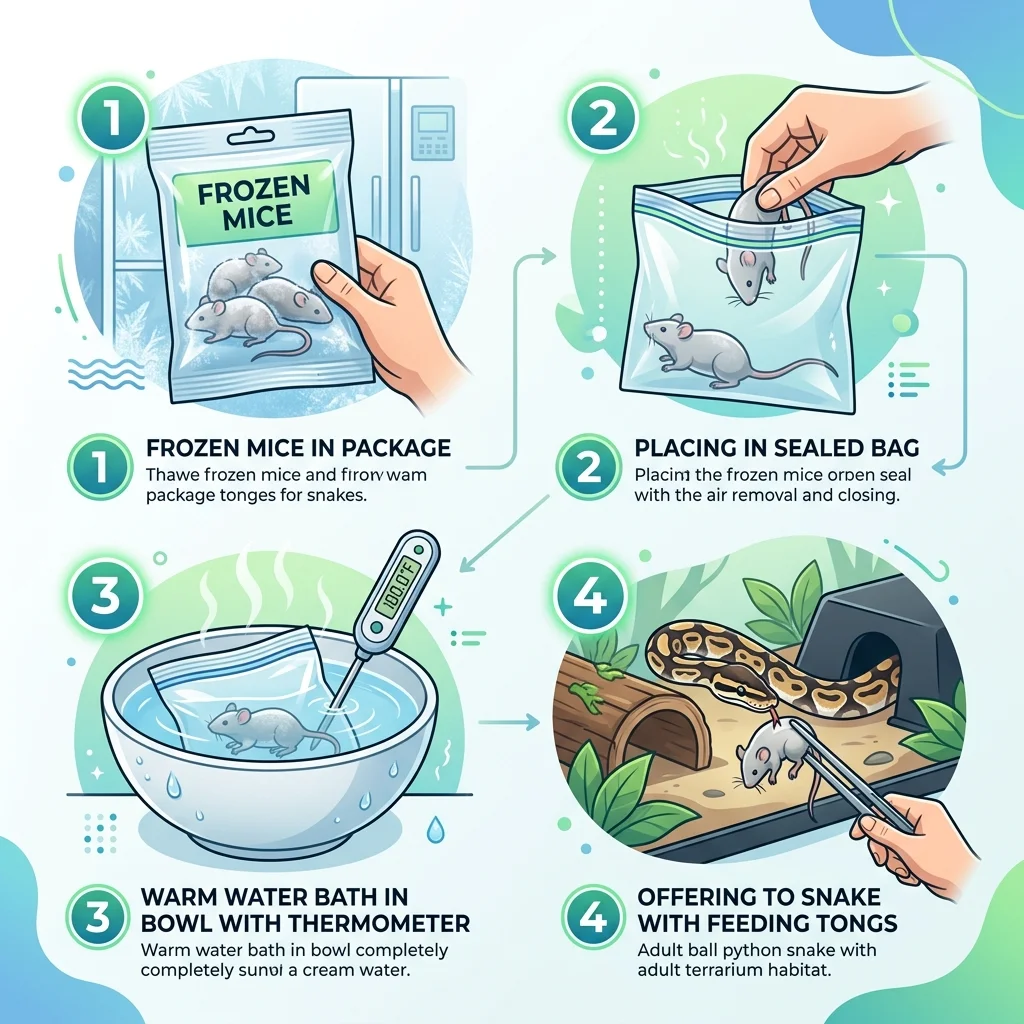
- Remove the frozen prey from its vacuum-sealed packaging
- Place it in a sealed zip-lock bag (prevents water absorption by the fur, which affects scent profile)
- Submerge in warm water (100–105°F) for:
- Pinky mice: 10–15 minutes
- Fuzzy to hopper: 15–20 minutes
- Adult mice: 20–30 minutes
- Verify surface temperature has reached 98–102°F with a laser thermometer
- Offer with feeding tongs, not by hand (king snakes can be vigorous strikers and may bite in feeding response)
For the complete protocol with timing charts for all prey sizes, see our guide to thawing frozen mice.
King Snake-Specific Presentation Tips
Wiggling the prey: Unlike ball pythons, which are primarily heat-seekers, king snakes hunt partially by sight and prey movement. Gently "walking" the thawed prey item across the substrate surface using tongs triggers the visual prey-tracking behavior that precedes a strike. This is the single most effective technique for encouraging a hesitant king snake to strike at frozen/thawed prey.
Prey placement: Place thawed prey in a position that simulates a mouse in motion — slightly away from the snake's current position, angled so the prey appears to be moving away from the snake. Prey placed directly on top of the snake or positioned statically may be ignored.
Time of feeding: King snakes are more active at dusk and after dark. Offering food in the evening reliably produces higher first-strike acceptance rates than daytime feeding attempts.
5. Seasonal Feeding Adjustment
The Brumation Signal
Many captive king snakes — particularly those kept with natural photoperiod variation — show a predictable feeding reduction from October through February. This manifests as:
- Reduced activity level
- Hiding more frequently
- Taking longer to strike or showing less interest
- Occasional complete refusal of offered prey
This is normal and not a cause for concern if your snake has a healthy body weight and no other signs of illness. A king snake in brumation-adjacent state can safely skip 4–8 weeks of feeding with no health consequences.
Temperature-Based Feeding Triggers
If you want to maintain feeding throughout winter without brumation, keep your king snake's enclosure warm end at 85–88°F consistently. The key trigger for brumation behavior in most Lampropeltis species is ambient temperature — an animal maintained at summer temperatures year-round will usually continue feeding through winter.
However, there is a herpetological case for allowing mild seasonal temperature reduction. Captive king snakes that experience a winter "cool season" at 65–72°F for 8–10 weeks have been shown in anecdotal collection records to have better reproductive performance and potentially longer lifespans. During the cool season, reduce feeding to every 3–4 weeks or suspend feeding entirely if temperatures drop below 65°F (below this threshold, digestive function is impaired).
The Spring Feeding Surge
After winter reduction, king snakes typically enter a spring feeding surge in March–April. This coincides with breeding season readiness and produces reliably aggressive feeding behavior. Use this period to:
- Return to normal feeding schedule
- Upgrade prey size if the snake's weight warrants it
- Address any nutritional debt from reduced winter intake
6. The Obesity Problem: King Snake's Biggest Health Risk
We've mentioned obesity twice already because it genuinely is the most common health problem in captive king snakes. It deserves dedicated treatment.
Why King Snakes Overeat
Kingsnakes are opportunistic feeders in the wild — they cannot predict when the next meal will appear, so they eat whenever prey is available. In captivity, prey is available every week, and the snake's regulatory mechanisms for satiety are not calibrated for this level of consistent food availability.
A king snake will continue accepting food even when it has sufficient caloric reserves. Unlike humans, who have complex neuroendocrine feedback systems for hunger and satiety that adapt to consistent food availability, snakes maintain their wild-calibrated drive to eat whenever prey is present.
Body Condition Scoring for King Snakes
The Body Condition Score (BCS) system used for reptiles is a 1–9 scale:
- 1–3: Underweight. Spine and ribs visible through skin, significant muscle wasting
- 4: Lean. Slightly below ideal, spine palpable
- 5: Ideal. Oval cross-section, spine not easily felt but palpable with pressure, smooth muscle coverage
- 6: Slightly overweight. Spine requires more pressure to feel, slight "squareness" to cross-section
- 7–9: Overweight to obese. Round cross-section, visible fat deposits in neck and flanks, spine not palpable
Target BCS for captive king snakes: 4.5–5.5
Assess your king snake's BCS monthly. If it is trending above 5.5, reduce prey size by one step and/or extend feeding intervals before obesity becomes entrenched.
Recovery from Obesity
If your king snake is already obese (BCS 7+), do not attempt rapid weight loss through severe food restriction — this can cause hepatic lipidosis as fat is mobilized too quickly from the liver. Instead:
- Reduce prey size by two steps (from adult large to hopper, for example)
- Extend feeding intervals to every 14–21 days
- Increase activity opportunities (longer enclosure, more climbing opportunities, regular supervised exercise time)
- Monitor weight monthly
Expect recovery to take 6–18 months depending on initial severity.
7. Troubleshooting King Snake Feeding Problems
Refusal in a Previously Reliable Feeder
The most common causes of sudden feeding refusal in a king snake that has been eating regularly:
| Cause | Signs | Solution |
|---|---|---|
| Upcoming shed | Cloudy/blue eyes, dull skin | Wait 1–2 weeks until shed completes |
| Seasonal brumation response | October–February, reduced activity | Allow natural winter reduction, resume in spring |
| Recent handling | Refusal within 48 hours of handling | Implement no-handling rule 48h before feeding |
| Prey too large | Previous regurgitation or sluggishness after eating | Reduce prey size by one step |
| Enclosure too cool | Activity reduced year-round | Verify warm-end temperature reaches 85°F |
| Underlying illness | Weight loss, lethargy outside of shed/season | Veterinary evaluation |
The Double Strike Problem
King snakes with a very aggressive feeding response occasionally strike their prey multiple times, over-constrict, or attempt to swallow prey starting from the wrong end. These behaviors are most common in very food-motivated individuals.
Solutions:
- Use a feeding container to limit spatial confusion
- Offer prey away from the snake's head, allowing it to track and orient before striking
- If the snake consistently struggles with prey orientation, try offering prey positioned with the head toward the snake
When a King Snake Won't Accept Frozen
Though rare, some king snakes — particularly wild-caught adults or those that were fed live prey for years before rehoming — refuse frozen/thawed prey. The techniques most effective for these individuals:
- Freshly killed prey: Offer a live prey item immediately after euthanasia (CO2 or cervical dislocation). The prey will still be warm and limber. This bridges from live to recently killed, and from there to frozen/thawed.
- Scent transfer: Rub frozen prey with live prey fur or bedding
- Prey variety: Offer a different species (fuzzy rat instead of mouse, or quail chick)
- The "assist" feed: Gently place the prey item against the snake's lips (never force-feed) to trigger the tongue-sampling that may initiate a feeding response
For more troubleshooting, see our comprehensive king snake feeding guide which covers species-specific behavioral details.
8. Prey Size Chart by Snake Length (Alternative Method)
For keepers who prefer to size prey by snake length rather than weight (useful if you don't have a scale):
| Snake Total Length | Recommended Mouse Size |
|---|---|
| 8–12 inches (hatchling) | Pinky (2–4g) |
| 12–18 inches | Fuzzy (5–9g) |
| 18–24 inches | Hopper (10–18g) |
| 24–30 inches | Weaned/small adult (19–28g) |
| 30–36 inches | Adult small (29–39g) |
| 36–42 inches | Adult medium (40–54g) |
| 42–48 inches | Adult large (55–75g) |
| 48+ inches | Jumbo mouse or small rat |
Caveat: Body length is a less precise sizing method than body weight because the same length king snake can have very different body mass depending on species, sex, and individual genetics. The girth rule (prey no wider than the snake's widest point) remains the most reliable field method.
For the complete breakdown of how all frozen feeder sizes relate to snake species across the hobby, see our frozen mice size chart.
9. Diet Variety and Supplementary Prey
Unlike many snake species, king snakes benefit from dietary variety. In the wild, California kingsnakes eat lizards, small snakes, bird eggs, small birds, mice, and rats — a diverse diet that naturally provides a broader nutritional profile than any single prey type.
In captivity, true diet variety (different prey species at different feedings) is not strictly necessary for health if the primary prey is nutritionally complete. However, there are practical benefits:
Benefits of occasional diet variation:
- Prevents the "prey fixation" that can lead to refusing a prey type after a supply disruption
- Provides some nutritional complementarity (e.g., quail chicks have higher vitamin A content than mice)
- Maintains the broad behavioral feeding repertoire that makes king snakes easier to transition if needed
Appropriate supplementary prey items for captive king snakes:
- Frozen/thawed pinky or fuzzy rats (same size range as mice)
- Frozen quail chicks (available from specialized suppliers)
- Frozen gerbils (where available and legal to sell)
Never offer king snakes: other venomous prey items live, wild-caught prey of any kind, fish, or amphibians (which may carry chytrid fungus).
10. Frequently Asked Questions
How often should I feed my California kingsnake?
Adult California kingsnakes (18+ months, 400g+) should be fed every 10–14 days. Juveniles should be fed every 5–7 days. Never feed more than once every 5 days regardless of life stage, as this interval is too short for proper SDA completion and leads to obesity over time.
What size mouse for my kingsnake?
Use the girth rule: the prey item should be approximately equal to the widest diameter of your king snake's midsection — not its head, not its neck, but the widest part of the body. In weight terms, aim for prey equal to 10–15% of the snake's body weight for juveniles and 5–10% for adults.
My king snake used to eat every week but now refuses. What's wrong?
The most likely cause depends on the time of year. If it's October–February, a seasonal brumation response is probable. If it's during a normal active season, check for shed signs (cloudy eyes, dull color), verify enclosure temperatures, and review whether handling occurred within 48 hours of the feeding attempt. If none of these apply and the refusal has lasted more than 3–4 weeks with signs of weight loss or behavioral change, consult a reptile veterinarian.
Can I feed my king snake too much?
Yes, and it's very common. King snakes have a strong feeding drive and will accept food well beyond their caloric needs. The result is obesity, which causes fatty liver disease and other serious health problems. Follow the feeding frequency and prey size guidelines in this article, and assess body condition monthly. If your snake is getting round, reduce food immediately.
Should I handle my kingsnake before or after feeding?
Do not handle your king snake within 48 hours before a feeding attempt (elevated cortisol suppresses feeding drive) or within 48–72 hours after feeding (digestion should not be interrupted by handling). Outside these windows, king snakes are generally very tolerant of regular handling.
Summary: King Snake Feeding Schedule at a Glance
| Age | Frequency | Prey Size |
|---|---|---|
| Hatchling (0–3 months) | Every 5–7 days | Pinky |
| Juvenile (3–12 months) | Every 5–7 days | Fuzzy → Hopper |
| Sub-adult (12–24 months) | Every 7–10 days | Weaned → Adult medium |
| Adult (2+ years) | Every 10–14 days | Adult large → Jumbo/small rat |
| Winter brumation | Every 3–4 weeks or pause | Reduce one size |
The key to a successful king snake feeding schedule is consistency, weight-appropriate prey sizing, and vigilance against overfeeding. A king snake fed correctly will grow to full size, maintain healthy body condition, and remain a reliable feeder for its entire 20–25 year captive lifespan.
For more species-specific feeding detail, explore our king snake feeding guide covering each Lampropeltis subspecies in depth.