Key Takeaway
A complete science-based guide to reptile digestion and snake digestive systems. Covers anatomy, gastric acid strength, digestion time, temperature effects, and what keepers need to know for proper feeding management.
Table of Contents
- 1. Snake Digestive Anatomy: An Overview
- The Jaw and Swallowing Apparatus
- The Esophagus
- The Stomach
- Small Intestine
- Large Intestine and Cloaca
- 2. Specific Dynamic Action (SDA): The Most Important Concept in Snake Feeding
- What Happens During SDA
- SDA Energy Cost
- SDA Duration and Practical Implications
- 3. How Snake Stomach Acid Works
- pH and Digestive Capacity
- Digestive Enzymes
- What Can Snakes Not Digest?
- 4. How Long Does It Take a Snake to Digest?
- Variables Affecting Digestion Time
- Approximate Digestion Times by Species
- 5. The Role of Temperature in Reptile Digestion
- The Thermal Window for Digestion
- Why Temperature Gradients Matter
- Thermal Requirements by Common Species
- 6. The Snake Digestive Cycle: From Swallow to Elimination
- Hours 0–2: Swallowing and Esophageal Transit
- Hours 2–12: Gastric Acid Ramp-Up
- Hours 12–48: Peak Gastric Digestion (SDA Peak)
- Hours 48–96: Gastric Completion and Small Intestinal Absorption
- Days 4–7: Completion and Defecation
- Days 7–14: Appetite Building
- 7. Regurgitation: When Digestion Fails
- Common Causes of Regurgitation
- Post-Regurgitation Protocol
- 8. How Snake Digestion Differs from Other Reptiles
- Compared to Lizards
- Compared to Crocodilians
- The Reptilian vs Mammalian Digestive Tradeoff
- 9. Practical Implications for Feeding Management
- Mandatory Post-Feeding Handling Restriction
- Temperature Verification Is Non-Negotiable
- Weight-Based Feeding Intervals
- Understanding the "Not Eating" Period
- 10. Frequently Asked Questions About Snake Digestion
- How strong is snake stomach acid?
- Can a snake digest bones?
- What happens if a snake can't digest its food?
- How long after eating can I handle my snake?
- Why do snakes need specific temperatures to digest?
- Summary: Key Facts About the Reptile Digestive System
Few physiological systems in the animal kingdom are as impressive — or as misunderstood by keepers — as the reptile digestive system. A ball python that swallows a mouse whole and then disappears into its hide for four days is doing something metabolically extraordinary: running a digestive upregulation so dramatic that its internal organs literally change in size to accommodate the incoming meal.
Understanding how your snake digests its food is not merely academically interesting. It directly informs practical husbandry decisions: how long after feeding can you handle your snake? Why does your corn snake vomit if disturbed 12 hours post-feeding? How strong is snake stomach acid, and why does a ball python need days between meals while a king snake can feed again in 5? Why does temperature matter so critically to digestive success?
This guide answers all of these questions, starting with the anatomy and working through the complete digestive sequence from swallowing to elimination.
1. Snake Digestive Anatomy: An Overview
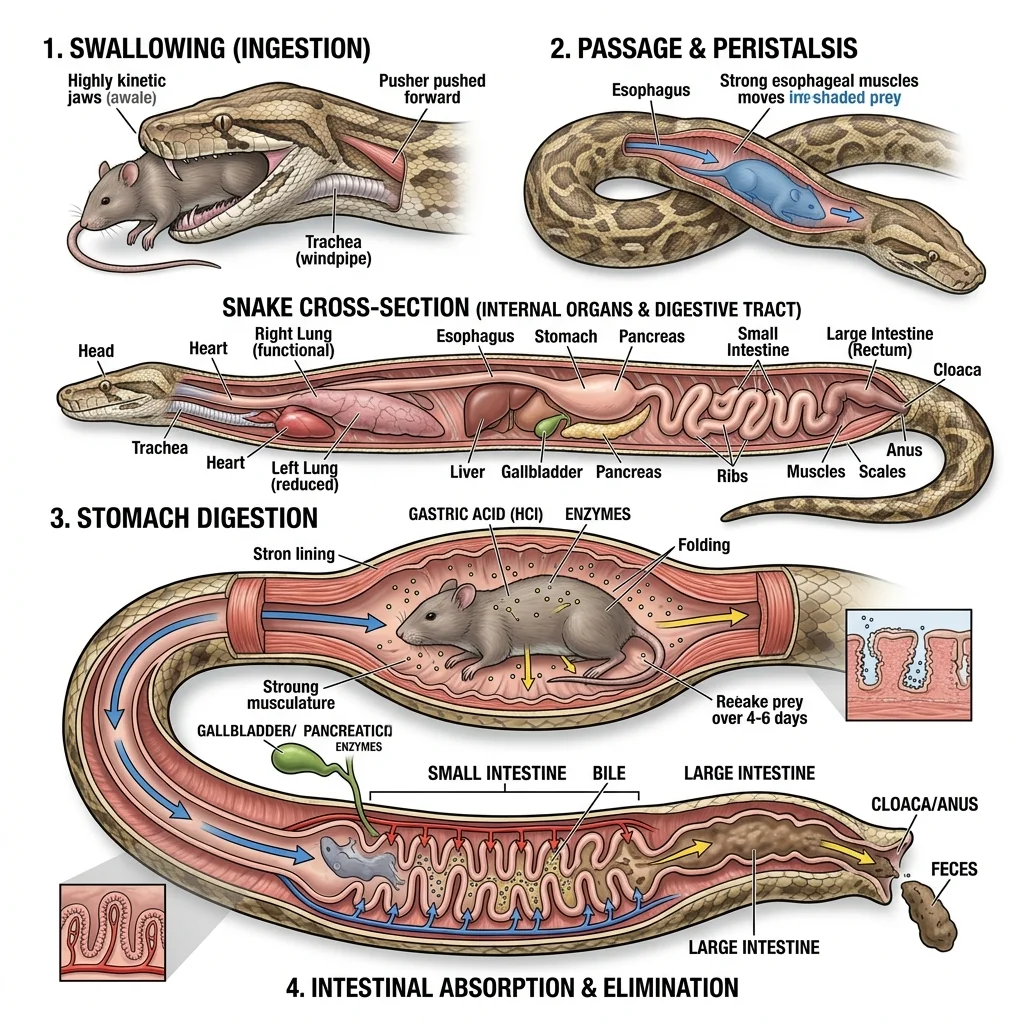
The snake digestive system is a linear tube running from the mouth to the cloaca — elegant in its simplicity, extraordinary in its functional capacity.
The Jaw and Swallowing Apparatus
The snake's jaw is the entry point to one of nature's most remarkable feeding systems. Unlike mammals, snakes do not chew. Their jaw bones are connected by elastic ligaments rather than a rigid symphysis at the chin — this allows the two halves of the lower jaw to spread independently, accommodating prey items of considerable width relative to the snake's head.
The mechanism of swallowing is known as inertial feeding: rather than using a tongue and throat to push food down, snakes "walk" their jaws alternately over stationary prey, using a ratchet-like action where each side of the jaw advances independently. Watch a ball python swallowing in slow motion and you can see each maxillary, palatine, and pterygoid tooth set advancing independently in a wave that moves prey progressively toward the esophagus.
This swallowing process can take anywhere from 1 minute (a small pinky mouse for a hatchling) to 20+ minutes (an adult rat for a large boa). During swallowing, the glottis (breathing opening) is extended from the mouth so the snake can continue breathing despite the prey item blocking its esophagus — an elegant respiratory adaptation.
The Esophagus
The esophagus in snakes is a long, highly distensible tube occupying the anterior third of the body cavity. It is lined with both mucous-secreting glands (for lubrication of the passing prey) and digestive glands that begin predigestion even before the prey reaches the stomach.
Muscular contraction (peristalsis) moves prey through the esophagus toward the stomach. In large pythons and boas, this transit can be observed externally as a visible bulge moving along the snake's body over the course of minutes.
The Stomach
The snake's stomach is located in the mid-body region and is the primary site of initial chemical digestion. It is a highly distensible organ with a highly acidic environment — gastric pH in actively digesting snakes has been measured as low as pH 1.5 to 2.0.
To put this in context: Human gastric acid ranges from pH 1.5 to 3.5. Snake gastric acid, at pH 1.5–2.0, is at the acid end of that spectrum — capable of dissolving bone over extended digestion time. This is why a snake can consume prey whole, including bones, and eliminate primarily soft tissue waste. The hydroxyapatite crystals in bone mineral are slowly dissolved by sustained gastric acid exposure over 48–96 hours of active digestion.
Small Intestine
Following the stomach, partly digested content moves into the small intestine — the primary site of nutrient absorption. In snakes, the small intestine is relatively short compared to body length (another adaptation to infrequent, high-protein meals — a long intestine is energetically expensive to maintain and is unnecessary for animals that eat so infrequently).
The small intestinal wall is lined with villi and microvilli that dramatically increase surface area for absorption. Critically, the density and height of these villi increase dramatically during active digestion and regress between meals — this is part of the Specific Dynamic Action (SDA) phenomenon described in the next section.
Large Intestine and Cloaca
The large intestine absorbs water and compacts waste. Snake waste (referred to as "passing" or defecation) typically includes:
- Dark feces: Predominantly undigested protein waste, microbial mass, and bile-pigmented compounds
- White/cream uric acid: The snake's nitrogenous waste. Unlike mammals (which excrete liquid urea in urine), reptiles excrete insoluble uric acid as a semi-solid — a major water conservation adaptation
- Bones/hair (occasionally): In snakes with faster digestion, incompletely dissolved bone fragments and hair may pass. This is more common in colubrids like corn snakes; pythons typically dissolve bone more completely
Waste exits through the cloaca — a single posterior opening that also serves reproductive functions.
2. Specific Dynamic Action (SDA): The Most Important Concept in Snake Feeding
Specific Dynamic Action (SDA) is the metabolic cost of digesting a meal. In snakes, SDA represents one of the most dramatic metabolic events in the vertebrate world.
What Happens During SDA
When a snake swallows prey, the following organ-level changes occur:
| Organ | Change During SDA |
|---|---|
| Small intestine mass | Increases 40–60% within 48 hours |
| Intestinal villi height | Increases 2–3 fold |
| Liver mass | Increases 20–40% |
| Liver enzyme activity | Increases 5–10 fold |
| Heart mass | Increases 30–40% (in pythons) |
| Metabolic rate | Increases 6–20 fold over resting rate |
| Core body temperature preference | Increases 3–5°F (behavioral fever) |
These changes, documented through landmark studies by Dr. Stephen Secor at the University of Alabama, represent a physiological investment to process a large, infrequent meal. The organs literally grow to handle the incoming nutrient load, then regress back to resting size between meals.
SDA Energy Cost
SDA consumes a significant portion of the energy available in the meal being digested. Estimates from radiotelemetry and respirometry studies put SDA cost at:
- 14–35% of the caloric content of the meal in pythons
- 8–20% in more active colubrid species
- Higher percentage for oversized meals — explaining why oversized prey provides diminishing nutritional return
This is why prey sizing accuracy matters metabolically — oversized prey imposes higher SDA costs relative to nutritional return. See our frozen mice size chart for the size references that optimize this ratio across common prey sizes.
SDA Duration and Practical Implications
The SDA cycle duration varies by snake species and prey size:
| Species Type | Prey Size | SDA Duration |
|---|---|---|
| Ball python (Python regius) | Mouse or small rat | 5–7 days |
| Corn snake (Pantherophis guttatus) | Mouse | 3–5 days |
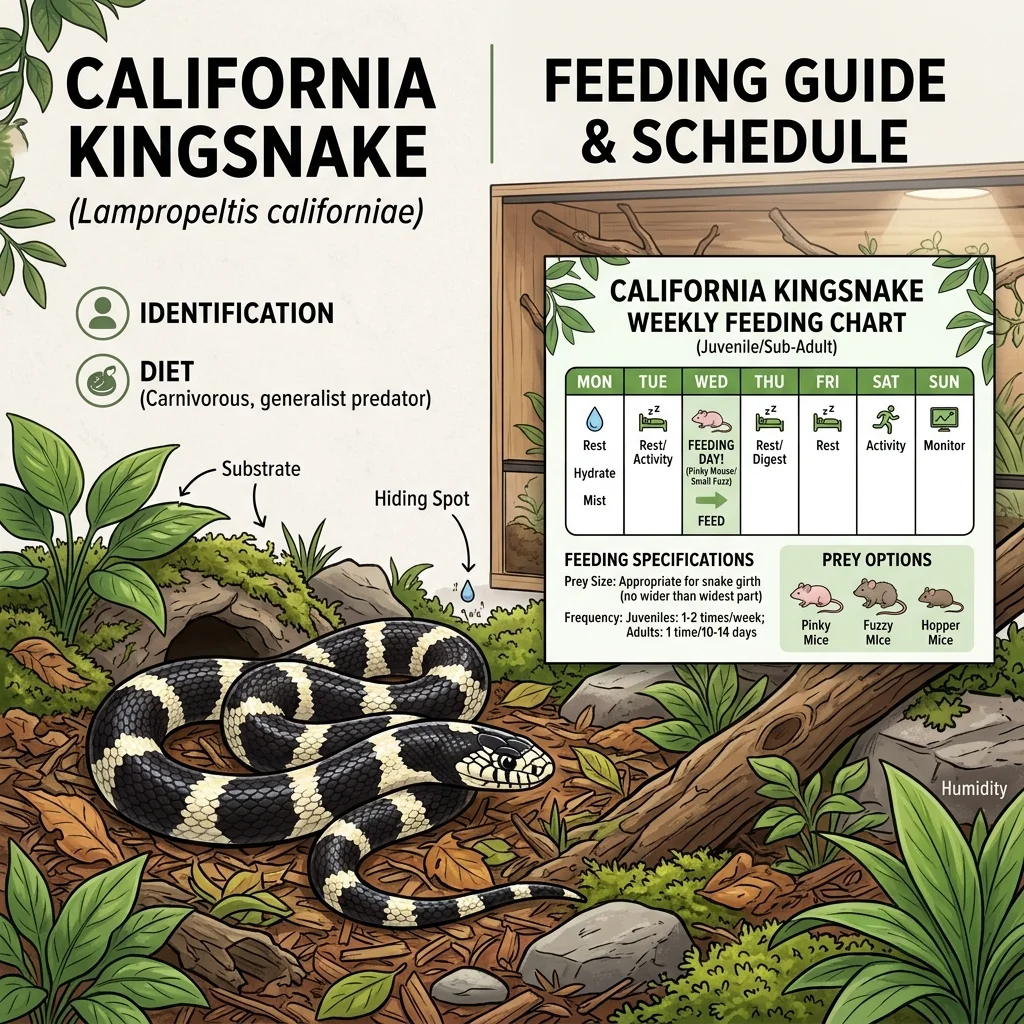
| King snake (Lampropeltis spp.) | Mouse | 3–5 days |
| Boa constrictor | Rat | 6–10 days |
| Burmese python (Python bivittatus) | Rabbit | 10–14 days |
The practical implication for keepers is straightforward: do not feed again before the SDA cycle is complete. Feeding before full SDA completion leads to compounding digestive burden, regurgitation, and over time, nutritional imbalance.
This is why the recommended feeding intervals exist (weekly for colubrids, bi-weekly for pythons) — they're mapped to SDA biology, not arbitrary.
3. How Snake Stomach Acid Works
The question "how strong is snake stomach acid?" comes up frequently, and the answer is genuinely impressive.
pH and Digestive Capacity
As noted above, actively digesting snakes produce gastric acid at pH 1.5–2.0. This highly acidic environment is maintained by specialized parietal cells in the stomach lining and is activated shortly after prey ingestion.
At this pH, the major digestive events are:
- Protein denaturation: Prey protein structures are unfolded, exposing peptide bonds to enzymatic cleavage
- Pepsinogen activation: The enzyme pepsinogen is converted to active pepsin, which begins cleaving protein chains
- Bone dissolution: Extended gastric acid exposure dissolves bone mineral over 48–96 hours
Digestive Enzymes
Beyond hydrochloric acid, snake gastric juice contains:
- Pepsin: A protease (protein-cutting enzyme) that is maximally active at pH 1.5–2.0
- Lipase: Breaks down fats. Begins in the stomach, continues in the small intestine
- Pancreatic enzymes (secreted into the small intestine): Include amylase (carbohydrate digestion), more protease activity, and phospholipases
What Can Snakes Not Digest?
Despite the remarkable digestive capacity, there are materials that consistently resist full digestion:
- Hair/fur: Keratin in mammal fur is highly resistant to proteolysis. Most passes through incompletely digested in faster-digesting colubrids; pythons tend to break down more of it due to longer gastric retention time
- Feathers: Similarly keratin-based; quail and bird prey produces visible feather waste in many species
- Claws and nails: The hardened keratin and calcium of claws often passes partially intact
- Some synthetic contaminants: A concern for wild-caught prey that may have ingested environmental pollutants — another argument for captive-bred frozen feeder prey
4. How Long Does It Take a Snake to Digest?
Digestion time is one of the most-asked questions about snake biology, and the answer depends on multiple variables.
Variables Affecting Digestion Time
Temperature is the dominant factor. Snakes are ectotherms — their metabolic rate scales directly with environmental temperature. At optimal temperatures (80–85°F for most common species), digestion proceeds at full efficiency. Below 70°F, digestion slows dramatically. Below 60°F, it may essentially stop — which is why feeding during brumation or when enclosure temperatures are inadequate creates serious problems.
Prey size is the second major factor. A ball python digesting a pinky mouse will complete the process in 3–4 days. The same ball python digesting a jumbo mouse or small rat may take 6–8 days for complete processing.
Individual metabolic variation is real. Within a species, individuals vary in their baseline metabolic rate, which affects digestion speed. Younger, more active animals generally digest faster than older, heavier adults.
Species differences reflect evolutionary dietary specialization. Sit-and-wait ambush predators (pythons, boas) that evolved for infrequent large meals have longer digestion times than active hunters (king snakes, corn snakes) that evolved for more frequent smaller meals.
Approximate Digestion Times by Species
| Species | Prey Size | Temp | Estimated Complete Digestion |
|---|---|---|---|
| Corn snake | Hopper mouse | 82°F | 3–4 days |
| King snake | Adult small mouse | 82°F | 3–5 days |
| Ball python | Fuzzy mouse | 84°F | 4–6 days |
| Ball python | Adult mouse | 84°F | 5–7 days |
| Boa constrictor | Rat pup | 84°F | 6–9 days |
| Ball python | Adult mouse | 72°F (too cool) | 8–14+ days |
"Complete digestion" here means the point at which the visible prey lump has fully resolved, SDA organ hypertrophy has begun to regress, and the snake has defecated or is about to defecate the indigestible residue.
5. The Role of Temperature in Reptile Digestion
Temperature is not merely a comfort consideration for reptile keeping — it is a physiological requirement for functional digestion.
The Thermal Window for Digestion
Each reptile species has an optimal temperature range for digestive enzyme activity. Outside this range:
-
Below the minimum threshold (~65°F for most common species): Digestive enzyme activity falls to near zero. Prey may sit in the stomach for weeks without being processed, eventually rotting and causing severe digestive illness. This is why feeding during brumation, or in an insufficiently heated enclosure, can be genuinely life-threatening.
-
Within the optimal range (typically 78–88°F for the warm end): Digestive processes proceed at full efficiency. SDA is completed in the expected time window.
-
Above the maximum threshold (~95°F+ for most species): Enzyme denaturation begins. Overheated snakes also experience systemic stress that can halt digestion.
Why Temperature Gradients Matter
Captive snakes should always have access to a thermal gradient — a warm end and a cool end in their enclosure. After eating, snakes preferentially thermoregulate in the warmer end to maximize digestive enzyme activity. This is behavioral fever: the snake actively seeks higher temperatures to speed up its immune response (digestion involves handling potential pathogens) and enzymatic processing.
An enclosure without an adequate warm end — 82–86°F for most common species — forces snakes to digest at suboptimal temperatures, extending SDA duration and increasing regurgitation risk.
Thermal Requirements by Common Species
| Species | Warm End | Cool End | Optimal for Digestion |
|---|---|---|---|
| Ball python | 88–92°F | 76–80°F | 84–88°F |
| Corn snake | 85–88°F | 72–76°F | 82–86°F |
| King snake | 85–88°F | 70–75°F | 82–86°F |
| Boa constrictor | 88–92°F | 76–80°F | 84–88°F |
6. The Snake Digestive Cycle: From Swallow to Elimination
Here is the complete digestive timeline for a ball python consuming an appropriately sized frozen/thawed mouse:
Hours 0–2: Swallowing and Esophageal Transit
- Snake locates prey, strikes, constricts or holds
- Jaw apparatus begins inertial feeding
- Prey moves through esophagus via peristalsis
- Glottis extended for continuous breathing
Hours 2–12: Gastric Acid Ramp-Up
- Prey arrives in stomach
- Parietal cells begin secreting hydrochloric acid
- Gastric pH drops from resting (~7) toward active digestion level (~1.5–2.0)
- Pepsin activated, begins protein denaturation
- Prey lump visible externally in midsection
Hours 12–48: Peak Gastric Digestion (SDA Peak)
- Metabolic rate reaches 6–20× resting baseline
- Organ hypertrophy at maximum
- Prey lump remains visible but begins softening
- Snake seeks warmest available microhabitat (behavioral thermoregulation)
- Critical window: Do not handle during this period — regurgitation risk is highest
Hours 48–96: Gastric Completion and Small Intestinal Absorption
- Stomach has processed most soft tissue
- Partially digested material moves into small intestine
- Nutrient absorption begins: amino acids, fatty acids, vitamins, minerals
- Visible prey lump largely resolved
- SDA organ hypertrophy begins to regress
Days 4–7: Completion and Defecation
- Small intestinal absorption complete
- Waste compacted in large intestine
- Uric acid formed and added to waste
- Snake defecates (feces + uric acid mass)
- SDA complete — snake returns to resting metabolic state
- Enclosure temperature preference may slightly decrease
Days 7–14: Appetite Building
- Resting metabolic state re-established
- Digestive organs regressed to resting size
- Appetite hormones begin signaling food-seeking behavior
- Snake ready for next feeding attempt
7. Regurgitation: When Digestion Fails
Regurgitation — the voluntary expulsion of incompletely digested or unprocessed prey — is the most serious acute feeding-related event in captive snakes. It must be distinguished from true vomiting (rare in snakes) and understood as a sign that something in the digestive process has gone wrong.
Common Causes of Regurgitation
| Cause | Mechanism | Solution |
|---|---|---|
| Handling too soon post-feeding | Physical disturbance during SDA peak triggers active expulsion | No handling for 48–72 hours post-feeding |
| Prey too large | Stomach cannot process; prey expelled | Reduce prey size by one step |
| Enclosure too cold | Digestive enzymes inactive; prey putrefies | Verify and correct temperatures |
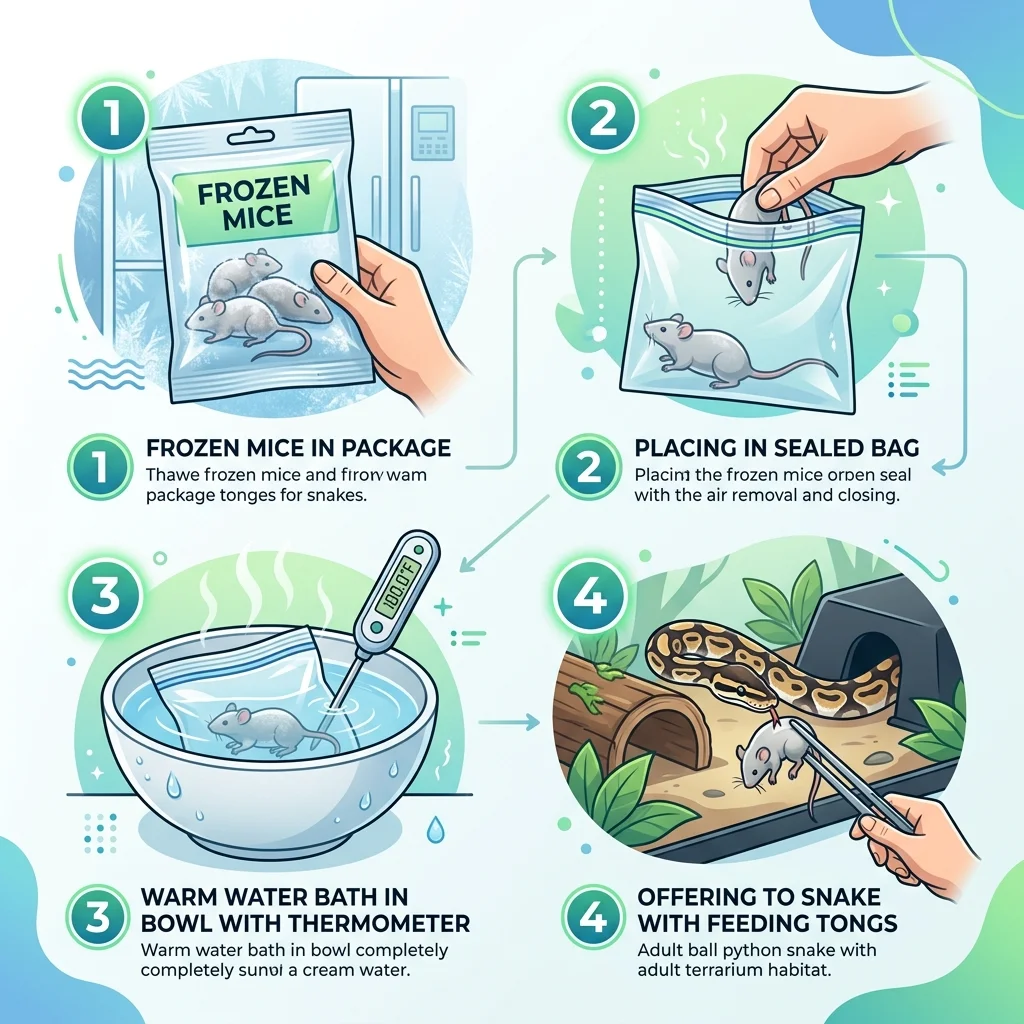
| Prey offered too hot | Prey surface bacteria multiply rapidly; toxin load triggers expulsion | Keep prey below 105°F |
| Respiratory infection | Upper respiratory infections impair swallowing muscle coordination | Veterinary evaluation |
| Parasites | Gastrointestinal parasites disrupt digestion | Fecal exam and treatment |
Post-Regurgitation Protocol
After a regurgitation event, do not offer food for 2–4 weeks minimum. The esophageal and gastric tissues have been stressed by the regurgitation event (gastric acid contact with the esophageal lining is corrosive). The digestive system needs time to recover.
When feeding resumes, offer prey 25–50% smaller than the item that was regurgitated, at optimal temperature. If regurgitation recurs, veterinary evaluation is warranted — chronic regurgitation can indicate a serious underlying condition.
For the complete guide to snake regurgitation causes and treatment, see our snake regurgitation guide.
8. How Snake Digestion Differs from Other Reptiles
The snake digestive system, while sharing the basic reptilian blueprint, is specialized in ways that distinguish it from lizards, chelonians (turtles/tortoises), and crocodilians.
Compared to Lizards
Most lizards are more frequent feeders with shorter digestion windows — their SDA costs are lower (typically 5–12% of meal energy vs 14–35% in pythons) and their digestive anatomy includes a larger intestine relative to body size. Blue-tongued skinks, for example, are omnivores that digest plant material as well as animal prey — requiring cellulase-producing gut microbiome bacteria that snakes lack entirely.
For more on lizard digestion, see our guide to blue-tongued skink diet.
Compared to Crocodilians
Crocodilian digestive physiology is the closest parallel to snake digestion in terms of gastric acid strength and bone-dissolving capacity — crocodile gastric juice at pH 1.5–2.0 is essentially equivalent to python acid. However, crocodilians have a two-chambered stomach (similar in concept to avian gizzards) that provides mechanical processing in addition to chemical digestion.
The Reptilian vs Mammalian Digestive Tradeoff
Reptile digestive systems represent a fundamentally different metabolic strategy than mammals: infrequent large meals → dramatic organ upregulation → efficient processing → extended fasting period. Mammals maintain continuous high metabolic rates requiring regular fueling, with continuously active digestive systems.
Neither approach is "better" — they're adaptations to different ecological niches. But understanding the reptilian approach helps keepers avoid the most common mistake: trying to feed snakes on mammalian schedules (daily or every-other-day) that are biologically incompatible with reptile digestive physiology.
9. Practical Implications for Feeding Management
The biology in this guide translates directly into the following keeper practices:
Mandatory Post-Feeding Handling Restriction
Do not handle your snake for a minimum of 48 hours after feeding. For large pythons digesting large prey, extend this to 72 hours. The SDA peak at 12–48 hours is when regurgitation risk is highest, and physical disturbance during this period activates a stress response that can override digestion.
Temperature Verification Is Non-Negotiable
Your enclosure's warm end should reach 82–88°F (species-dependent) before and after every feeding. Use a temperature gun or reliable digital probe — analog dial thermometers are notoriously inaccurate and should not be trusted for this purpose.
Weight-Based Feeding Intervals
Rather than feeding on a rigid calendar schedule, experienced keepers track:
- The date of last successful feeding
- The date of defecation post-feeding
- Body weight trend (monthly weighing)
Defecation typically signals SDA completion — after your snake defecates following a meal, it is metabolically "ready" for the next offering. Using defecation as a proxy for feeding readiness is more biologically accurate than a fixed calendar interval.
Understanding the "Not Eating" Period
New keepers frequently panic when a snake doesn't eat for 2–3 weeks. In most cases, the snake is simply in the post-feeding fasting period, in shed, or in seasonal behavioral reduction. A snake that is maintaining body weight, shows normal behavior outside of feeding, and has a healthy appearance is not in danger from a 2–3 week feeding gap.
For complete guidance on snake feeding frequency across all common species, see our how often to feed a snake guide.
10. Frequently Asked Questions About Snake Digestion
How strong is snake stomach acid?
Snake gastric acid during active digestion reaches pH 1.5–2.0, comparable to the most acidic range of human gastric acid. At this pH, snake gastric juice dissolves bone mineral over 48–96 hours of sustained contact. The acid is produced by parietal cells in the stomach lining and activates specialized digestive enzymes (primarily pepsin) that break down prey protein.
Can a snake digest bones?
Yes. The combination of sustained gastric acid (pH 1.5–2.0) and extended gastric retention time allows snakes to dissolve most bone mineral content. Larger, denser bones (femur, pelvis) may not be fully dissolved and pass in the waste as bone fragments. Hair and claws also typically pass incompletely digested.
What happens if a snake can't digest its food?
If temperatures are too low, if the prey is too large, or if the snake is ill, the digestive process may fail. Signs of digestive failure include: prey lump that remains visible and hard for more than 7 days (at correct temperatures), lethargy beyond normal post-feeding torpor, discomfort when palpating the midsection, and ultimately regurgitation. Persistent digestive failure requires veterinary evaluation.
How long after eating can I handle my snake?
A minimum of 48 hours for most species. For large pythons that have eaten a particularly large meal, 72 hours is safer. The key indicator is the visible prey lump — once the lump has resolved and the snake is back to normal behavior and activity level, handling is safe.
Why do snakes need specific temperatures to digest?
Snakes are ectotherms — their body temperature and thus their metabolic rate is set by the environment. The digestive enzymes (pepsin, lipase, pancreatic enzymes) have an optimal temperature range that corresponds to the snake's preferred body temperature during digestion. Below this range, enzyme activity falls dramatically and digestion essentially stalls.
Summary: Key Facts About the Reptile Digestive System
- Snake digestion begins with inertial feeding — jaw bones "walk" over prey without chewing
- The stomach produces gastric acid at pH 1.5–2.0, capable of dissolving bone over days
- Specific Dynamic Action (SDA) causes dramatic organ upregulation during each meal — up to 40–60% intestinal mass increase
- SDA costs 14–35% of the meal's total caloric content in pythons
- Complete digestion takes 3–7 days for most common pet snakes at optimal temperatures
- Temperature is the single most critical variable — digestion stalls below ~65°F
- Do not handle snakes within 48 hours of feeding to avoid regurgitation
- Defecation post-meal signals SDA completion and readiness for the next feeding
Understanding reptile digestion transforms how you approach every feeding decision — from prey sizing to temperature management to handling schedules. For more on how to apply this knowledge to specific species feeding protocols, explore our ball python feeding schedule guide and our corn snake feeding guide.