Key Takeaway
The definitive guide to snake feeding frequency. Species-specific charts for ball pythons, corn snakes, boas, king snakes, hognose snakes, milk snakes, and more — with age-based schedules and seasonal adjustment guidance.
Table of Contents
- 1. The Biology of Snake Feeding Frequency
- Metabolic Rate Variation
- Specific Dynamic Action (SDA)
- Body Size and Meal Size Relationship
- Age and Growth Phase
- 2. Master Feeding Frequency Chart by Species
- Ball Python (Python regius)
- Corn Snake (Pantherophis guttatus)
- Boa Constrictor (Boa constrictor)
- King Snake (Lampropeltis spp.)
- Milk Snake (Lampropeltis triangulum and related spp.)
- Western Hognose Snake (Heterodon nasicus)
- Rat Snake (Pantherophis spp. — includes Black Rat Snake, Texas Rat Snake, etc.)
- Garter Snake (Thamnophis spp.)
- Blue-Tongued Skink (Tiliqua spp.)
- 3. The Age-Based Reduction: The Most Important Adjustment
- 4. The 5% and 10% Rule: Complementing Frequency with Correct Prey Size
- 5. Seasonal Adjustments: When Normal Rules Don't Apply
- Species Most Likely to Seasonally Fast
- 6. Signs You Are Feeding Too Often
- 7. Signs You Are Feeding Too Infrequently
- 8. Building a Feeding Log
- Frequently Asked Questions
- Conclusion
- 9. Species You Didn't Know Could Eat Frozen Feeders
- 10. Winter and Summer: Managing Seasonal Feeding Changes
"How often should I feed my snake?" is one of the most searched questions in reptile keeping — and one of the most incompletely answered. Most answers you'll find online give you a single frequency for a species without accounting for age, body weight, season, or the individual snake's metabolism. This results in keepers underfeeding juveniles in critical growth phases or overfeeding adults into obesity-related health problems.
The correct answer is: it depends on the species, the life stage, and the time of year — and this guide gives you the complete, species-specific answer for every major pet snake.
At Loxahatchee Rodents, with 25+ years of breeding experience and Bill Galloway's background as an Assistant Curator at Palm Beach Zoo, we have developed feeding schedules based on both zoological nutritional science and practical experience with thousands of individual animals. This guide compiles everything we know into a single, comprehensive reference.
1. The Biology of Snake Feeding Frequency
Before the charts, a brief foundation of why different species require different feeding frequencies.
Metabolic Rate Variation
Snakes vary enormously in their metabolic rates based on evolutionary origin. Tropical species from stable-climate environments (ball pythons, boa constrictors) typically have lower metabolic rates than temperate North American species (corn snakes, king snakes, garter snakes) that evolved with more variable food availability.
A higher metabolic rate means faster digestion, faster nutrient turnover, and more frequent feeding requirements. A lower metabolic rate means slower digestion, greater tolerance of fasting, and less frequent feeding needs.
Specific Dynamic Action (SDA)
After every meal, a snake's entire digestive system undergoes Specific Dynamic Action (SDA) — a temporary massive upregulation of digestive organs and metabolic processes to break down the meal. This process takes:
- 3–5 days at optimal temperatures for small prey items (pinkies, fuzzies)
- 5–7 days for medium prey
- 7–10 days for large prey items in heavy-bodied constrictors
Offering another meal before SDA is complete typically results in refusal, regurgitation, or digestive stress. This is why feeding intervals have a physiological basis — they're not arbitrary.
Body Size and Meal Size Relationship
Larger snakes with heavier prey items have longer SDA cycles. A ball python consuming a rat that equals 10% of its body weight requires significantly longer to digest than a corn snake eating a mouse of the same proportion. This explains why adult boas are fed monthly while corn snakes are fed weekly.
Age and Growth Phase
Juveniles in active growth phases need more frequent, proportionally larger meals to fuel both maintenance metabolism and tissue growth. As animals reach adult size, the growth component disappears and frequency can be reduced. This age-based reduction in feeding frequency is one of the most important adjustments keepers need to make — many adults are chronically overfed because the keeper never reduced from the juvenile schedule.
2. Master Feeding Frequency Chart by Species
Ball Python (Python regius)
| Life Stage | Age | Weight | Frequency | Prey Size |
|---|---|---|---|---|
| Hatchling | 0–6 months | 50–200g | Every 7 days | Pinky to Fuzzy Rat (5–15g) |
| Early Juvenile | 6–12 months | 200–400g | Every 7–10 days | Rat Pup to Weanling (20–40g) |
| Juvenile | 12–24 months | 400–800g | Every 10 days | Weanling to Small Rat (35–55g) |
| Sub-Adult | 2–3 years | 800g–1.5kg | Every 14 days | Small Rat (45–75g) |
| Adult | 3+ years | 1.5kg+ | Every 14–21 days | Medium Rat (80–120g) |
| Seasonal Fast | Oct–Mar | — | Offer every 14 days; accept refusals | — |
For detailed troubleshooting and a full schedule guide, see our ball python feeding schedule guide.
Corn Snake (Pantherophis guttatus)
| Life Stage | Age | Weight | Frequency | Prey Size |
|---|---|---|---|---|
| Hatchling | 0–3 months | 8–15g | Every 5–7 days | Pinky Mouse (2–4g) |
| Juvenile | 3–9 months | 15–50g | Every 7 days | Fuzzy Mouse (5–9g) |
| Sub-Adult | 9–18 months | 50–150g | Every 7 days | Hopper Mouse (10–18g) |
| Young Adult | 18 months–3 years | 150–400g | Every 7–10 days | Adult Small Mouse (19–28g) |
| Adult | 3+ years | 350–900g | Every 10–14 days | Adult Medium Mouse (30–45g) |
For the complete corn snake feeding guide including troubleshooting, see our corn snake feeding guide.
Boa Constrictor (Boa constrictor)
| Life Stage | Age | Weight | Frequency | Prey Size |
|---|---|---|---|---|
| Hatchling | 0–6 months | 60–500g | Every 7–10 days | Hopper–Adult Mouse / Rat Pinky |
| Juvenile | 6–18 months | 500g–2.0kg | Every 10–14 days | Rat Pup to Small Rat |
| Sub-Adult Male | 1.5–4 years | 2–6kg | Every 14–21 days | Medium Rat (150–200g) |
| Sub-Adult Female | 1.5–4 years | 3–9kg | Every 14–21 days | Large Rat (250–400g) |
| Adult Male | 4+ years | 4–8kg | Every 3–4 weeks | Medium Rat (150–250g) |
| Adult Female | 4+ years | 7–15kg | Every 3–4 weeks | Large–Jumbo Rat (350–600g) |
For the complete boa constrictor feeding chart with detailed age/sex breakdown, see our boa constrictor feeding chart.
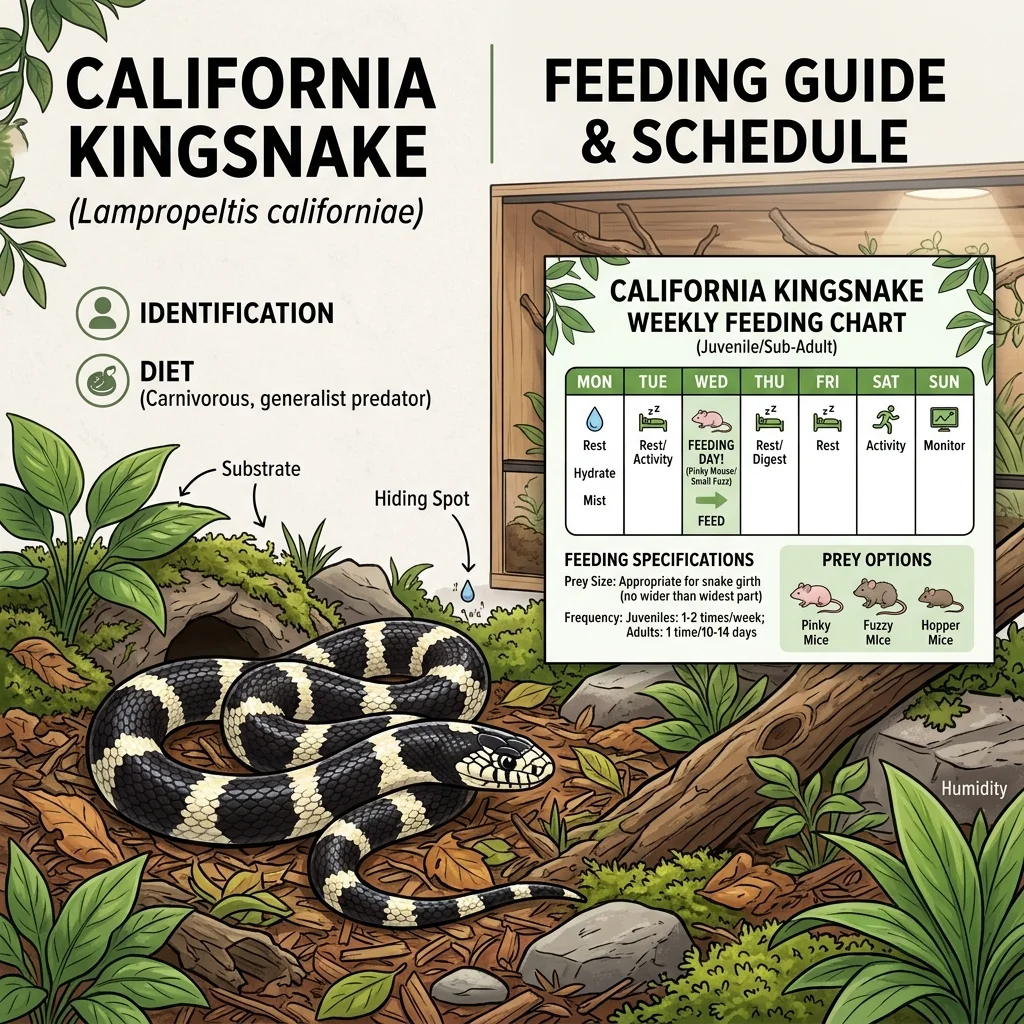
King Snake (Lampropeltis spp.)
| Life Stage | Age | Weight | Frequency | Prey Size |
|---|---|---|---|---|
| Hatchling | 0–3 months | 10–25g | Every 5–7 days | Pinky Mouse |
| Juvenile | 3–9 months | 25–100g | Every 7 days | Fuzzy–Hopper Mouse |
| Sub-Adult | 9–24 months | 100–350g | Every 7–10 days | Hopper–Small Adult Mouse |
| Adult | 2+ years | 300–900g+ | Every 10–14 days | Adult Small–Medium Mouse |
For the full king snake guide with species chart, see our king snake feeding guide.
Milk Snake (Lampropeltis triangulum and related spp.)
| Life Stage | Age | Weight | Frequency | Prey Size |
|---|---|---|---|---|
| Hatchling | 0–3 months | 5–20g | Every 5–7 days | Pinky Mouse (2–4g) |
| Juvenile | 3–9 months | 20–80g | Every 7 days | Fuzzy Mouse (5–8g) |
| Sub-Adult | 9–24 months | 80–250g | Every 7–10 days | Hopper Mouse (10–15g) |
| Adult | 2+ years | 200–700g | Every 10–14 days | Adult Small Mouse (20–35g) |
For the complete milk snake guide including techniques for shy feeders, see our milk snake feeding guide.
Western Hognose Snake (Heterodon nasicus)
| Life Stage | Sex | Weight | Frequency | Prey Size |
|---|---|---|---|---|
| Hatchling | Any | 5–10g | Every 5–7 days | Pinky Mouse (2–4g) |
| Juvenile | Any | 10–35g | Every 7 days | Pinky–Fuzzy Mouse |
| Adult Male | Male | 60–200g | Every 10–14 days | Hopper–Small Adult Mouse |
| Adult Female | Female | 150–500g | Every 7–10 days | Adult Small–Medium Mouse |
For the complete guide including toad scenting and transition techniques, see our hognose snake feeding guide.
Rat Snake (Pantherophis spp. — includes Black Rat Snake, Texas Rat Snake, etc.)
| Life Stage | Age | Weight | Frequency | Prey Size |
|---|---|---|---|---|
| Hatchling | 0–6 months | 10–30g | Every 5–7 days | Pinky Mouse |
| Juvenile | 6–18 months | 30–150g | Every 7 days | Fuzzy–Hopper Mouse |
| Sub-Adult | 18 months–3 years | 150–500g | Every 7–10 days | Adult Small–Medium Mouse |
| Adult | 3+ years | 400g–1.5kg | Every 10–14 days | Adult Medium–Large Mouse |
Rat snakes grow large (adults reach 4–6 feet) and eventually benefit from adult large mice or small weanling rats. The transition criteria are the same as for other colubrids: switch to rats when the snake consistently requires prey over 50g and is a heavy-bodied individual.
Garter Snake (Thamnophis spp.)
Garter snakes are unique in the pet snake world because they consume a very different diet — small fish, earthworms, and occasionally pinkies are their primary food sources. They are not traditional frozen rodent feeders.
| Life Stage | Frequency | Prey |
|---|---|---|
| Hatchling–Juvenile | Every 3–4 days | Earthworms, pinky mice (occasional), small fish |
| Adult | Every 5–7 days | Earthworms, small fish strips, occasional pinkies |
For garter snakes, pinkies can be used as an occasional supplement but should not be the primary food source — whole pinkies are too high in fat and protein for a species evolved on invertebrates and fish.
Blue-Tongued Skink (Tiliqua spp.)
Blue-tongued skinks are omnivores, not snakes — but they are reptile feeder rodent consumers and many keepers of this species use pinky mice as a protein supplement.
| Life Stage | Frequency (Overall Diet) | Rodent Component |
|---|---|---|
| Juvenile | Daily to every 2 days | Pinkies: once per week maximum |
| Adult | Every 2–3 days | Pinkies: once every 7–10 days |
For a complete blue-tongued skink diet guide covering all food categories, see our blue-tongued skink diet guide.
3. The Age-Based Reduction: The Most Important Adjustment
The single most impactful change most keepers need to make to their feeding schedule is the age-based frequency reduction as snakes reach adulthood.
The pattern repeats across virtually all species:
- Juveniles need frequent feeding to support active growth
- Adults need significantly less frequent feeding to maintain body weight without developing obesity
Here is the reduction schedule summarized across all major species:
| Species | Juvenile Frequency | Adult Frequency | Reduction Factor |
|---|---|---|---|
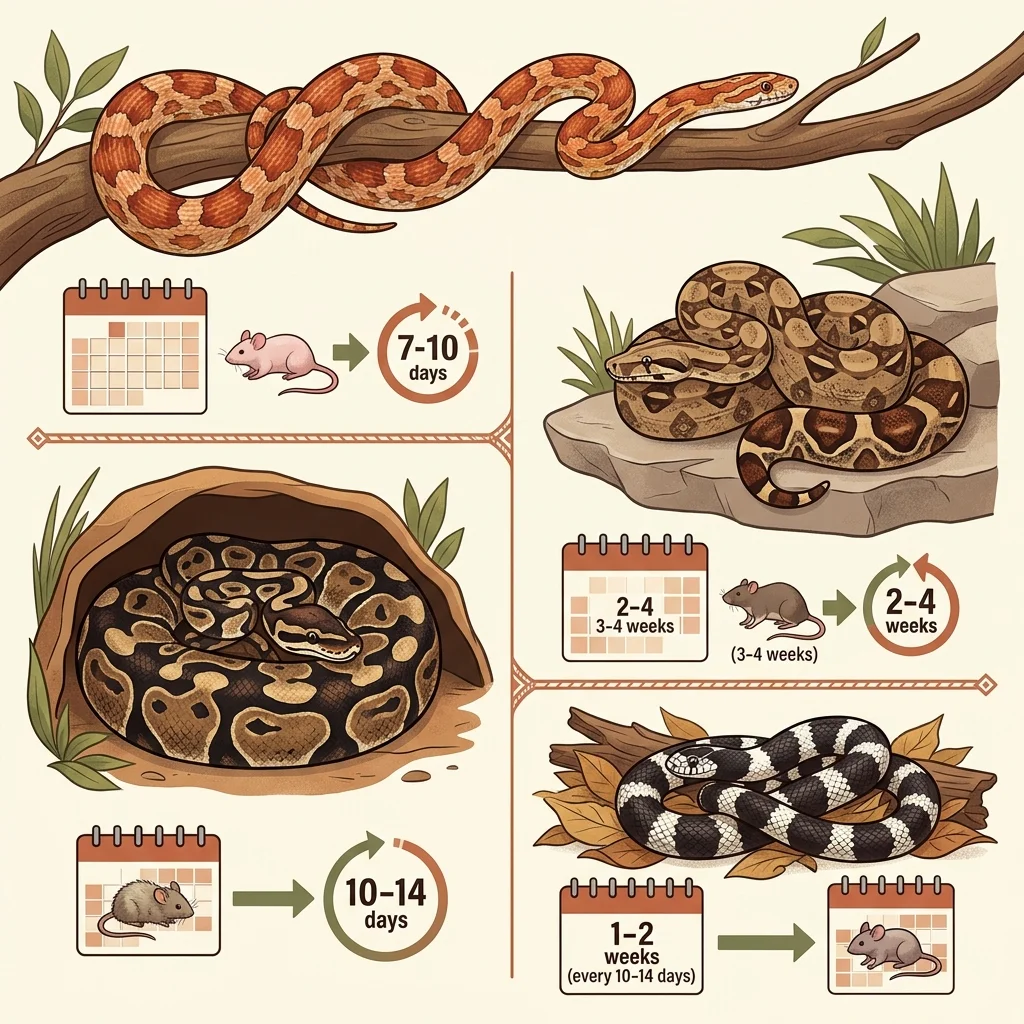
| Ball Python | Every 7 days | Every 14–21 days | 2–3x less frequent |
| Corn Snake | Every 7 days | Every 10–14 days | 1.5–2x less frequent |
| Boa Constrictor | Every 7–10 days | Every 3–4 weeks | 3–4x less frequent |
| King Snake | Every 7 days | Every 10–14 days | 1.5–2x less frequent |
| Hognose Snake | Every 7 days | Every 10–14 days | 1.5–2x less frequent |
If you have been feeding your adult snake on the juvenile schedule, gradually stepping down is better than abruptly reducing — cut frequency by one step (e.g., from every 7 days to every 10 days) and hold that for 3–4 feedings before reducing again.
4. The 5% and 10% Rule: Complementing Frequency with Correct Prey Size
Frequency alone doesn't determine nutritional adequacy — prey size matters equally. The two variables work together:
For juveniles: 10% of body weight per feeding at the juvenile frequency → appropriate growth rate
For adults: 5% of body weight per feeding at the adult frequency → healthy weight maintenance
Example:
- 800g juvenile ball python: 10% = 80g per meal, every 10 days
- 1,800g adult ball python: 5% = 90g per meal, every 14–21 days
Note that the actual meal weight is similar between a large juvenile and a moderate adult — but the frequency is the key variable that differs.
For the complete prey sizing reference, see our rat size chart by weight in grams and frozen mice size chart.
5. Seasonal Adjustments: When Normal Rules Don't Apply
All snake species show some degree of seasonal variation in feeding behavior, even in captivity. Understanding this prevents unnecessary alarm during normal seasonal fasts.
Species Most Likely to Seasonally Fast
| Species | Fast Period | Typical Duration | Notes |
|---|---|---|---|
| Ball Python | October–March | 4–16 weeks | Adults most affected; highly variable |
| Boa Constrictor | November–February | 2–8 weeks | Milder than ball pythons in consistent heat |
| Corn Snake | October–February | 2–6 weeks | More variable; some individuals don't fast |
| King Snake | October–March | 4–12 weeks | Stronger brumation drive than corn snakes |
| Milk Snake | October–February | 2–8 weeks | Eastern subspecies more affected than tropical |
| Hognose Snake | October–February | 4–10 weeks | Strong seasonal instinct |
What to do during a seasonal fast:
- Continue offering food on the normal schedule
- Remove uneaten prey after 30–45 minutes without forcing interaction
- Monitor body weight monthly — the snake should not lose more than 5–10% of pre-fast body weight
- Resume normal feeding as the fast ends (typically spontaneously in February–March)
What not to do:
- Force-feed (dangerous without veterinary supervision)
- Increase feeding frequency before the fast (this doesn't prevent the fast)
- Drastically alter husbandry in response to the fast (this adds stress without benefit)
6. Signs You Are Feeding Too Often
These physical and behavioral signs indicate over-feeding regardless of whether you're following the "correct" frequency chart:
Physical signs:
- Visible skin folds on the sides (loose skin when the snake is resting)
- Very thick, cylindrical tail with no taper
- Rounded, "blocky" body profile from above
- Sluggishness beyond normal post-feeding digestion period
Behavioral signs:
- Regurgitation occurring more than once per year (see our snake regurgitation guide)
- Refusal of appropriately-sized prey after short intervals (the digestive system isn't ready)
- Unusually long digestion periods — prey lump visible for more than 7 days
If you observe these signs, reduce prey size (not frequency, initially) by one category and monitor over 2–3 months.
7. Signs You Are Feeding Too Infrequently
Physical signs:
- Visible spine through the skin (particularly concerning)
- Concave or "pinched" lateral body profile
- Prominent ribs visible through the skin
- Tail that narrows sharply at the base rather than tapering gradually
Behavioral signs:
- Excessive activity and restlessness (hunger-driven search behavior)
- Very fast feeding response with no hesitation — always immediately accepting prey
- Rapid, enthusiastic consumption of prey without the normal investigatory behavior
If you observe significant weight loss signs, consult an exotic veterinarian before increasing feeding — weight loss can also be caused by illness, parasites, or metabolic disease, and adding food without addressing the underlying cause won't resolve the problem.
8. Building a Feeding Log
The most important tool for answering "how often should I feed my snake?" for your specific individual — not the average of the species — is a feeding log.
Track at minimum:
- Date of every feeding attempt
- Result: Accepted / Refused / Strike-and-release
- Prey type, size category, and weight (grams)
- Snake weight (weighed monthly)
- Notes: Pre-shed, seasonal, handling history, environmental changes
After 6 months of data, you will have a precise picture of your individual animal's feeding rhythm — which will be more accurate than any chart, because it is specific to your animal.
For detailed guidance on setting up and interpreting a feeding log, see our ball python feeding schedule guide (the principles apply equally to all species).
Frequently Asked Questions
Q: My pet store told me to feed my ball python every 5 days. Is that right? A: No. Every 7 days is the minimum for hatchlings; adults should be fed every 14–21 days. Every 5 days is power-feeding territory that leads to long-term health damage. The pet store recommendation is unfortunately common but physiologically incorrect.
Q: I went on vacation and missed two feeding sessions. Did I hurt my snake? A: Almost certainly not. Healthy adult snakes of most pet species can easily fast for 2–4 weeks without any health impact. Missing two sessions is a minor event in the life of a snake that evolved to occasionally fast for months.
Q: Can I feed my snake every day if it's very hungry? A: No. Even a very hungry snake needs the SDA cycle to complete between meals. Daily feeding causes chronic digestive stress, hepatic lipidosis, and rapid-onset obesity. Follow the schedules in this guide.
Q: My snake is much larger than average for its age. Should I feed more or less often? A: More often is not the solution. Increase prey size (use our rat size chart by weight in grams to calculate 5% or 10% of actual body weight) while keeping the same frequency. A larger meal at the correct interval is better than more frequent smaller meals.
Conclusion
The correct feeding frequency for your snake is determined by its species, its life stage, its body weight, and the time of year. Use the species-specific charts in this guide as your baseline, monitor body condition monthly, keep a feeding log, and adjust seasonally based on your individual animal's patterns.
For additional detailed resources by species, explore our ball python not eating guide, corn snake feeding guide, boa constrictor feeding chart, king snake feeding guide, milk snake feeding guide, and hognose snake feeding guide. For prey sizing, see our frozen mice size chart and rat size chart by weight in grams.
Written by Bill Galloway, Former Assistant Curator at Palm Beach Zoo and co-founder of Loxahatchee Rodents.
9. Species You Didn't Know Could Eat Frozen Feeders
Beyond the commonly discussed species, several reptile species benefit from frozen feeder mice that many keepers don't initially consider:
Blue-Tongued Skinks (Tiliqua spp.) Omnivores that can incorporate pinky mice as a protein supplement — no more than once per week for adults. Frozen pinkies are ideal since they avoid the disease transmission risk of live prey. See our blue-tongued skink diet guide for complete guidance on their omnivorous diet.
Monitor Lizards (small to medium species) Savannah monitors (Varanus exanthematicus), Acanthurus monitors, and similar species can accept frozen-thawed mice as part of a varied diet. They should not be fed exclusively on mice — varied protein sources including insects and crustaceans are important for complete nutrition.
Large Skinks and Tegus Argentine black and white tegus (Salvator merianae) and similar species accept frozen mice as part of their diet. Tegus specifically benefit from the calcium content of whole prey bones.
For all feeder rodent sizing reference including mice and rats, see our frozen mice size chart and rat size chart by weight in grams.
10. Winter and Summer: Managing Seasonal Feeding Changes
The seasonal feeding variation is one of the most important things to understand and plan for. Here is a practical seasonal feeding calendar:
September–October (Transition to Slower Period):
- Watch for reduced feeding interest as days shorten and temperatures cool
- Do not panic if ball pythons and king snakes begin refusing
- Continue offering food on schedule, but reduce prey size slightly to account for lower metabolic demand
- This is a good time to do a thorough enclosure temperature audit
November–February (Seasonal Fast Period):
- Most adult pythons, boas, and many colubrids slow or stop feeding
- Continue offering food every 2–3 weeks; accept refusals gracefully
- Monitor body condition monthly — weight loss greater than 10% of pre-fast body weight warrants attention
- Hatchlings and juveniles (under 1 year old) should be encouraged to continue feeding during this period; their growth stage makes long fasts riskier
March–April (Spring Return to Feeding):
- Most species spontaneously resume feeding as days lengthen
- First post-fast meal: offer one size smaller than usual, wait 7 extra days before the second meal
- Spring is the peak time to attempt prey size upgrades and dietary transitions
May–August (Peak Feeding Period):
- Highest reliability for all species
- Best time for: live-to-frozen transitions, prey size increases, introducing new prey types
- Take advantage of peak feeding drive; this is when reluctant feeders are most likely to accept something new
For species-specific seasonal guidance, see our ball python feeding schedule, corn snake feeding guide, and boa constrictor feeding chart.
Written by Bill Galloway, Former Assistant Curator at Palm Beach Zoo and co-founder of Loxahatchee Rodents.