Key Takeaway
Is your ball python refusing food? This expert guide covers every reason a ball python stops eating — from shedding and seasonal changes to illness — with actionable solutions for each cause.
Table of Contents
- 1. First: How Long Is Too Long Without Eating?
- 2. Cause #1: Shedding (Most Common Cause)
- 3. Cause #2: Seasonal Fasting (October–February)
- 4. Cause #3: Incorrect Temperatures
- 5. Cause #4: Inadequate Humidity
- 6. Cause #5: Inadequate Hides
- 7. Cause #6: Recent Stress Events
- 8. Cause #7: Prey Presentation Issues
- 9. Cause #8: Reproductive Behavior
- 10. Cause #9: Illness (When to See a Vet)
- 11. Practical Step-by-Step Troubleshooting Protocol
- Frequently Asked Questions
- Conclusion
Of all the questions we receive at Loxahatchee Rodents, the most common by far is: "My ball python hasn't eaten in [X] weeks — what do I do?" Ball pythons (Python regius) are notorious for their willingness to go on prolonged feeding strikes, sometimes lasting months, even in an otherwise healthy, well-cared-for snake.
The good news: in the vast majority of cases, a ball python that stops eating is doing so for a completely normal, manageable reason. This guide walks through every documented cause of feeding refusal in ball pythons, from the mundane to the medically serious, with specific, actionable solutions for each. For additional expert guidance, refer to the Association of Reptilian and Amphibian Veterinarians (ARAV) clinical guidelines on reptile husbandry and health.
1. First: How Long Is Too Long Without Eating?
Before diving into troubleshooting, it's important to establish context. Ball pythons are known to fast for extended periods even in perfect health.
Normal fasting durations for healthy ball pythons:
- Hatchlings: More than 3 weeks without eating warrants attention
- Juveniles (under 1 year): 4–6 weeks without eating warrants investigation
- Sub-adults (1–3 years): Up to 8 weeks is within the range of normal
- Adults (3+ years): Up to 3–4 months during a seasonal fast is documented and not automatically concerning
Signs that the fast is NOT just normal behavior (seek vet care):
- Visible weight loss (ribs becoming visible, spine prominent)
- Wheezing, crackling, or bubbling sounds when breathing
- Mucus or discharge from the mouth or nostrils
- Lethargic beyond normal (won't respond to gentle touch)
- Open-mouth breathing (except during active constriction or feeding)
- Abnormal posture (stargazing — head tilted upward involuntarily)
If your ball python shows any of these signs in addition to not eating, contact an exotic veterinarian immediately rather than continuing to troubleshoot.
2. Cause #1: Shedding (Most Common Cause)
Probability: Very high. If your ball python recently stopped eating, check its eyes.
How to identify:
- Eyes appear milky, blue-grey, or cloudy
- Skin appears dull rather than vibrant
- The snake may be more reclusive than usual
What's happening: The space between the old skin and the new skin fills with lymphatic fluid, creating the characteristic "blue phase" that lasts 5–10 days. During this phase, vision is severely impaired, making the snake feel vulnerable and disinterested in hunting.
Solution: Do not offer food during the blue phase. Wait until after the snake has shed completely. Then offer food 3–5 days later. Shedding-related fasts resolve themselves entirely once the shed is complete.
Pro tip: If your ball python is in pre-shed but the eyes have not fully clouded over yet (the "clear phase" — eyes have returned to normal but shed hasn't happened), you can try offering food. Some snakes will still eat during the clear phase.
3. Cause #2: Seasonal Fasting (October–February)
Probability: Very high for adult ball pythons, especially during their first few autumns with you.
What's happening: Ball pythons in their native West Africa experience a distinct dry season from November through March, during which prey availability decreases and temperatures drop slightly. The ancestors of captive ball pythons evolved to reduce feeding activity during this period. Even in a perfectly maintained captive environment with consistent temperature and humidity, many ball pythons retain this seasonal instinct.
Signs:
- Fast begins in late October or November
- Resumes spontaneously in February or March
- Snake is active, maintains weight, and shows no signs of illness
Solution: Offer food every 7–10 days during the fast. If refused, simply remove the prey and try again the following week. Do not force feed. Do not panic. Ensure the snake maintains adequate body condition (no visible ribs or spine). A seasonal fast typically resolves itself as naturally as it started.
4. Cause #3: Incorrect Temperatures
Probability: Very high, especially in new setups or after equipment changes.
Why it matters: Ball pythons are ectotherms — their metabolism is entirely dependent on external heat. Without adequate warmth, digestive enzymes cannot function, and the snake's body sends a signal to not accept food it cannot process.
Required temperatures:
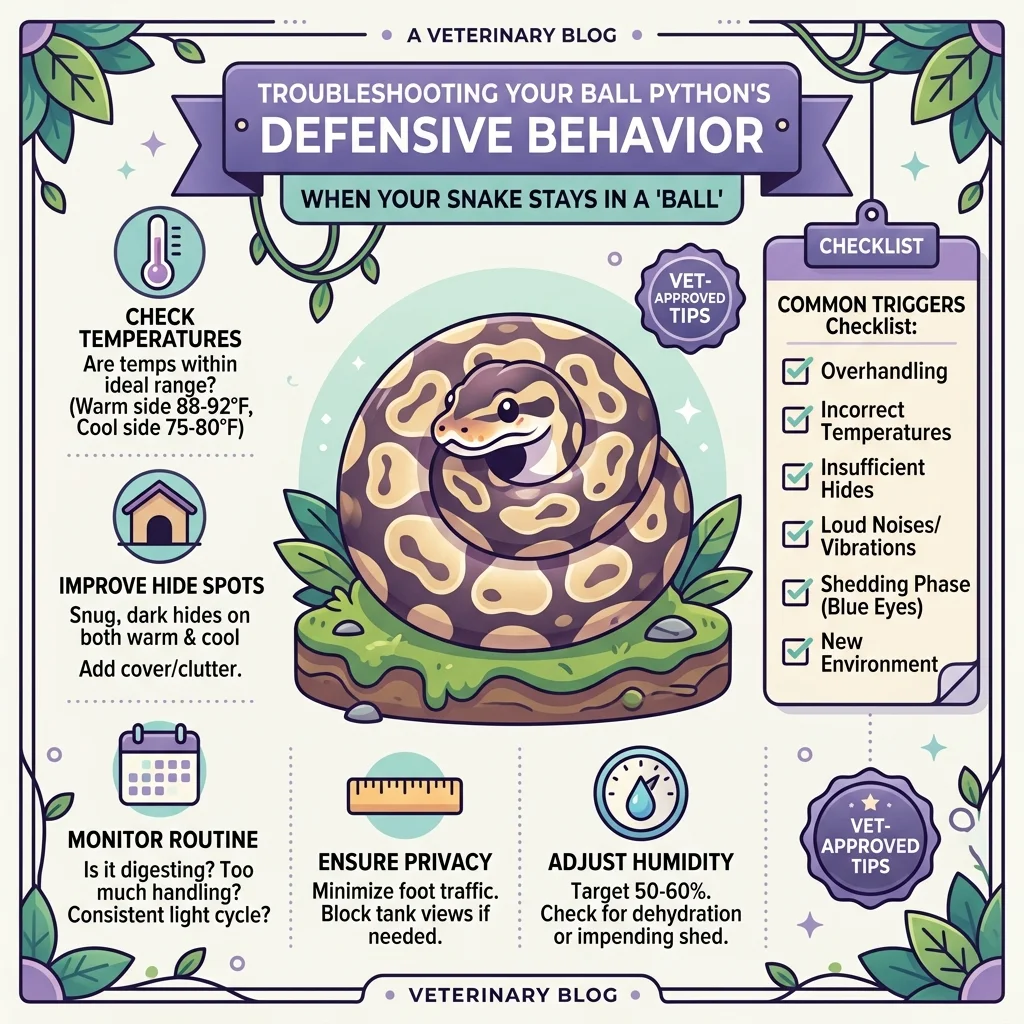
- Hot spot / basking: 88–92°F
- Warm side ambient: 82–86°F
- Cool side: 76–80°F
- Night drop: Not lower than 74°F
How to check accurately:
- Use an infrared temperature gun to spot-check surface temperatures at multiple points in the enclosure
- Use a digital thermometer with a probe for ambient air temperature
- Do NOT rely on stick-on analog thermometers — they are notoriously inaccurate
Common equipment failures to check:
- Thermostat malfunction (the most common single cause of sudden temperature drops)
- Heat mat that has stopped working
- Ceramic heat emitter or basking bulb that has burned out
- Seasonal drop in room temperature as HVAC settings change
5. Cause #4: Inadequate Humidity
Probability: High, particularly in dry climates or during winter when indoor heating reduces ambient humidity.
Why it matters: Ball pythons are native to humid West African environments. Their respiratory system and skin require humidity levels of 60–80% to function optimally. When humidity drops below 50%, the snake enters a state of mild respiratory stress that often manifests as feeding refusal.
How to check: Use a digital hygrometer placed on the cool side of the enclosure at the snake's level. Do not trust analog humidity gauges.
Solution: Add a damp hide (a plastic container with a lid, filled with damp sphagnum moss, with a snake-sized hole cut in the lid) on the warm side. Mist the enclosure lightly with clean water every 2–3 days. Consider switching to a substrate that retains humidity better, such as coco fiber or a bioactive substrate mix.
6. Cause #5: Inadequate Hides
Probability: High, especially in newer or larger enclosures.
Why it matters: Ball pythons are prey animals that spend most of their time in burrows and tight crevices in the wild. Without adequate cover, they experience chronic stress that directly suppresses their feeding response.
The hide test: Your ball python's hide should be small enough that the snake is in contact with the walls on all sides when coiled inside it. A hide that is too large offers no security benefit. A snake in an inadequate hide is a snake that will not eat reliably.
What "adequate hides" means:
- At least two hides per enclosure — one on the warm side, one on the cool side
- Opaque (no see-through sides)
- Appropriately sized (snug, not roomy)
- Placed directly on the substrate at ground level
7. Cause #6: Recent Stress Events
Probability: Moderate to high.
Common stress triggers that cause feeding refusal:
- New enclosure: Allow a new ball python at least 2 weeks of "settling in" before attempting to feed. Do not handle during this period.
- Moving/relocation: Any move to a new home, enclosure, or even a different room can trigger a 2–4 week fast.
- Excessive handling: Ball pythons should not be handled more than 3–4 times per week and never within 48 hours of a feeding attempt.
- Loud or vibrating environment: Subwoofers, foot traffic directly above or below the enclosure, or proximity to vibrating appliances.
- Visible threats: Cats, dogs, or other animals that can see or paw at the enclosure.
Solution: Remove all stressors. Handle minimally or not at all. Give the snake privacy and quiet for 2–4 weeks, then reattempt feeding.
8. Cause #7: Prey Presentation Issues
Probability: Moderate.
Ball pythons can be surprisingly picky about how prey is presented.
Prey temperature issues:
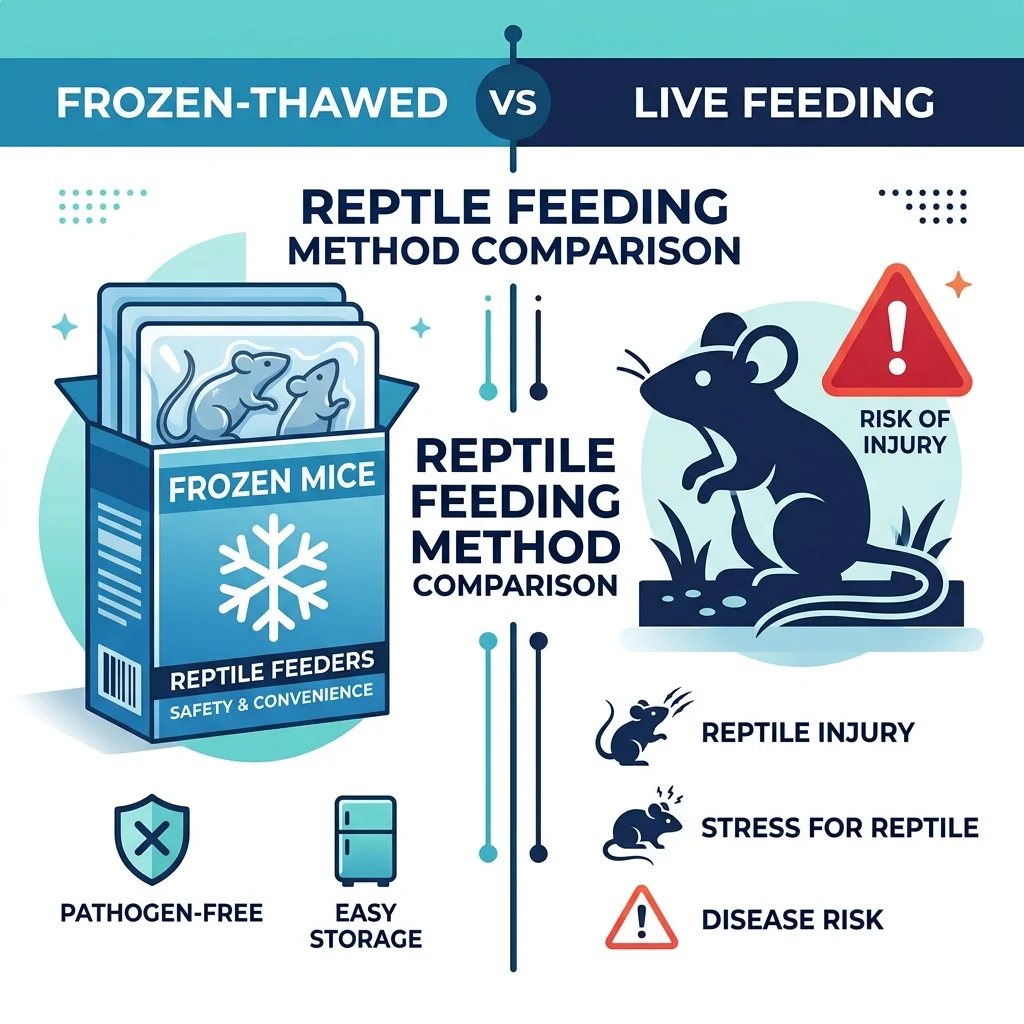
- Prey must be warmed to 98–102°F before offering
- A cold or lukewarm mouse will be refused by most ball pythons
- Use a warm water bath (as described in our thawing guide) and verify temperature with an infrared gun
Prey size issues:
- Prey that is too large will be refused after investigation or strike
- Prey that is too small may be ignored as "not worth the effort"
- See our ball python feeding schedule for correct sizing by age
Prey species issues:
- Some ball pythons imprinted on a specific prey species (mice vs. rats) and will refuse the other
- Try switching prey species (mice to rats or vice versa) if a snake has been refusing for multiple sessions
- ASF rats (African Soft Fur rats) are often accepted by ball pythons that refuse domestic mice — see our feeder nutrition comparison
9. Cause #8: Reproductive Behavior
Probability: High for adult animals during breeding season (October–March).
Males: Adult male ball pythons often refuse food almost entirely during breeding season. They are hormonally driven to find mates, not to eat. This is normal and self-resolving. Attempting to force-feed a reproductively active male is stressful and unnecessary.
Females: Gravid (pregnant) females may also stop eating for the final 4–8 weeks before laying/birthing. A female that has recently mated and is holding follicles or eggs should not be disturbed or force-fed.
10. Cause #9: Illness (When to See a Vet)
Probability: Lower than husbandry causes, but critical not to miss.
If you have addressed all husbandry factors, waited an appropriate length of time, and tried all prey presentation adjustments without success, the snake may be ill. Common illnesses that cause feeding refusal include:
- Internal parasites: Cryptosporidiosis (Crypto) is particularly common in ball pythons and causes chronic wasting and feeding refusal. It requires veterinary diagnosis via fecal testing.
- Respiratory infection (RI): Bacterial or viral. Symptoms include wheezing, mucus, and open-mouth breathing. Requires antibiotic treatment.
- Inclusion Body Disease (IBD): A retroviral disease of boids. Causes neurological symptoms and wasting. No treatment available.
- Mouth rot (infectious stomatitis): Bacterial infection of the oral tissue. Visible as swelling, redness, or caseous (cheesy) deposits around the mouth.
If illness is suspected, contact an ARAV-certified exotic veterinarian immediately. You can find certified vets through the ARAV veterinarian directory.
11. Practical Step-by-Step Troubleshooting Protocol
Follow these steps in order before escalating to veterinary care:
- Check eyes — Is the snake in shed? Wait until after.
- Check temperatures with an IR gun at warm side, cool side, and floor level.
- Check humidity with a digital hygrometer.
- Evaluate hides — Are they appropriately sized and positioned?
- Review handling log — Have you handled the snake within 48 hours of a feeding attempt?
- Review stress history — Any new pets, moves, or equipment changes recently?
- Try different prey presentation — Different size, species, or scenting.
- Try feeding at night — In a dark, quiet environment.
- Try cover method — Paper bag or small dark container.
- If none of the above work after 6–8 weeks in a healthy adult: Consult an exotic vet for fecal testing.
Frequently Asked Questions
Q: How long can a ball python go without eating?
A: Healthy adult ball pythons can fast for 3–4 months during seasonal changes, while juveniles should not go longer than 4–6 weeks. If weight loss or illness signs appear, seek veterinary care immediately.
Q: Should I force-feed my ball python?
A: No, force-feeding should only be done by a veterinarian under sedation. It can cause injury or stress. Address husbandry issues first.
Q: What if my ball python hasn't eaten in months?
A: Check for illness signs like weight loss or respiratory issues. Consult an ARAV-certified vet for testing, as parasites or infections may be the cause.
Q: Can shedding cause permanent feeding refusal?
A: No, shedding-related fasts resolve after the shed completes. Offer food 3–5 days post-shed.
Q: How do I know if my ball python is sick?
A: Look for wheezing, mucus, lethargy, or abnormal posture. These require immediate veterinary attention.
Conclusion
A ball python that refuses food is almost never an emergency on its own. More often, it is communicating something about its environment, its biology, or its psychological state that can be addressed with patience and methodical troubleshooting. By working through the causes in this guide, the vast majority of ball python keepers will resolve their snake's feeding strike without veterinary intervention.
For more expert resources, explore our complete library of ball python guides and feeding guides, or visit our home page to learn more about Loxahatchee Rodents and our 25+ years of expertise in reptile nutrition.
Written by Bill Galloway, Former Assistant Curator at Palm Beach Zoo and co-founder of Loxahatchee Rodents.