Key Takeaway
How to build a consistent ball python feeding schedule that minimizes refusals. Expert guide covering interval setting, tracking methods, seasonal adjustment, and the psychology of ball python feeding behavior.
Table of Contents
- 1. The Ball Python's Natural Feeding Biology
- Cyclical Prey Availability in the Wild
- Specific Dynamic Action (SDA)
- 2. Building Your Ball Python Feeding Schedule
- Step 1: Determine the Base Interval
- Step 2: Choose Your Feeding Day
- Step 3: Set Up Your Tracking System
- Step 4: Define Your "Concern Threshold"
- 3. The Complete Weekly Feeding Protocol
- 24 Hours Before Feeding Day
- 2 Hours Before Feeding Time
- 30 Minutes Before Feeding
- The Feeding Attempt
- After a Successful Feeding
- After a Refusal
- 4. When the Schedule Breaks: Troubleshooting Refusals
- Cause 1: Pre-Shed
- Cause 2: Seasonal Fast (October–March)
- Cause 3: Prey Temperature Issues
- Cause 4: Recent Handling or Stress
- Cause 5: Prey Size Mismatch
- Cause 6: Reproductive Activity
- Cause 7: Illness or Parasites
- 5. Seasonal Schedule Adjustment
- October–November: Anticipating the Seasonal Slowdown
- December–February: Managing the Seasonal Fast
- March–April: Resumption of Feeding
- May–September: Peak Feeding Period
- 6. Prey Sizing on a Schedule: When to Size Up
- 7. Record Keeping Templates
- Frequently Asked Questions
- Conclusion
- 8. Tools for Building the Perfect Ball Python Feeding System
- 9. Feeding Through Life's Disruptions

The ball python's reputation as an unpredictable feeder hides an important truth: most ball pythons, on a well-designed feeding schedule with appropriate husbandry and quality prey, will feed reliably for months and years without significant refusals. The keepers who experience chronic, frustrating feeding strikes are often the ones who lack a consistent schedule — offering food unpredictably, skipping feeding dates, changing prey sizes frequently, or handling the snake the day before a feeding attempt.
Consistency is not just nice to have in ball python feeding. For a species evolved to anticipate seasonal prey availability cycles, consistency is the behavioral mechanism that predicts and prevents refusals. A ball python that receives prey at the same interval, in the same conditions, with prey at the same temperature and size, develops what can best be described as a feeding "expectation" — and an animal in this state feeds reliably.
This guide shows you how to build that system, how to track it, how to adjust it seasonally, and how to interpret the deviations that even a perfectly managed ball python will occasionally produce.
1. The Ball Python's Natural Feeding Biology
Understanding why consistency matters requires understanding how ball python feeding works at a biological level.
Cyclical Prey Availability in the Wild
Ball pythons (Python regius) inhabit the semi-arid savannas, grasslands, and forest edges of West and Central Africa. Their prey — primarily small to medium rodents (Mastomys, Cricetomys, Mus) — fluctuates in availability with the rainfall cycle. During the dry season (roughly November–March), rodent activity is reduced and ball python feeding activity decreases correspondingly.
This cyclical prey availability has shaped ball python metabolism and behavior over millions of years. Their digestive system is designed to be efficient — one appropriately sized meal sustains them for 10–21 days at optimal temperatures. Their behavior includes seasonal metabolic downregulation that is only partially suppressed in captivity.
Specific Dynamic Action (SDA)
When a ball python swallows prey, its digestive system undergoes a dramatic upregulation known as Specific Dynamic Action (SDA). Organs literally increase in mass — the small intestine by up to 40%, the liver enzymes by several fold — to process the incoming meal. This process peaks at approximately 48 hours post-ingestion and is essentially complete by day 5–7.
The practical implication: a ball python is not "ready" to eat again until SDA is complete and the digestive system has returned to its resting state. Offering food before this point may result in disinterest or refusal — not because the snake is being difficult, but because its biology is not yet primed for another hunt. This is why the 10–14 day interval for adults is not arbitrary; it maps to the complete SDA cycle plus a natural appetite-building period.
2. Building Your Ball Python Feeding Schedule
Step 1: Determine the Base Interval
The correct feeding interval depends on your ball python's life stage:
| Life Stage | Weight | Recommended Interval |
|---|---|---|
| Hatchling (0–6 months) | Under 200g | Every 7 days |
| Early Juvenile (6–12 months) | 200–400g | Every 7–10 days |
| Juvenile (12–24 months) | 400–800g | Every 10–14 days |
| Sub-Adult (2–3 years) | 800g–1.5kg | Every 14 days |
| Adult (3+ years) | 1.5kg+ | Every 14–21 days |
Note: These are target intervals for animals actively growing or at maintenance weight. Seasonal adjustments are covered in Section 5.
Step 2: Choose Your Feeding Day
Select a day of the week that is:
- Consistently available for you (a weekday evening for most people)
- At least 48 hours away from any planned handling sessions
- Not immediately before a travel period or disruption to the snake's environment
Once you choose your feeding day, treat it as a fixed appointment. Consistency matters more than which specific day you choose.
Step 3: Set Up Your Tracking System
Tracking is the single most underutilized tool in ball python management. Without records, you are guessing. With records, you have data that reveals patterns, predicts seasonal fasts, and tells you exactly when a refusal has exceeded the range of normal.
Minimum tracking fields for each feeding session:
- Date of feeding attempt
- Prey type (rat vs. mouse), size classification, and weight in grams
- Result: Accepted / Refused / Strike-and-release / No response
- Prey temperature at offering (IR gun reading)
- Notes (shedding, behavior, enclosure changes)
A simple spreadsheet, a dedicated notebook, or a reptile management app (ReptiTrack, ReptiFiles) all work well.
Step 4: Define Your "Concern Threshold"
Before you experience a refusal, decide in advance at what point you will:
- Begin troubleshooting actively
- Consult a veterinarian
Recommended thresholds:
| Life Stage | "Continue Monitoring" | "Active Troubleshooting" | "Veterinary Consultation" |
|---|---|---|---|
| Hatchling | 2 refusals | 3 consecutive refusals | 4+ consecutive refusals |
| Juvenile | 3 refusals | 4–5 consecutive refusals | 6+ consecutive refusals |
| Adult (seasonal context) | Up to 8 weeks | 10+ weeks | 12+ weeks without eating |
| Adult (non-seasonal) | 2 refusals | 3–4 consecutive refusals | 5+ consecutive refusals |
Having these thresholds defined in advance removes the emotional response from the equation. You're not "panicking" after 2 refusals, and you're not "waiting too long" after 10.
3. The Complete Weekly Feeding Protocol
Every feeding session should follow the same ritual in the same sequence. Consistency in presentation is as important as consistency in timing.
24 Hours Before Feeding Day
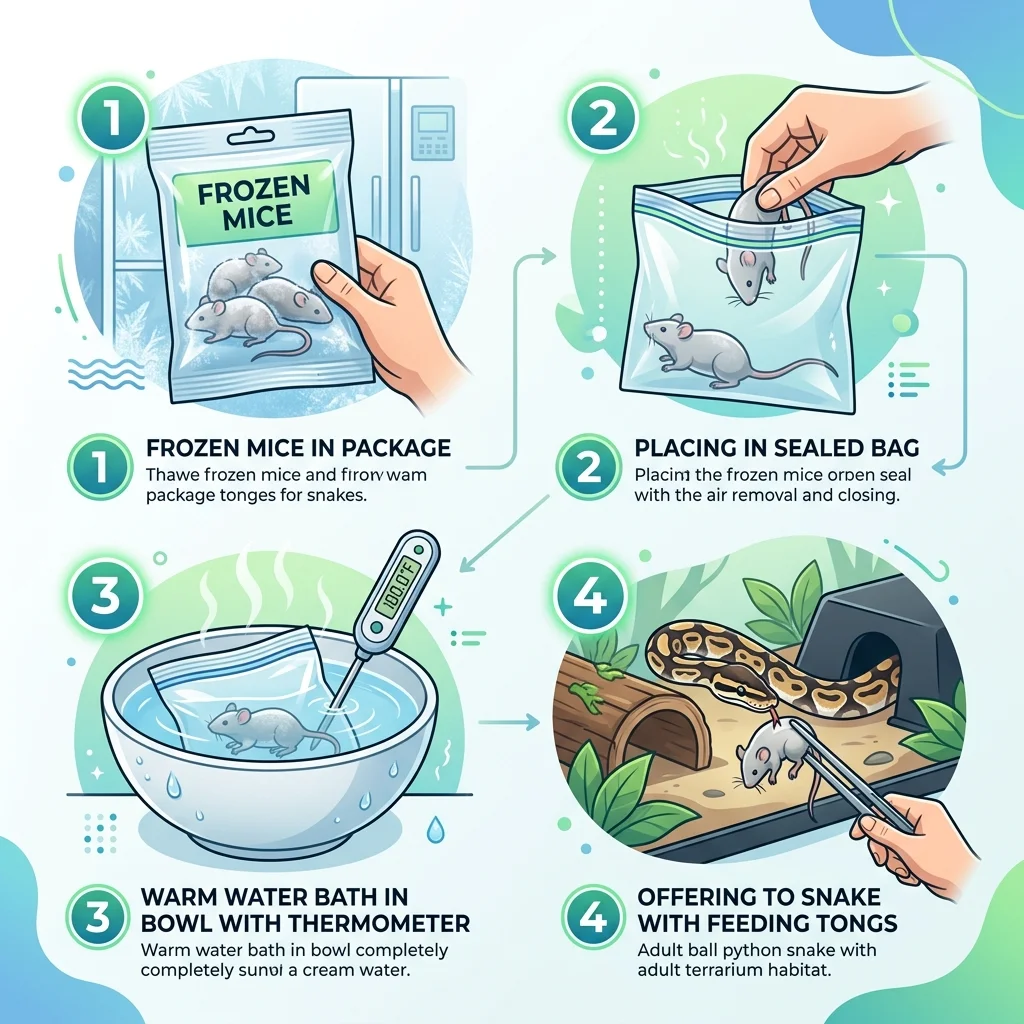
- Move the frozen prey from the freezer to the refrigerator for the slow thaw phase. Do not thaw at room temperature — see our how to thaw frozen mice guide for why this matters.
- Confirm your feeding tongs are clean and available. Always use stainless steel feeding tongs — never offer prey with bare hands.
- Record the previous feeding session in your tracking log if you haven't already.
2 Hours Before Feeding Time
- Dim the room lights in the area where you feed. Ball pythons are nocturnal hunters that feed best in low-light conditions.
- Verify enclosure temperatures with an infrared gun: warm side should be 88–92°F. If temperatures are not within range, address before proceeding.
30 Minutes Before Feeding
- Begin the warm water bath phase: place the thawed prey (in a sealed bag) in 100–105°F water for 15–20 minutes (20–25 minutes for large rats).
- While waiting, prepare the feeding container if you use one — a dark plastic tub with a lid, approximately the size of the snake's body length.
The Feeding Attempt
- Verify prey surface temperature with IR gun: target 98–102°F.
- Open the enclosure or place the snake in the feeding container. Do not hover or watch intently — your presence can inhibit the feeding response in sensitive individuals. Offer the prey, give one slow wiggle with the tongs, then step back out of the snake's direct visual field.
- Allow 10–15 minutes for the feeding response to develop. Do not repeatedly wiggle the prey or "push" the snake toward it.
- If the snake strikes, immediately move away and give the snake privacy to complete constriction and ingestion. This can take 20–45 minutes.
- If there is no response after 15 minutes, try one slow wiggle and allow another 5–10 minutes. If still no response, remove the prey.
After a Successful Feeding
- Return the snake to its enclosure if you used a separate feeding container.
- Record the feeding in your log: date, prey weight, result.
- No handling for 48–72 hours. A snake with a meal in its GI tract is vulnerable and digesting — disturbance can cause regurgitation. See our snake regurgitation guide if this occurs.
- Ensure the warm side temperature remains consistent for the next 3–5 days while digestion completes.
After a Refusal
- Record the refusal in your log: date, prey specs, temperature at offering, any environmental notes.
- Do not attempt to feed again immediately. Wait until the next scheduled feeding date.
- On the next feeding date, try one modification from the troubleshooting list in Section 4.
4. When the Schedule Breaks: Troubleshooting Refusals
A ball python on a consistent schedule that refuses food is almost always communicating one of a limited set of conditions. Use this reference to identify the most likely cause and apply the targeted fix.
Cause 1: Pre-Shed
How to identify: Opaque, milky-blue eyes; dull skin coloration; spending more time in hides or water dish. Action: Do not offer food. Wait until the shed is complete, then wait an additional 5–7 days before the next feeding attempt.
Cause 2: Seasonal Fast (October–March)
How to identify: Refusal begins in late October to November; snake is active, alert, maintains body weight; no other signs of illness. Action: Continue offering food on schedule every 10–14 days. Accept refusals without intervention as long as body condition remains good. Most seasonal fasts resolve spontaneously by February–March.
For adults: a seasonal fast of 8–16 weeks is within the documented normal range for ball pythons. For hatchlings and juveniles, seasonal fasts of this length are less typical and warrant closer monitoring.
Cause 3: Prey Temperature Issues
How to identify: Snake shows interest (tongue-flicking, approach) but won't strike; or strikes but releases without constricting. Action: Check the prey temperature with an IR gun. If below 98°F, return to warm water bath for an additional 10 minutes and retry. If you don't own an IR gun, purchase one — it is the single most important feeding tool.
Cause 4: Recent Handling or Stress
How to identify: Feeding attempt within 48 hours of handling; any recent changes to the enclosure, room environment, or household activity levels. Action: Establish the 48-hour handling blackout window strictly. If other stressors are present (new pet in the home, enclosure moved, loud events), allow 1–2 weeks of full environmental calm before retrying.
Cause 5: Prey Size Mismatch
How to identify: Snake has grown noticeably since last prey size adjustment; or snake consistently shows interest but doesn't strike. Action: Weigh your snake. Calculate 5% of body weight. Use our rat size chart by weight in grams to confirm you're offering the correct size.
Cause 6: Reproductive Activity
How to identify: Adult male refusing food in fall/winter; or adult female recently exposed to a male. Action: Males in breeding condition often refuse food for weeks to months. This is normal and self-resolving. Continue offering on schedule; accept refusals without intervention.
Cause 7: Illness or Parasites
How to identify: Refusal persists beyond the seasonal period; accompanied by weight loss, respiratory symptoms (wheezing, mucus), abnormal posture (stargazing), or behavioral changes. Action: This warrants veterinary consultation. Do not continue troubleshooting independently if illness signs are present. Contact an ARAV-certified exotic veterinarian for examination and fecal testing.
For a comprehensive 12-cause troubleshooting guide, see our complete ball python not eating guide.
5. Seasonal Schedule Adjustment
Ball python feeding schedules should not be static year-round. Seasonality is a biological reality for this species, even in captivity.
October–November: Anticipating the Seasonal Slowdown
Begin monitoring your ball python's feeding response more carefully. Most adults will begin showing reduced interest in October. Do not interpret this as a problem — it is a normal transition.
Action: Continue offering food on schedule. If the snake eats but takes longer than usual to respond, this is an early sign of seasonal slowdown. Begin reducing prey size by one category to reduce digestive load.
December–February: Managing the Seasonal Fast
Most adult ball pythons will refuse multiple consecutive feedings during this period. This is one of the most documented aspects of ball python behavior and is entirely normal.
Action: Continue offering food every 14 days. Remove uneaten prey after 30 minutes without forcing interaction. Monitor body weight monthly — a ball python in a seasonal fast should not lose more than 5–10% of its pre-fast body weight over a 3-month fast.
March–April: Resumption of Feeding
Ball pythons typically resume feeding spontaneously in February–March. The feeding response may be initially hesitant — try offering a prey item 1 category smaller than usual for the first post-fast meal, then return to normal sizing at the next session.
Action: Resume normal schedule. Most animals that accepted prey reliably pre-fast will return to reliable feeding within 2–3 sessions.
May–September: Peak Feeding Period
This is typically the period of most reliable feeding for ball pythons. Take advantage of it:
- If a size-up is needed, introduce it during this period when the feeding drive is strongest
- If you're transitioning from mice to rats, summer is the best time to attempt the transition
- If you're working with a reluctant feeder, summer feeding drives are strong enough that even resistant snakes often come around
For complete guidance on transitioning prey types, see our switch snake from live to frozen guide.
6. Prey Sizing on a Schedule: When to Size Up
Prey size should be adjusted when the snake's body weight increases sufficiently to warrant the next size category. Here's a practical protocol:
- Weigh monthly. Use a digital kitchen scale. Record in your feeding log.
- Calculate 5% of current weight. Compare to the rat chart.
- Size up when: The calculated 5% meal weight has been at the mid-to-upper range of your current prey category for two consecutive feedings.
- Transition gradually: For one feeding session, offer a prey item at the lower weight of the new category rather than jumping to the middle. This gives the snake's digestive system a gentler adjustment.
Example: Your adult ball python has grown from 1,200g to 1,450g. Previous prey: Small Rat (approximately 60g). New calculation: 5% of 1,450g = 72.5g. This falls at the upper end of Small Rat territory and into Medium Rat territory. Next feeding: offer a Small-Medium (70–75g) rat to bridge the size increase.
For the complete sizing reference, see our rat size chart by weight in grams.
7. Record Keeping Templates
A simple, complete feeding log entry looks like this:
Date: [DATE]
Prey: [TYPE] [SIZE CATEGORY] | [WEIGHT]g
Prey Temp at Offering: [TEMP]°F
Result: ✓ Accepted / ✗ Refused / ⚡ Strike-only
Snake Weight (if weighed today): [WEIGHT]g
Notes: [In pre-shed / seasonal / handled 3 days ago / etc.]
After 3–6 months of records, you will begin to see your specific animal's patterns:
- Is the snake consistent year-round or does it reliably slow in winter?
- What prey size has it been on, and when did the last size-up happen?
- How many consecutive feedings does it typically accept vs. refuse?
- Is there a pattern to what environmental conditions correlate with refusals?
This data is invaluable when discussing your snake's health with a veterinarian and when evaluating whether a current refusal is within or outside the normal pattern for this specific animal.
Frequently Asked Questions
Q: My ball python ate reliably for 8 months and then suddenly refused 3 meals in a row. Is this a problem? A: Count the months — if it's October–February, this is almost certainly the seasonal fast. Check body condition and review your records for any pattern. Three refusals alone is not cause for alarm in an otherwise healthy adult ball python.
Q: Should I change anything about the feeding schedule for a female ball python? A: Female ball pythons are typically larger than males and may require larger prey items for the same weight. During the breeding season, females that have been introduced to a male may show reduced feeding interest. Post-laying females should be offered food more frequently (every 7–10 days) to recover body condition.
Q: My ball python eats fine but I can never predict which session it will refuse. Any tips? A: Start tracking all feeding sessions in detail. Look for correlations with: temperature (check with IR gun every feeding), handling in the prior 48 hours, time of day, and month of year. Most "unpredictable" refusers have an identifiable pattern once the data is in front of you.
Q: Is it okay to feed my ball python more than once a week to accelerate growth? A: No. Power feeding — feeding more frequently than the SDA cycle allows — causes significant long-term health damage including hepatic lipidosis and cardiovascular disease. The schedule in this guide is designed for optimal lifetime health, not maximum growth speed.
Conclusion
A ball python on a consistent, well-designed feeding schedule is a fundamentally different animal than a ball python being fed erratically. Consistency in interval, prey size, presentation, temperature, and handling separation creates the conditions for reliable feeding behavior — and when refusals do occur, a solid tracking system lets you identify the cause quickly and respond appropriately.
The investment in setting up this system — 60 minutes to build a tracking spreadsheet and define your seasonal protocol — pays dividends across the entire 25–30 year lifespan of your animal.
For more expert resources, see our comprehensive ball python not eating guide, ball python morph feeding guide, and rat size chart by weight in grams. Explore our complete reptile feeding guides for all species.
Written by Bill Galloway, Former Assistant Curator at Palm Beach Zoo and co-founder of Loxahatchee Rodents.
8. Tools for Building the Perfect Ball Python Feeding System
The complete toolkit for a science-based ball python feeding program:
Digital kitchen scale (±1g accuracy) The most essential non-enclosure tool. Costs $10–15. Without accurate snake weight data, you are guessing at prey sizing. Weigh your ball python monthly on an empty stomach.
Infrared temperature gun The second most essential feeding tool. Costs $15–20. Allows you to verify prey surface temperature (target: 98–102°F), warm side basking surface temperature, and cool side ambient temperature. Multiple readings at each measurement session.
Stainless steel feeding tongs (14–16 inches) Never offer prey from your hand to a ball python. Ball pythons in feeding mode cannot distinguish between your warm, prey-scented hand and the prey item. A bite from an adult ball python — particularly a large female — is a significant injury. See our reptile feeding tongs guide for the complete selection guide.
Dedicated feeding container A dark plastic tub (approximately 20-gallon equivalent) with ventilation holes. Used only for feeding sessions. Keeps feeding contexts clearly separated from the main enclosure.
Feeding log spreadsheet or app Can be as simple as a Google Sheets document or a dedicated app (ReptiTrack, MorphMarket, etc.). Track date, prey specs, snake weight, and result. Three months of data will tell you more about your individual animal than any general guide.
Secondary thermostat (as a backup) Not strictly a feeding tool, but thermostat failure is the most common single cause of ball python regurgitation. Having a spare thermostat allows you to quickly test and replace a malfunctioning unit rather than discovering the failure after a regurgitation event.
9. Feeding Through Life's Disruptions
Real ball python keeping doesn't happen in a perfectly controlled environment. Here's how to manage feeding around common life disruptions:
Travel:
- Feed 2–3 days before departure to allow digestion to begin
- Do not attempt to feed immediately before travel — motion during early digestion causes regurgitation
- A healthy adult ball python can fast for 2–3 weeks during your absence with no health impact
- Provide a reliable house-sitter with written instructions if absence exceeds 3 weeks (juveniles should be fed)
Moving/Relocation:
- Do not feed within 5 days before or after a move — the stress of relocation suppresses feeding and increases regurgitation risk
- Allow 14 days after moving before resuming the feeding schedule
- If the snake hasn't eaten for 3+ weeks post-move, this is normal settling behavior
Enclosure Changes:
- Significant enclosure changes (new substrate, new decor layout, new location in the room) are mild stressors
- Allow 3–5 days after any significant enclosure change before the next feeding attempt
For additional guidance on recovering a disrupted feeding schedule, see our ball python not eating guide and our snake regurgitation guide for regurgitation recovery.
Written by Bill Galloway, Former Assistant Curator at Palm Beach Zoo and co-founder of Loxahatchee Rodents.