Key Takeaway
Do ball python morphs feed differently? This evidence-based guide examines every claim about morph-specific feeding behavior — from spider wobble affecting feeding to albino vision issues — with expert analysis.
Table of Contents
- 1. First: Understanding Ball Python Morph Genetics
- What Morphs Are
- What Morphs Are Not
- 2. The Spider Morph: The One Legitimate Exception
- The Spider Wobble
- The Spider Morph Ethics Debate
- 3. Other Neurological Morphs: Champagne and Woma
- Champagne Ball Pythons
- Woma Ball Pythons
- Super Champagne and Super Spider
- 4. Vision-Affecting Morphs: Albino, Axanthic, and Others
- Albino Ball Pythons
- Other Color Morphs (Pastel, Mojave, Enchi, etc.)
- 5. The Clown Morph: A Special Case for Chronic Refusers
- What the Evidence Shows
- 6. Super Forms: Homozygous Morphs and Their Feeding Behavior
- Super Mojave / Blue Eyed Leucistic (BEL)
- Super Pastel
- Super Enchi, Super Leopard, etc.
- Super Black Pastel / Super Cinnamon
- 7. Individual Variation: The Bigger Factor
- 8. The Correct Feeding Protocol for Ball Python Morphs
- Standard Feeding Protocol
- 9. Summary: What Morphs Actually Affect Feeding
- Conclusion
- 10. Practical Protocol for Every Morph Keeper
- Standard Ball Python Feeding Protocol (All Morphs)
- Morph-Specific Modifications
- 11. Morph Genetics Research: What We Still Don't Know
Few questions in ball python keeping generate more conflicting anecdotal information than this: Do different morphs feed differently? Browse any reptile forum and you'll find keepers insisting their spider ball pythons are "notoriously difficult feeders," that albino ball pythons can't see prey as well, or that genetic mutations in paradox and puzzle morphs create feeding challenges. You'll also find equally passionate keepers insisting that any difference in feeding behavior is purely individual and has nothing to do with morph genetics.
The truth, as with most things in biology, is nuanced — and importantly, it is knowable. At Loxahatchee Rodents, with 25+ years of experience and Bill Galloway's background as an Assistant Curator at Palm Beach Zoo, we've worked with hundreds of ball python morphs and have a clear picture of what the evidence actually shows.
This guide examines every major claim about morph-specific feeding behavior in ball pythons, separates fact from myth, and gives you practical guidance for feeding your specific animal regardless of its morph.
1. First: Understanding Ball Python Morph Genetics
To evaluate whether morphs feed differently, it helps to understand what morph genetics actually are and aren't.
What Morphs Are
Ball python morphs are individuals carrying one or more genetic mutations that affect pigmentation and/or pattern. These mutations alter the expression of melanin, xanthophyll, and other pigments in the skin. They are color and pattern genes, not behavioral genes.
The most common mutations include:
| Mutation Type | Examples | What It Affects |
|---|---|---|
| Recessive | Albino, Piebald, Clown, Ghost | Color and/or pattern; requires two copies |
| Dominant | Spider, Pinstripe, Champagne | Pattern; one copy produces the phenotype |
| Co-dominant | Pastel, Lesser, Mojave, Enchi | Color brightness; one copy produces effect, two copies produce super form |
What Morphs Are Not
Morph genetics do not directly alter:
- Digestive system anatomy or function
- Olfactory (smell) sensitivity
- Thermo-sensory pit organ function
- Hunger drive or prey recognition
- Immune function (with one critical exception discussed below)
This means that in the vast majority of morphs, there is no physiological basis for different feeding behavior. The exceptions are documented and specific, not general.
2. The Spider Morph: The One Legitimate Exception
The spider ball python is the most important and most complex case in this discussion. The spider mutation is a dominant neurological mutation — and this makes it categorically different from color morphs.
The Spider Wobble
Spiders carry a condition called Wobble Syndrome or Wobble, formally referred to as a vestibular/neurological defect. In the mildest cases, it is barely noticeable — a slight head tremor when the snake is stressed. In more severe cases, it produces corkscrew body movements, stargazing (head and neck bent backward), and loss of spatial orientation.
How Wobble Affects Feeding:
The vestibular system (inner ear and associated neural structures) plays a role in spatial orientation — knowing where the snake is in space relative to where the prey is. A snake with significant Wobble may struggle to accurately strike at prey:
- Strike misses: Spider ball pythons with moderate-to-severe Wobble may strike at the general area of the prey but fail to connect accurately
- Difficulty locating prey: Some individuals have difficulty orienting toward the prey item even when they clearly detect it through heat and scent
- Stress-induced Wobble amplification: The feeding context (anticipation, excitement) can temporarily worsen Wobble symptoms, making feeding sessions more chaotic than routine handling
Practical Accommodations for Spider Ball Pythons:
- Offer prey at snake level, not above the head: Snakes with vestibular issues have more difficulty striking upward than striking forward at level prey
- Present prey closer than usual: Reducing the strike distance reduces the targeting error introduced by Wobble
- Use a longer tong: A 14–16 inch tong keeps your hand further from the strike zone — spider ball pythons with Wobble can have erratic, far-off strike directions
- Feed in a contained space: A small feeding tub contains erratic movements and helps the snake succeed at capturing the prey
- Give extra time: Some spider ball pythons need multiple attempts to successfully constrict prey. Don't remove the prey after one missed strike — allow several minutes
Severity is highly variable: Some spider ball pythons have virtually undetectable Wobble and feed completely normally. Others require the accommodations above. Assess your individual animal and adjust accordingly.
The Spider Morph Ethics Debate
The neurological aspect of the spider mutation has made it one of the most ethically debated morphs in the ball python community. Major herpetoculture organizations including the British Veterinary Association (BVA) have called for reduced production of spider ball pythons due to welfare concerns. This is beyond the scope of a feeding guide, but it's worth being aware of.
3. Other Neurological Morphs: Champagne and Woma
Champagne Ball Pythons
The champagne morph (also called "Headstamp") is produced by a co-dominant mutation in the EDNRB gene. Like spider, champagne carries a neurological component. Champagne ball pythons frequently display:
- Head tremors and wobble similar to (but separate from) spider wobble
- Stargazing episodes
- Difficulty orienting during feeding
Feeding guidance: Same as for spider ball pythons. Offer prey at snake level, allow extra time, use a feeding tub.
Woma Ball Pythons
Woma morphs (not to be confused with actual Woma pythons) carry a different neurological mutation that also produces wobble in many individuals. The severity varies widely between individuals.
Feeding guidance: Assess your individual woma for Wobble presence and severity. Apply spider accommodations if needed.
Super Champagne and Super Spider
Homozygous forms of both mutations (Super Champagne = two copies of champagne gene; Super Spider = two copies of spider gene) produce severe, life-threatening neurological defects. These animals are generally unable to feed normally and often cannot survive long-term without significant intervention. Responsible breeders do not intentionally produce these combinations.
4. Vision-Affecting Morphs: Albino, Axanthic, and Others
Albino Ball Pythons
The albino mutation eliminates melanin production, producing snakes with yellow and white patterning and red eyes. The red eyes are a result of melanin being absent in the iris, allowing blood vessels to show through.
The common claim: "Albino ball pythons can't see as well and have trouble spotting prey."
The evidence: This claim is partially accurate in specific contexts. Here's the nuanced reality:
- Ball pythons are not primarily visual hunters. They rely on thermal pit organs and chemosensory (Jacobson's organ) detection — not vision — as their primary prey detection systems.
- Melanin in the iris functions to control light entering the eye. Albino ball pythons are more photosensitive than wild-type animals — they are effectively functionally blind in bright light.
- In normal to dim lighting conditions, albino ball pythons have adequate visual function for their needs.
Practical implication: Feed albino ball pythons in dimmer lighting than you might use for wild-type animals. If you notice your albino consistently striking at incorrect angles in brightly lit conditions, reduce lighting intensity during feeding sessions. This applies to any pink-eyed (amelanistic) ball python morph.
Other Color Morphs (Pastel, Mojave, Enchi, etc.)
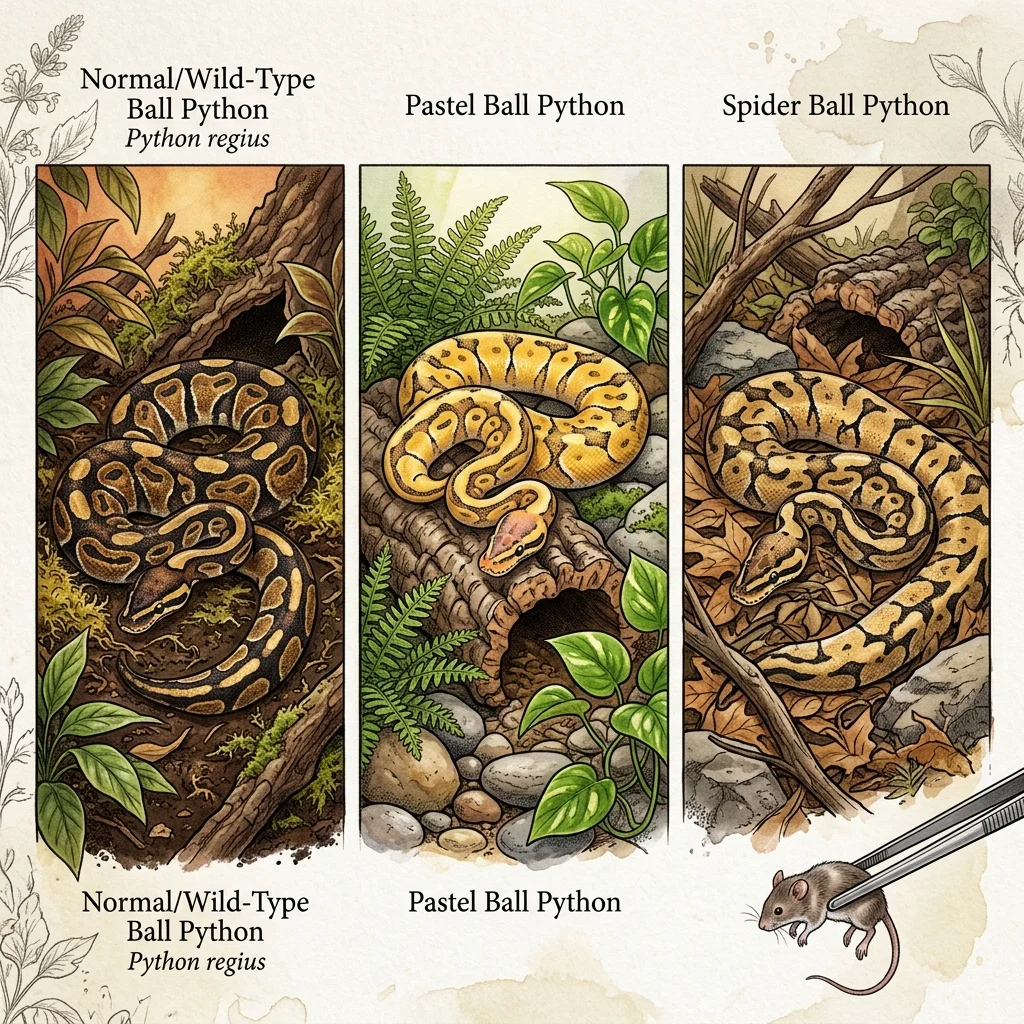
These morphs alter pigmentation but do not meaningfully affect vision or neurological function. A pastel ball python and a wild-type ball python of identical weight and health should feed identically in identical conditions.
Claim: "Lighter morphs have weaker feeding responses." Evidence: Not supported by physiology or controlled observation. Any difference in feeding behavior between a lighter and darker morph is due to individual variation, not genetics.
5. The Clown Morph: A Special Case for Chronic Refusers
Clown ball pythons have a reputation in the community for being difficult feeders. But is this genetic or environmental?
What the Evidence Shows
The clown mutation itself affects pattern expression, not neurological or digestive function. However, there is a documented pattern among clown ball pythons:
- Clown ball pythons are disproportionately found at the smaller end of adult body weight ranges — suggesting they may have a slightly lower anabolic drive than other morphs
- Clown ball pythons frequently show reduced feeding frequency compared to normal-type animals even in identical husbandry conditions
Whether this represents a genuine metabolic difference associated with the clown gene or is a result of the clown morph being disproportionately produced by breeders who may have had less optimal husbandry during critical early growth periods is impossible to determine from the available data.
Practical guidance: If your clown ball python is a chronically reluctant feeder, follow the same troubleshooting protocol from our ball python not eating guide. The husbandry-first approach applies regardless of morph genetics.
6. Super Forms: Homozygous Morphs and Their Feeding Behavior
When two animals carrying the same co-dominant gene are bred together, the offspring can receive two copies of the mutation (the "Super" form). Some super forms are dramatically different from the single-gene version:
Super Mojave / Blue Eyed Leucistic (BEL)
Completely white ball pythons with blue eyes. No evidence of neurological involvement. No documented feeding differences compared to normally-sighted ball pythons of the same age and weight.
Super Pastel
Brighter yellow than single-gene pastel. No neurological involvement. No documented feeding differences.
Super Enchi, Super Leopard, etc.
No documented neurological involvement or feeding differences.
Super Black Pastel / Super Cinnamon
Both the super black pastel and super cinnamon produce animals with kinked spines and other physical deformities. These physical issues — not the gene itself — can affect feeding ability if the deformity impacts swallowing. Assess individual animals.
7. Individual Variation: The Bigger Factor
Having addressed morph-specific factors, it is important to emphasize that individual variation overwhelms morph genetics in the vast majority of cases.
Within a clutch of sibling ball pythons carrying identical genetics, you will find:
- Animals that eat enthusiastically every 10 days without variation
- Animals that feed reliably but are somewhat cautious
- Animals that go on extended seasonal fasts
- Animals that prefer rats over mice or vice versa
- Animals that respond strongly to movement cues and animals that respond primarily to heat
This variation is not genetic — it reflects individual experience, early socialization, enclosure history, and the random variation inherent in complex biological systems.
The practical takeaway: troubleshoot based on the individual animal, not on morph assumptions. A ball python that is a difficult feeder should be assessed using the full troubleshooting framework regardless of whether it is a normal, a pastel, or a spider.
8. The Correct Feeding Protocol for Ball Python Morphs
The following applies to all ball python morphs except those with documented neurological involvement (spider, champagne, woma — see Section 2):
Standard Feeding Protocol
Prey sizing: 5–10% of body weight. Use our rat size chart by weight in grams for exact sizing.
Prey temperature: 98–102°F surface temperature as verified by infrared temperature gun. This is non-negotiable for a species that relies primarily on thermal detection.
Feeding frequency:
- Hatchlings (0–6 months): Every 7 days
- Juveniles (6 months–3 years): Every 10–14 days
- Adults: Every 14–21 days
Environment: Feed in a separate, dark feeding container or in the enclosure with lights dimmed. For albino and other pink-eyed morphs, reduce ambient lighting.
Never handle within 48 hours of a feeding session in either direction.
For the complete ball python feeding schedule and seasonal refusal guidance, see our ball python feeding schedule guide and our comprehensive ball python not eating guide.
9. Summary: What Morphs Actually Affect Feeding
| Claim | Evidence Verdict | Practical Implication |
|---|---|---|
| Spider morphs feed differently | ✅ TRUE (neurological Wobble affects strike accuracy) | Use feeding accommodations described in Section 2 |
| Champagne/Woma morphs feed differently | ✅ TRUE (neurological wobble) | Same accommodations as spider |
| Albino morphs have worse vision | ⚠️ PARTIALLY TRUE (in bright light only) | Feed in dim lighting |
| Clown morphs are chronic refusers | ⚠️ UNCERTAIN (possibly genetic, possibly husbandry) | Standard troubleshooting applies |
| Pastel/Enchi/Mojave/Lesser feed differently | ❌ NOT SUPPORTED | No morph-specific accommodations needed |
| Super forms (BEL, etc.) feed differently | ❌ NOT SUPPORTED (except physically deformed supers) | Standard protocol applies |
| Morph genetics cause weaker feeding responses | ❌ NOT SUPPORTED | Individual variation is the dominant factor |
Conclusion
The short answer to "do ball python morphs feed differently?" is: mostly no — with specific, documented exceptions for morphs with neurological components (spider, champagne, woma) and minor practical adjustments for vision-impaired morphs (albino) in bright light conditions.
For the vast majority of the hundreds of commercially available ball python morphs, the morph genetics affect color and pattern only. The same feeding protocol, the same prey sizing, the same temperatures, and the same troubleshooting framework applies regardless of whether your ball python is a normal, a piebald, a pastel super enchi firefly, or anything in between.
For complete feeding guides, see our ball python not eating guide, ball python feeding schedule guide, and rat size chart by weight in grams. Explore our full library of reptile feeding guides for more expert resources.
Written by Bill Galloway, Former Assistant Curator at Palm Beach Zoo and co-founder of Loxahatchee Rodents.
10. Practical Protocol for Every Morph Keeper
Regardless of which morph your ball python is, the following universal feeding protocol applies with only the morph-specific modifications noted:
Standard Ball Python Feeding Protocol (All Morphs)
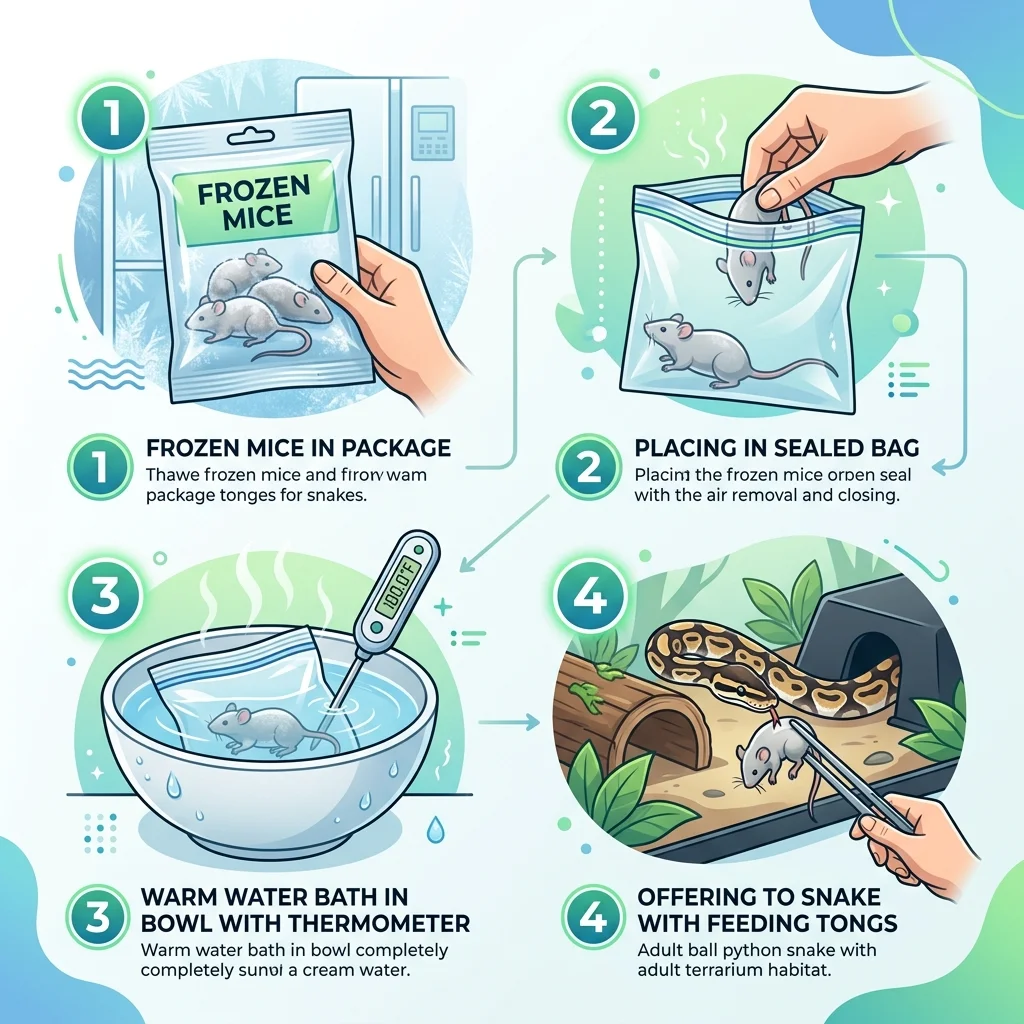
Step 1: Prepare your prey 24 hours in advance Move the frozen rat from the freezer to the refrigerator. For large prey items, allow 24–36 hours.
Step 2: Warm water bath (20 minutes before offering) Submerge in 100–105°F water for 20 minutes. Longer for large prey.
Step 3: Temperature verification Surface temperature 98–102°F with an infrared gun. Non-negotiable.
Step 4: Feeding environment Dim lights. Feeding container or darkened enclosure. Evening session.
Step 5: Tongs presentation Level or just below snake head height. Slow oscillation if no immediate response.
Step 6: No hovering Step back immediately after presentation. Give the snake 15–20 minutes without human observation.
Morph-Specific Modifications
| Morph | Modification |
|---|---|
| Spider, Champagne, Woma | Lower tong position; extra distance from handler; feeding tub required |
| Albino and pink-eyed morphs | Dimmer lighting — room should be dark during feeding |
| Clown | Standard protocol; extra patience if chronic refusal; rule out husbandry issues first |
| All other morphs | Standard protocol — no modifications |
For the complete ball python feeding schedule, troubleshooting, and seasonal adjustment guidance, see our ball python feeding schedule guide. For prey sizing, see our rat size chart by weight in grams.
11. Morph Genetics Research: What We Still Don't Know
The ball python morph community is still relatively young — widespread commercial production of morphs only began in earnest in the 1990s–2000s. This means long-term health data on many morphs is limited.
What the research suggests but hasn't conclusively established:
- Whether specific color mutations affect long-term metabolic function beyond the documented neurological cases
- Whether there are subtle immune differences between high-expression super morphs and standard morphs
- The full genetic picture of why some morphs (such as clown) appear to have lower average adult body weights
As the ball python morph community ages and more detailed long-term health records become available, this picture will become clearer. Until then, the conservative approach is:
- Trust the documented data (spider wobble is real and significant; most color morphs are physiologically equivalent)
- Monitor your individual animal's feeding response and body condition independent of morph assumptions
- Consult ARAV-certified exotic veterinarians for any unusual feeding patterns rather than assuming morph genetics are the cause
Written by Bill Galloway, Former Assistant Curator at Palm Beach Zoo and co-founder of Loxahatchee Rodents.