Key Takeaway
Corn snake refusing frozen mice? This expert troubleshooting guide covers 8 specific causes and proven solutions for every type of frozen prey refusal, from temperature issues to prey scent and size problems.
Table of Contents
- Why Corn Snakes Are Good Feeders (But Not Always Easy Ones)
- The Diagnostic Checklist: Before You Read the Fixes
- Fix #1: The Prey Is the Wrong Temperature (Most Common)
- Fix #2: The Prey Is the Wrong Size
- Fix #3: The Snake Is in Pre-Shed (Ecdysis)
- Fix #4: The Enclosure Temperature Is Too Low
- Fix #5: You Handled the Snake Too Recently
- Fix #6: The Snake Is New to Your Collection
- Fix #7: The Snake Was Previously Fed Live Prey
- Scenting Technique
- The "Brain" Technique
- The Wiggle Technique
- The Cover Method
- The Fresh Kill Bridge Method
- Fix #8: Environmental and Timing Adjustments
- Feed After Dark
- Use a Separate Feeding Container
- Reduce Frequency Temporarily
- Try a Different Prey Item
- Check for Other Snakes
- When to See a Vet
- Frequently Asked Questions
- Conclusion
You've done everything right: you bought quality frozen mice, you thawed them properly (or so you thought), you warmed them up — and your corn snake turned its nose up and refused. This is one of the most frustrating experiences in reptile keeping, but it is almost always solvable with the right diagnosis.
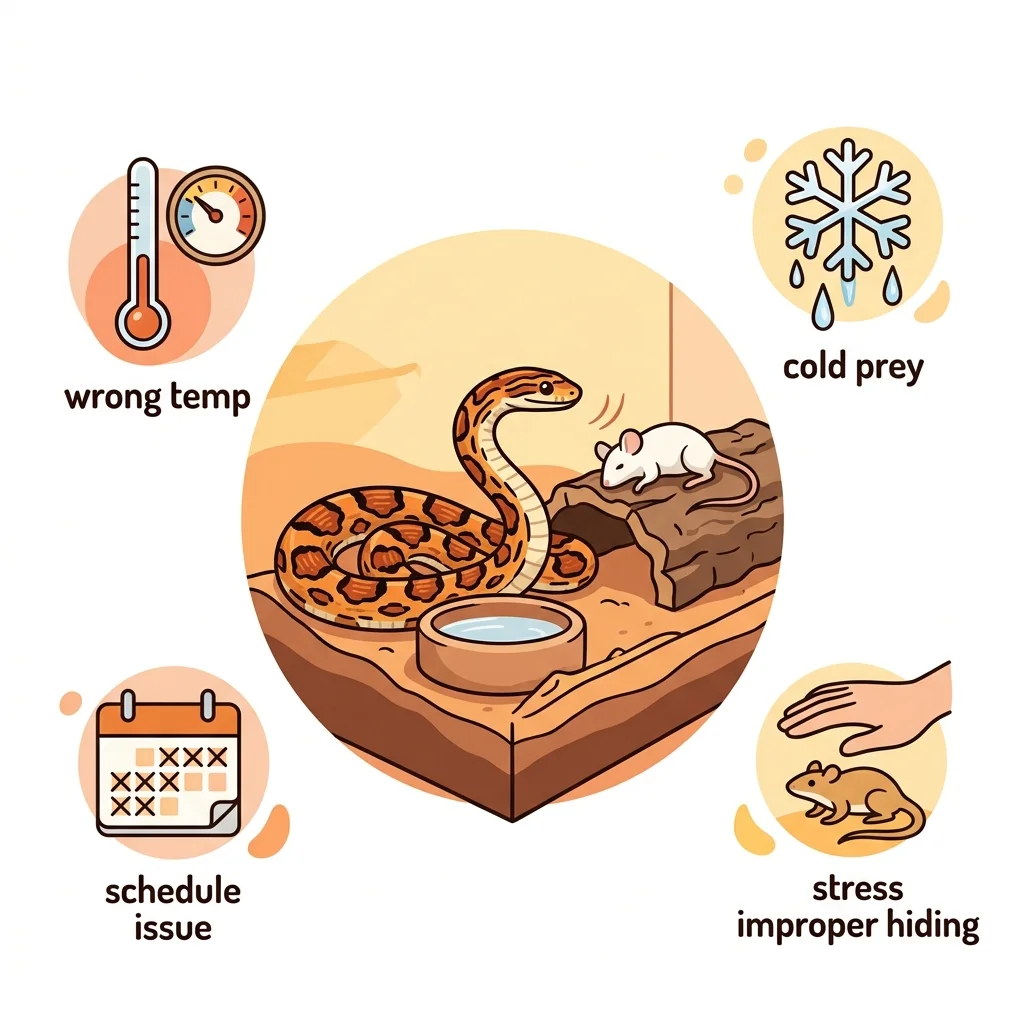
The key insight that most guides miss: there is no single reason a corn snake refuses frozen mice. The solution depends entirely on which specific factor is causing the refusal. Applying the wrong fix wastes time and stresses your snake unnecessarily. This guide gives you a diagnostic framework to identify the exact cause and apply the correct solution.
At Loxahatchee Rodents, we have been producing frozen feeder mice since 2001 and have helped thousands of keepers troubleshoot exactly this problem. These 8 fixes are ranked by frequency — start with Fix #1 and work your way down.
Why Corn Snakes Are Good Feeders (But Not Always Easy Ones)
Corn snakes (Pantherophis guttatus) have a well-deserved reputation as reliable, enthusiastic feeders — but this reputation can create unrealistic expectations. A corn snake that refuses a meal is not a broken corn snake. It is a corn snake communicating something specific about its prey, its environment, or its biology.
Unlike ball pythons — which are famous for prolonged, seemingly random food strikes that can last months — corn snake food refusals almost always have an identifiable, fixable cause. The challenge is identifying which cause applies to your specific animal.
The Diagnostic Checklist: Before You Read the Fixes
Before applying any specific fix, run through this rapid checklist. If you find a "yes" answer, jump to the corresponding fix number:
- Is the prey the wrong temperature? → Fix #1
- Is the prey the wrong size? → Fix #2
- Is the snake currently in pre-shed? → Fix #3
- Has the enclosure temperature dropped? → Fix #4
- Have you been handling the snake recently? → Fix #5
- Is the snake new to your collection? → Fix #6
- Is this a snake previously fed live prey? → Fix #7
- Have you tried scenting or environmental changes? → Fix #8
Fix #1: The Prey Is the Wrong Temperature (Most Common)
Frequency: Very high. This accounts for more than half of all corn snake frozen prey refusals.
Corn snakes, like all snakes, detect prey through two primary sensory channels: heat (via pit organs and thermosensory skin receptors) and chemical scent (via the Jacobson's organ in the roof of the mouth). A frozen-thawed mouse that has not been properly warmed fails on the heat channel, and no amount of scent quality will fully compensate.
What "properly warmed" means:
- Surface temperature of 98–102°F (36.7–38.9°C) as measured by an infrared temperature gun
- Warmth distributed throughout the prey — not just a hot surface with a cold core
- Achieved through the warm water bath method, not room temperature thawing
The complete warming protocol:
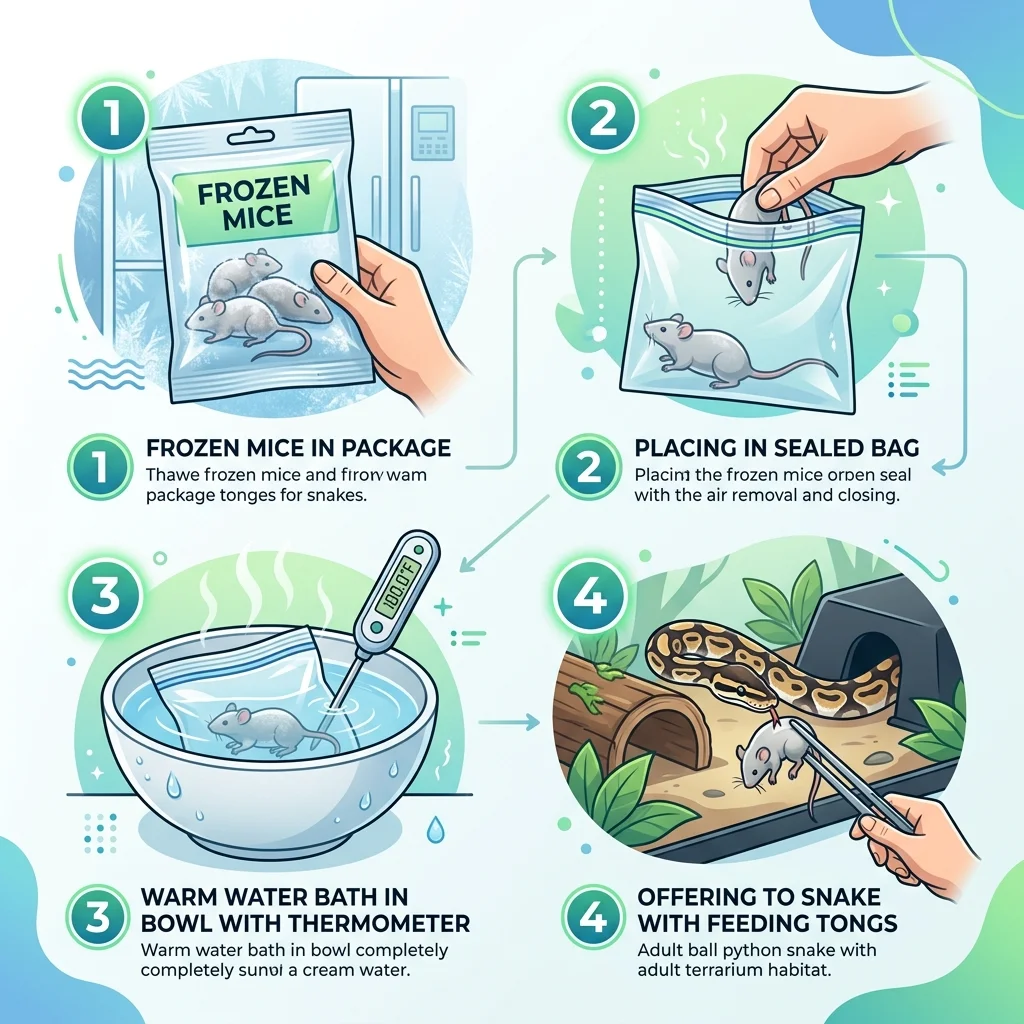
- Thaw the mouse in the refrigerator for 12–24 hours
- Place in a watertight bag and submerge in 100–105°F water for 15 minutes (10 minutes for pinkies/fuzzies, 20 minutes for large adults)
- Verify surface temperature with an IR gun before offering
What most keepers do wrong:
- Thaw at room temperature and offer without warming in water (the mouse feels warm to the touch but surface temperature is only 72–75°F — far below the snake's detection threshold)
- Warm in water that is too hot (above 110°F), which denatures surface proteins and destroys the scent cues the snake needs
- Microwave the mouse (creates hot spots, destroys cellular structure and scent — never do this)
See our complete how to thaw frozen mice guide for step-by-step photos and detailed protocol.
Solution: Re-warm your frozen mouse correctly and retry. If you have been offering at the wrong temperature, you may have conditioned your snake to associate frozen prey with "cold" = "not food." It may take 2–3 sessions of correctly warmed prey to break this association.
Fix #2: The Prey Is the Wrong Size
Frequency: High, particularly with snakes that have recently grown.
Corn snakes are precise in their prey size preferences. A mouse that is noticeably too large will be investigated, possibly struck, and then released or refused. A mouse that is significantly too small may be ignored as "not worth pursuing." The target: prey diameter equal to the widest part of the snake's body.
Quick sizing guide:
| Snake Weight | Correct Mouse Size | Weight Range |
|---|---|---|
| Under 15g | Pinky | 2–4g |
| 15–50g | Fuzzy | 5–9g |
| 50–150g | Hopper | 10–18g |
| 150–400g | Adult Small | 19–28g |
| 400–900g | Adult Medium | 29–45g |
For the complete sizing reference, see our frozen mice size chart.
Signs the prey is too large:
- Snake strikes the mouse but immediately releases it
- Snake shows interest, investigates, but doesn't strike
- Snake attempts to swallow but backs off after getting the head partially in
- Snake swallows but regurgitates within 24 hours
Signs the prey is too small:
- Snake ignores the prey entirely after one or two tongue flicks
- Snake shows interest from a distance but won't pursue
- Snake has been eating without issue but recently started refusing (you may have forgotten to size up as the snake grew)
Solution: Drop down one size category if the prey may be too large. Size up one category if the snake has grown since your last order and you haven't updated the prey size.
Fix #3: The Snake Is in Pre-Shed (Ecdysis)
Frequency: Very high. Pre-shed is responsible for a large proportion of corn snake refusals.
During the pre-shed phase (also called pre-ecdysis), the space between the old skin layer and the new skin fills with lymphatic fluid. This fluid layer clouds the eye caps (spectacles), causing the characteristic "blue phase" — milky, opaque eyes. In this state, the snake's vision is severely compromised.
A corn snake with impaired vision feels vulnerable and often stops hunting. Offering food during the blue phase is almost always futile.
How to identify pre-shed:
- Eyes appear milky, blue-grey, or visibly cloudy
- Overall skin color appears duller than normal
- Snake may spend more time in hides or soaking in its water dish
- Behavior: slightly more defensive or reclusive than usual
Important note: Pre-shed has two phases. In the opaque phase, the eyes are cloudy. But a few days before shedding, the lymphatic fluid absorbs and the eyes clear temporarily — this is the clear phase. Many keepers are confused when their snake's eyes appear normal but it still won't shed for several more days. During the clear phase, some snakes will accept food.
Solution: Stop offering food during the blue phase. Resume offering food 5–7 days after a complete, successful shed. Do not try to force-feed a snake in pre-shed.
Fix #4: The Enclosure Temperature Is Too Low
Frequency: High, particularly in winter months or after thermostat changes.
Corn snakes are ectotherms. Their metabolism — including the production of digestive enzymes — is entirely temperature-dependent. A corn snake in an enclosure that is too cold cannot digest prey effectively. Its body responds by suppressing the feeding drive to avoid the toxicity of undigested food rotting in its GI tract.
Required temperatures for corn snakes:
| Zone | Required Temperature |
|---|---|
| Warm side ambient | 82–86°F |
| Cool side | 72–76°F |
| Night drop (acceptable) | 65–72°F |
How to verify temperatures accurately:
- Use a digital infrared temperature gun — these cost $15–20 and give accurate readings instantly
- Check the warm side surface temperature at the snake's level (not at the ceiling of the enclosure)
- Check at multiple points — heating equipment can malfunction partially, creating cold spots
Common temperature failure points:
- Thermostat malfunction (test with a spare thermostat if you suspect this)
- Under-tank heater that has stopped producing heat
- Room HVAC settings changed for the season (many keepers don't realize the room temperature drop affects the enclosure)
- Positioning the enclosure near an exterior wall or air conditioning vent
Solution: Correct the temperature to the required range. After correcting temperatures, wait 24–48 hours before offering food to allow the snake's metabolism to normalize. Then offer a correctly sized and warmed prey item.
Fix #5: You Handled the Snake Too Recently
Frequency: Moderate. Very common with new keepers who don't yet have an established handling routine.
Handling a corn snake within 48 hours of a feeding attempt creates two problems:
Problem 1: Physical stress suppresses feeding drive. Handling is a mild stressor for snakes, even calm corn snakes that are comfortable with human interaction. Stress hormones (corticosterone in reptiles) actively suppress appetite. A snake that was handled yesterday is physiologically in a mildly stressed state and much less likely to feed.
Problem 2: The snake may associate your hands with food. If you handle your snake with the same hands you use to offer prey, the snake may become "hand shy" or confused about whether your hand is a threat or a food source. Always use feeding tongs to offer prey.
The correct handling protocol:
- Never handle within 48 hours before a feeding attempt
- Never handle within 48 hours after a feeding attempt
- Maximum recommended handling: 3–4 times per week for no more than 15–20 minutes per session
- Wash hands before and after handling
Solution: Establish a firm no-handling window of 48 hours around every feeding session. If you've been handling too frequently, take a full week off from handling entirely and then attempt a feeding. You will likely find immediate improvement.
Fix #6: The Snake Is New to Your Collection
Frequency: Very high specifically in the context of recently acquired snakes.
A corn snake that has recently been moved to a new home — whether from a breeder, a pet store, or another keeper — needs time to settle in and feel secure before it will eat reliably. The unfamiliar smells, sounds, and visual stimuli of a new enclosure create chronic low-level stress that directly suppresses the feeding response.
What "settling in" requires:
| Factor | Requirement |
|---|---|
| Minimum settling time | 2 weeks before first feeding attempt |
| Hides | Two opaque hides — one warm side, one cool side |
| No handling | None during the first 2 weeks |
| No enclosure maintenance | Minimum disturbance during settling period |
| No other animals | No visual access to other pets or snakes |
Recommended approach:
- Set up the enclosure completely before the snake arrives
- Place the snake in the enclosure and leave it completely alone for 7 days
- At day 7, check temperatures and humidity only — do not handle
- At day 14, attempt first feeding using the warming protocol in Fix #1
Solution: Patience. A newly acquired corn snake that refuses food for the first 2–3 weeks is normal. Do not interpret refusal during the settling period as a problem requiring intervention.
Fix #7: The Snake Was Previously Fed Live Prey
Frequency: Very high for snakes acquired from certain breeders or pet stores that still use live prey.
A corn snake that has been fed exclusively live prey for any significant period may have a strong imprint on the scent signature, movement patterns, and heat signature of live prey. A frozen-thawed mouse, while identical in nutritional content, may not trigger the same feeding response because it presents differently on the scent and movement channels.
This is one of the most challenging transitions but one that virtually every corn snake can make with the right techniques.
Scenting Technique
Rub the warmed thawed mouse against bedding from a live mouse enclosure. The scent of a live mouse transferred to the frozen prey often triggers an immediate strike response.
The "Brain" Technique
Using a sterilized toothpick, make a very small perforation in the skull of the thawed mouse. The neural tissue scent is an extremely powerful prey recognition trigger for snakes. The mouse is already humanely euthanized, so this involves no additional harm.
The Wiggle Technique
Use stainless steel feeding tongs (minimum 10 inches long) and present the warmed prey with slow, undulating movements in front of the snake. Replicate the hesitant, side-to-side movement of a mouse exploring unfamiliar territory. Many live-feeding snakes will strike a moving target that they refused when offered stationary.
The Cover Method
Place the snake and the warmed, scented prey in a small paper bag or dark plastic container (with ventilation holes). Leave in a dark, quiet room for 30–60 minutes without any disturbance. The enclosed space, darkness, and scent concentration often produce a feeding strike from even resistant animals.
The Fresh Kill Bridge Method
Humanely euthanize a live mouse and offer it immediately while still body-warm. Once the snake accepts this, at the next feeding offer a properly warmed frozen-thawed mouse. Most snakes make the full transition within 3–5 feeding sessions using this bridge.
For the full transition guide covering all species and all techniques in detail, see our how to switch a snake from live to frozen prey guide.
Fix #8: Environmental and Timing Adjustments
Frequency: Moderate. These adjustments are often the difference between success and failure when all other factors have been addressed.
Feed After Dark
Corn snakes are crepuscular to nocturnal hunters in the wild — they are most active in low-light conditions when their thermal sensing is most effective. If you've been offering food in a brightly lit room during the day, try offering food after 9 PM in a dim or dark room.
Use a Separate Feeding Container
If you feed your corn snake in its main enclosure, the snake may have begun to associate the enclosure with stress (from cleaning, handling in the enclosure, etc.) rather than with hunting. A separate dark plastic tub placed in a quiet room creates a neutral, stimulus-rich feeding environment.
Reduce Frequency Temporarily
Counterintuitively, if your corn snake has been refusing food and you have been offering every week, try increasing the interval to 10–12 days. The increased hunger state sometimes makes reluctant feeders more willing to accept frozen prey.
Try a Different Prey Item
Some corn snakes develop a preference for a specific scent or presentation. If your snake has been refusing thawed mice from your current supplier, try a single mouse from a different source. The slightly different scent profile can reset a reluctant snake's feeding response.
Check for Other Snakes
If you keep multiple snakes and there is any visual or olfactory connection between their enclosures (e.g., same shelf, adjacent containers), the presence of another snake can suppress feeding. Try moving the refusing snake to a completely isolated location for a feeding session.
When to See a Vet
The 8 fixes above cover the vast majority of corn snake frozen prey refusals. However, there are circumstances where a veterinary visit is warranted:
Seek veterinary care if:
- Your corn snake refuses food for more than 4 weeks after all husbandry factors have been addressed
- Refusal is accompanied by weight loss (visible spine, concave lateral body profile)
- You observe wheezing, mucus from the nose or mouth, or open-mouth breathing
- You observe unusual posture or behavioral changes (excessive hiding, failure to respond to stimuli)
- Your snake is a hatchling or juvenile that has never successfully fed
An ARAV-certified exotic veterinarian can perform a fecal examination to rule out internal parasites, a physical exam to identify infection or injury, and a blood panel if metabolic disease is suspected. Find certified vets through the ARAV veterinarian directory.
Frequently Asked Questions
Q: My corn snake ate fine for months and then suddenly stopped. What happened? A: Sudden refusal after an established feeding history is most commonly caused by pre-shed (check the eyes), a seasonal response (winter months), a recent stress event, or a temperature drop. Work through the diagnostic checklist above.
Q: How long can a corn snake go without eating before it's dangerous? A: A healthy adult corn snake can fast for several weeks to months without medical risk, though this is longer than typical. A hatchling or juvenile that refuses more than 2–3 consecutive feedings warrants more active troubleshooting and potentially veterinary consultation.
Q: I've tried everything and my corn snake still won't eat. What's left? A: At this point, a veterinary exam is the right next step. In particular, ask for a fecal exam to rule out Cryptosporidium and a physical exam for mouth rot or respiratory infection — both of which can suppress appetite with no other visible symptoms in the early stages.
Q: Should I ever force-feed my corn snake? A: No — not without veterinary guidance. Force-feeding carries significant risk of injury, aspiration, and regurgitation. It should only be performed by a veterinarian under appropriate conditions and only when the snake poses genuine starvation risk.
Conclusion
A corn snake that refuses frozen mice is almost always solvable. By systematically working through the 8 fixes in this guide — starting with prey temperature and size, then moving through environmental and behavioral factors — the vast majority of keepers resolve the issue within 2–4 feeding sessions.
The most important principle: one fix at a time. If you change the prey size, the temperature, the feeding time, and the location all in the same session, you won't know which factor made the difference. Test one variable per session when possible.
Explore our complete corn snake feeding guide for the full feeding protocol, and visit our how often to feed your snake guide for species-specific frequency recommendations. For more resources, browse our complete reptile feeding guides or visit our home page.
Written by Bill Galloway, Former Assistant Curator at Palm Beach Zoo and co-founder of Loxahatchee Rodents.