Key Takeaway
The definitive ball python frozen mouse size guide. Learn exactly which frozen mouse size to feed at every life stage, how to measure correctly, and avoid the most common sizing mistakes that cause refusals and regurgitation.
Table of Contents
- 1. The Biology Behind Prey Sizing in Ball Pythons
- The Specific Dynamic Action (SDA) Cost
- The Girth Rule
- The 10–15% Body Weight Rule
- 2. Ball Python Frozen Mouse Size Guide by Life Stage
- Hatchling Ball Pythons (0–3 months, Under 100g)
- Juvenile Ball Pythons (3–12 months, 100–400g)
- Sub-Adult Ball Pythons (12–24 months, 400–1,000g)
- Adult Female Ball Pythons (2+ years, 1,000–2,500g)
- Adult Male Ball Pythons (2+ years, 700–1,200g)
- 3. Frozen Mouse Size Chart: The Master Reference
- 4. How to Thaw Frozen Mice Correctly
- The Warm Water Bath Method (Recommended)
- What Not to Do
- 5. Sizing Mistakes That Cause Feeding Refusals
- Prey That Is Too Warm
- Prey That Is Too Cold
- Size Escalation Shock
- Handling Too Close to Feeding
- 6. Mice vs. Rats for Ball Pythons: A Nutritional Comparison
- 7. Frozen Mouse Sources and Quality Indicators
- What to Look For
- 8. Frequently Asked Questions
- How do I know if my ball python is eating the right size mouse?
- Can I switch my ball python from mice to rats as an adult?
- My ball python is refusing frozen mice but accepted live before. What size should I try?
- At what weight should I upgrade from mice to rats?
- How long can I store frozen mice?
- Summary: Ball Python Frozen Mouse Size at a Glance
Choosing the correct frozen mouse size for a ball python is one of the most consequential decisions a keeper makes at every feeding — and one of the most frequently mishandled. Too large, and you risk regurgitation or, worse, genuine esophageal injury and a feeding strike that lasts months. Too small, and your snake fails to grow, accumulates nutritional debt, and eventually develops problems that don't manifest until years later.
The frustrating part is that "frozen mouse size" terminology is inconsistent across suppliers. One company's "adult medium" is another's "adult large." Weight classifications vary by 10–20g between vendors. And many keepers — especially those transitioning from live prey — simply never develop the habit of matching prey size to snake body weight with any precision.
This guide fixes all of that. Based on over 25 years of producing feeder rodents for zoos, private keepers, and herpetological research institutions, we provide the complete ball python frozen mouse size guide with exact gram weights, life-stage breakdowns, and species-specific sizing logic grounded in the biology of Python regius.
1. The Biology Behind Prey Sizing in Ball Pythons
Before we get to the charts, understanding why proper sizing matters physiologically will help you make better decisions in edge cases.
The Specific Dynamic Action (SDA) Cost
When a ball python swallows prey, its digestive system undergoes a dramatic metabolic event known as Specific Dynamic Action (SDA). Intestinal mass increases by up to 40%, pancreatic enzyme secretion surges, and liver enzyme activity rises by several fold — all to digest the incoming meal.
SDA represents a significant caloric cost. Studies on Python molurus and Python regius have shown that SDA can account for 14–35% of the total energy content of a meal. The larger and harder-to-digest the meal, the higher the SDA cost relative to the nutritional return.
This creates a practical rule: prey that is disproportionately large for the snake's current size creates an unfavorable energy equation. The snake spends more calories digesting an oversized meal than it extracts in usable nutrition. Over time, this leads to the chronic "maintenance" or even negative energy balance keepers mistake for health.
The Girth Rule
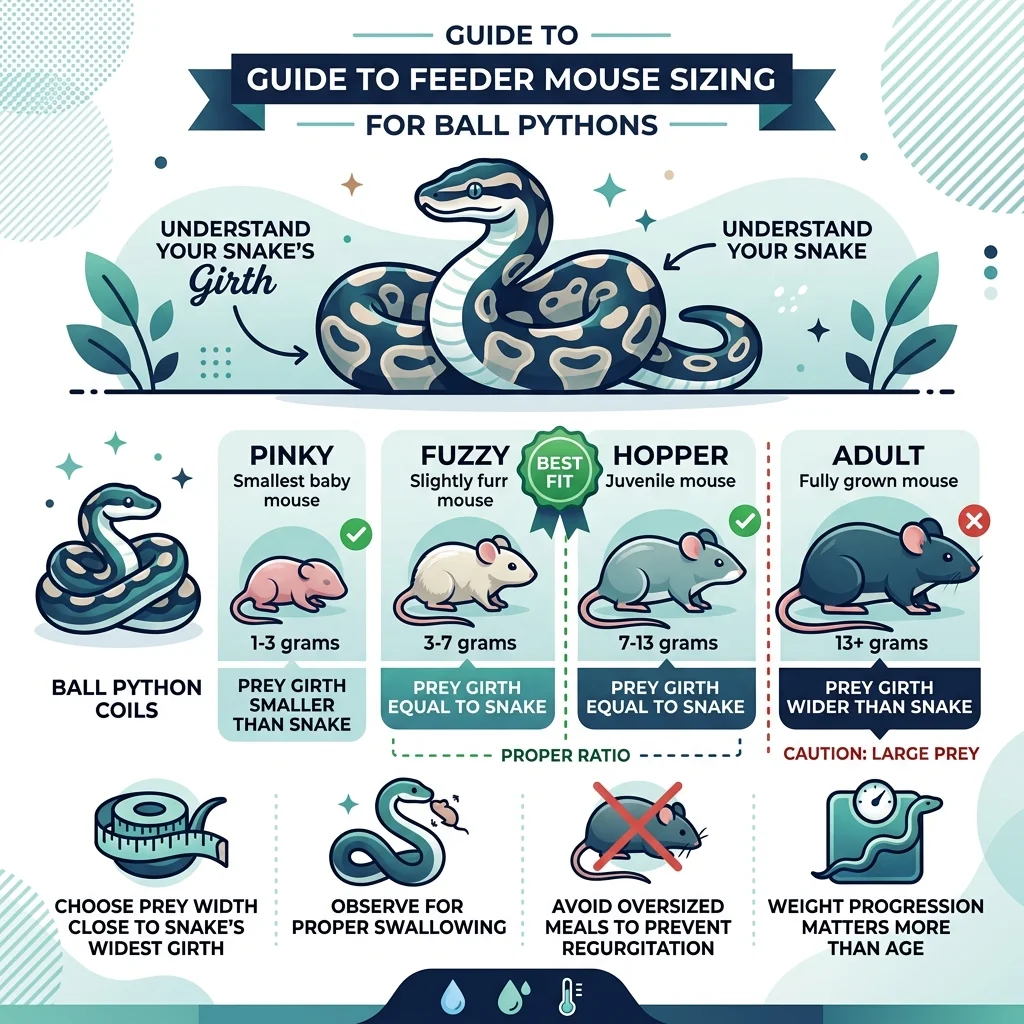
The gold-standard field method for prey sizing is the girth rule: prey should be approximately equal to — or no more than 1.5 times — the widest diameter of the snake's body at its thickest point (typically the mid-body region, not the head).
You do not need calipers. Hold the prey item next to your snake, or measure with your thumb and forefinger around the mid-body. If the prey is visibly wider than the snake, it is too large. If it is less than half the body diameter, it is too small.
The 10–15% Body Weight Rule
For precision-oriented keepers, the weight-based method is more reliable:
- Hatchlings and juveniles: Prey should be 10–15% of the snake's current body weight
- Adults: Prey should be 5–10% of the snake's current body weight
- Snakes in breeding condition (females): Reduce to 5–7% to avoid reproductive complications
This is why weighing your ball python monthly is such a valuable practice — it gives you a dynamic benchmark rather than a static size classification.
2. Ball Python Frozen Mouse Size Guide by Life Stage
Hatchling Ball Pythons (0–3 months, Under 100g)
Recommended prey: Pinky or Fuzzy mouse
| Mouse Size | Weight Range | Ball Python Weight Range |
|---|---|---|
| Pinky | 2–4g | 40–60g hatchling |
| Fuzzy | 5–9g | 60–100g hatchling |
Notes for hatchlings:
- Most ball pythons hatch at approximately 60–100g and measure 10–15 inches
- A standard pinky or fuzzy mouse is appropriate for the first 4–6 feedings
- Hatchlings should be fed every 5–7 days to support rapid growth
- Never offer a prey item wider than the hatchling's neck — at this life stage, the refusal risk from oversized prey is particularly high
- If a hatchling refuses a pinky, try a pinky rat instead — many ball pythons from West African bloodlines show a preference for rat scent even at the smallest sizes
Juvenile Ball Pythons (3–12 months, 100–400g)
Recommended prey: Fuzzy to Hopper mouse (transitioning to weanling rat by 250g+)
| Mouse Size | Weight Range | Ball Python Weight Range |
|---|---|---|
| Fuzzy | 5–9g | 100–150g juvenile |
| Hopper | 10–18g | 150–250g juvenile |
| Weaned/Small Adult | 19–28g | 250–350g (approaching max mouse size) |
Important transition note: By the time your ball python reaches 250–350g, you are approaching the upper limit of what a single mouse can provide nutritionally. This is the ideal point to transition to small rats rather than continuing to scale up mouse sizes. The reasons are:
- Nutritional efficiency: Rats have a higher meat-to-bone ratio at equivalent weights. A 30g rat pup delivers more usable protein and fat than a 30g adult mouse.
- Future feeding ease: Ball pythons that establish on rats early never develop the scent preference complications that plague keepers who try to switch adult snakes from mice to rats.
- Cost efficiency: Bulk rat prices per gram of prey are substantially lower than equivalent mouse sizes.
For our complete rat size chart for ball pythons, see that guide — but the key sizes for juvenile ball pythons are small rat pups (15–30g) and medium rat pups (30–50g).
Sub-Adult Ball Pythons (12–24 months, 400–1,000g)
Recommended prey: Adult mice (double-feeding) OR small to medium rats (preferred)
| Mouse Size | Weight Range | Ball Python Weight Range | Notes |
|---|---|---|---|
| Adult Small | 29–39g | 400–600g | Single mouse OR double fuzzy mouse |
| Adult Medium | 40–54g | 500–800g | Upper limit — consider rats instead |
| Adult Large | 55–75g | Not recommended | Exceeds safe girth ratio for most BP |
At the sub-adult stage, most keepers using mice will need to offer two prey items per feeding to meet caloric needs — particularly for growing females. This is manageable but logistically awkward.
Our strong recommendation: Use this transition period to switch to medium rats (80–120g). A single medium rat provides a complete meal for a 600–900g ball python and eliminates the complexity of double-feeding.
Adult Female Ball Pythons (2+ years, 1,000–2,500g)
Recommended prey: Large to jumbo mice (double or triple, impractical) OR medium to large rats
| Mouse Size | Weight Range | Ball Python Weight | Notes |
|---|---|---|---|
| Jumbo | 76–100g | 1,000g female | Barely adequate; two recommended |
| Adult Large (×2) | 55–75g each | 1,000–1,500g | Possible but complex |
Frankly, using mice to feed an adult female ball python is a nutritional and logistical challenge. Adult females weigh 1,500–2,000g and require 75–150g of prey per feeding (at 5–10% body weight). Achieving this with mice means offering 2–3 jumbos simultaneously — possible, but the snake must be willing to take multiple items and it creates handling challenges.
Switch to rats. For this life stage, refer to our ball python prey size calculator which provides exact rat size recommendations for every snake weight.
Adult Male Ball Pythons (2+ years, 700–1,200g)
Recommended prey: Adult medium to adult large mouse OR small to medium rat
Adult males are considerably smaller than females. A typical adult male weighs 700–1,200g, making them the most manageable size for continued mouse feeding if preferred.
| Mouse Size | Weight Range | Ball Python Weight |
|---|---|---|
| Adult Medium | 40–54g | 700–900g male |
| Adult Large | 55–75g | 900–1,200g male |
| Jumbo | 76–100g | 1,200g+ male |
Even for males, a small rat (80–120g) becomes more nutritionally efficient above 900g.
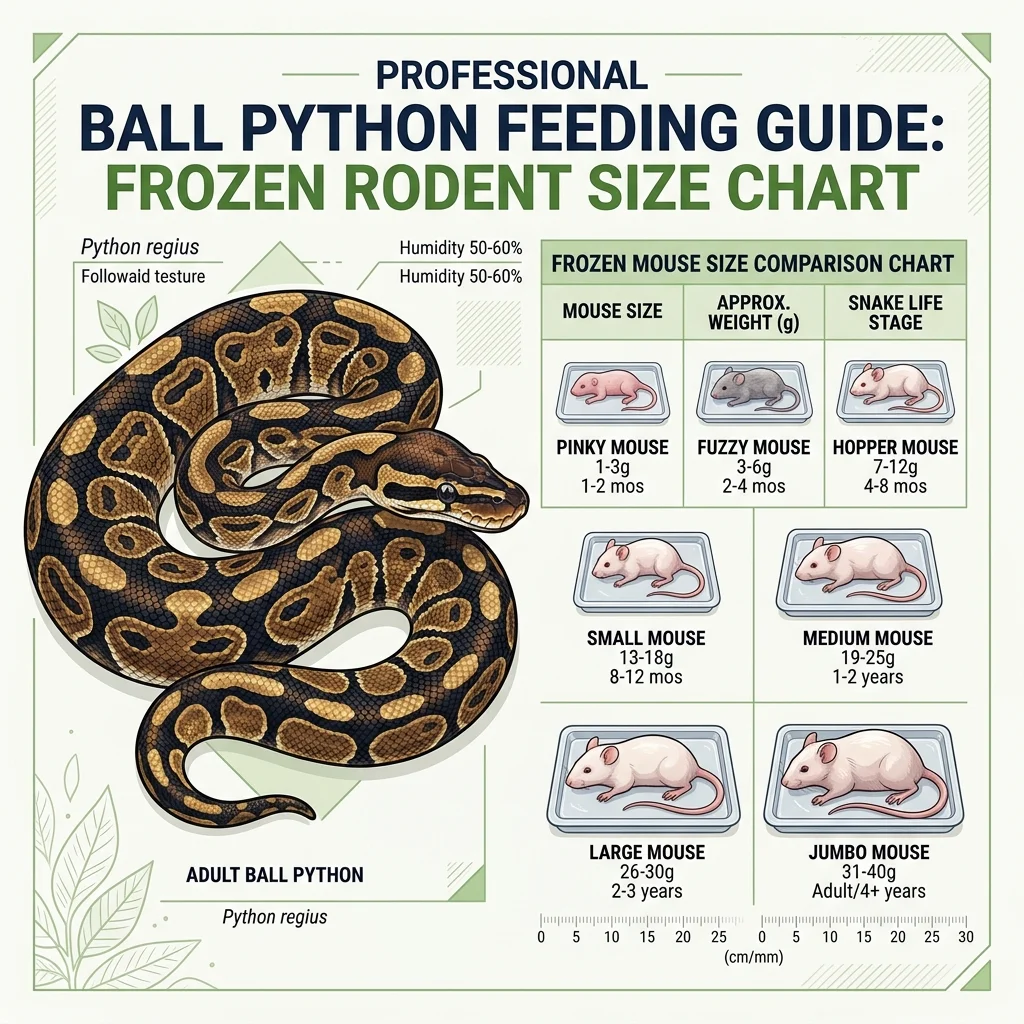
3. Frozen Mouse Size Chart: The Master Reference
The following chart integrates all life stages into a single reference. All weights are live weights at time of euthanasia. Loxahatchee Rodents uses CO2 euthanasia per AVMA guidelines.
| Mouse Size | Weight Range | Ball Python Weight | Feeding Interval |
|---|---|---|---|
| Pinky | 2–4g | 40–80g (hatchling) | Every 5–7 days |
| Fuzzy | 5–9g | 80–150g (hatchling/juvenile) | Every 5–7 days |
| Hopper | 10–18g | 150–250g (juvenile) | Every 7 days |
| Weaned | 19–28g | 250–350g (juvenile) | Every 7–10 days |
| Adult Small | 29–39g | 350–500g (sub-adult) | Every 7–10 days |
| Adult Medium | 40–54g | 500–700g (sub-adult) | Every 10–14 days |
| Adult Large | 55–75g | 700–1,000g (adult male) | Every 14 days |
| Jumbo | 76–100g | 1,000–1,200g (adult) | Every 14–21 days |
Important note on "double feeding": If your ball python's required caloric intake exceeds what a single prey item provides at appropriate girth, offer two smaller items rather than one oversized item. Two hoppers are better than one adult medium for a snake whose girth suggests a hopper. This principle — prioritizing girth accuracy over convenience — is the single most important lesson in prey sizing.
4. How to Thaw Frozen Mice Correctly
Prey size selection is only half of proper frozen feeding. The way you thaw your frozen mice directly affects feeding response and food safety.
The Warm Water Bath Method (Recommended)
- Remove the frozen mouse from its packaging
- Place it in a sealed plastic bag (this prevents water saturation of the fur)
- Submerge in warm — not hot — water (approximately 100–105°F / 38–40°C)
- Allow to thaw for 15–30 minutes depending on mouse size (pinkies thaw in 10 minutes; adult mice may take 25–35 minutes)
- Test with a thermometer — surface temperature of the prey should reach approximately 100°F before offering
- Offer with feeding tongs, never by hand
What Not to Do
- Never microwave frozen rodents. Microwaving creates uneven heating — frozen centers surrounded by scalding exteriors — and can cause internal steam pressure buildup that leads to dangerous eruption during thawing.
- Never thaw at room temperature. Room-temperature thawing creates bacterial bloom conditions on the prey's surface. Even if the snake accepts it, you are offering prey with elevated bacterial load.
- Never refreeze thawed prey. Once thawed, offer within 2 hours or discard. Refreezing and re-thawing degrades prey quality and increases pathogen risk.
For a full protocol with timing guides for all rodent sizes, see our complete guide on how to thaw frozen mice for snakes.
5. Sizing Mistakes That Cause Feeding Refusals
Understanding the link between improper sizing and feeding behavior helps you troubleshoot refusals correctly rather than defaulting to "my ball python is just being picky."
Prey That Is Too Warm
Ball pythons locate prey using infrared-sensitive pit organs. If frozen/thawed prey is warmed to above 105°F, the heat signature becomes atypical — it no longer matches the thermal profile of live prey. Some individuals refuse prey that is too hot just as reliably as prey that is too cold.
Solution: Use a laser thermometer to verify surface temperature is 98–102°F before offering.
Prey That Is Too Cold
The opposite problem is more common. Many keepers who "thaw" mice do not fully warm them, leaving a cold core that registers differently to the snake's heat pits. A surface temperature of 80°F is not adequate — the snake experiences the prey item as room-temperature, not alive.
Solution: After the warm water bath, feel the prey item throughout — it should be uniformly warm, not cold in the center. Add 5 additional minutes of warm bath if needed.
Size Escalation Shock
Some keepers make the mistake of jumping prey sizes too aggressively — going from a hopper to an adult medium in a single feeding. This can cause a refusal even in a ball python that has been feeding reliably for months.
Solution: Increase prey size by one step at a time. If moving from fuzzy to hopper, offer one hopper at the first upgraded feeding. If the snake takes it, you can proceed. If not, return to fuzzy for one more feeding before trying hopper again.
Handling Too Close to Feeding
Ball pythons should not be handled for 48 hours before a feeding attempt. Handling elevates cortisol, which suppresses feeding drive. This is not optional for reliable feeding — it is a physiological reality.
Similarly, do not handle within 48–72 hours after a feeding. Post-meal handling during active digestion can trigger regurgitation and, over time, feeding strike behavior.
6. Mice vs. Rats for Ball Pythons: A Nutritional Comparison
We've mentioned the rat transition several times because it is genuinely important for long-term ball python health. Here's the nutritional case:
| Nutrient | Adult Mouse (per 100g) | Small Rat Pup (per 100g) |
|---|---|---|
| Protein | 19.1g | 21.4g |
| Fat | 9.3g | 8.1g |
| Calcium | 70mg | 122mg |
| Phosphorus | 190mg | 167mg |
| Ca:P Ratio | 1:2.7 (unfavorable) | 1:1.4 (better) |
| Water Content | 67% | 70% |
The calcium-to-phosphorus ratio is the critical difference. Mice, particularly adult mice from standard feeder colonies, have a relatively poor calcium-to-phosphorus ratio. Rats, especially pups and weanlings, have a substantially better ratio — one that more closely approximates what a ball python would encounter with wild prey.
Long-term mouse-fed ball pythons are statistically more likely to develop metabolic bone issues than those transitioned to rats by adulthood. This data comes from zoological husbandry records where prey type histories are tracked across decades.
For a full breakdown of feeder rodent nutritional profiles, see our feeder rodent nutrition comparison.
7. Frozen Mouse Sources and Quality Indicators
Not all frozen mice are nutritionally equivalent. Production practices, colony genetics, and freezing protocols all affect the quality of the prey you're feeding your ball python.
What to Look For
Size consistency: A quality producer will have consistent weight ranges within each size class. If "adult medium" mice from your supplier vary from 35g to 60g, that supplier lacks standardized production protocols.
Vacuum sealing: Frozen mice should arrive vacuum-sealed, not in open plastic bags. Vacuum sealing prevents freezer burn, which degrades fat content and changes the scent profile of prey — contributing to feeding refusals.
CO2 euthanasia: Humane euthanasia via CO2 is the AVMA-approved standard for feeder rodents. CO2 euthanasia produces no residual compounds in prey tissues and is the industry benchmark.
Breeding colony management: Quality feeder rodent producers feed their colonies nutritionally complete diets. Colonies fed low-grade grain or scraps produce prey with suboptimal nutritional profiles — a problem that flows directly into your snake.
At Loxahatchee Rodents, all feeder mice are produced on a nutritionally complete diet, CO2 euthanized, individually graded by weight, and vacuum-sealed before freezing. You can read independent assessments of major frozen feeder suppliers in our guide to evaluating feeder rodent quality.
8. Frequently Asked Questions
How do I know if my ball python is eating the right size mouse?
The clearest post-feeding indicator is a visible but not dramatic "lump" in the snake's midsection approximately 24–48 hours after feeding. The lump should be a smooth, elongated bulge — not a hard, angular protrusion that looks like the prey item is creating distress. If you can clearly see the outline of the prey item through the snake's scales with sharp angles, the item may be too large. Additionally, any regurgitation within 48–72 hours of feeding is a strong signal that prey was oversized.
Can I switch my ball python from mice to rats as an adult?
Yes, but it takes patience. Adult ball pythons that have been conditioned to mouse scent for years can be reluctant to accept rat prey. Common techniques include scent transfer (rubbing rat prey with mouse fur or bedding), prey "washing" (briefly dipping rat prey in water used to thaw mice to transfer scent), and braining (a technique of last resort involving exposing the prey's brain matter to enhance scent stimulus). For a step-by-step protocol, see our guide to switching snakes from live to frozen prey which includes the rat transition protocol.
My ball python is refusing frozen mice but accepted live before. What size should I try?
When troubleshooting a switch from live to frozen, try offering prey that is one size smaller than what the snake accepted live. The reduced size creates a less intimidating presentation and a prey temperature that the snake may respond to more readily. Once the snake accepts frozen prey at the smaller size, you can work back up to the appropriate size over the next 3–4 feedings.
At what weight should I upgrade from mice to rats?
The optimal transition point for nutritional and behavioral reasons is 300–400g. At this weight, small rat pups (15–30g) provide an appropriate girth match and superior nutrition. The earlier in the snake's life you make this switch, the easier the transition — a 350g ball python that has only been fed mice for 6 months transitions to rats far more easily than a 1,500g adult that has eaten mice for 4 years.
How long can I store frozen mice?
Properly vacuum-sealed frozen mice can be stored for up to 12 months in a chest freezer maintained at 0°F (-18°C) or below. Quality degrades progressively from this point due to lipid oxidation (freezer burn) even in vacuum-sealed packaging. In standard zip-lock bags without vacuum sealing, quality degrades meaningfully after 4–6 months. Always store frozen prey in a dedicated freezer separate from human food where possible, and in an airtight container as a secondary layer of protection.
Summary: Ball Python Frozen Mouse Size at a Glance
- Hatchlings under 100g: Pinky or fuzzy mouse
- Juveniles 100–250g: Fuzzy to hopper mouse
- Juveniles 250–400g: Weaned to adult small mouse — consider rat pup transition here
- Sub-adults 400–700g: Adult medium mouse (or better, small rat)
- Adults 700g+: Jumbo mouse is barely adequate — switch to medium or large rat
- Adult females 1,500g+: Multiple mice impractical — large rat is the correct prey
The most important takeaway: sizing is dynamic, not static. Weigh your snake monthly, recalculate 10–15% of body weight, and adjust prey size accordingly. Ball pythons grow significantly in their first three years, and a feeding regimen appropriate for a 300g juvenile will be meaningfully different from what a 1,200g adult requires.
For the complete rat-based size chart covering all ball python life stages with weight-specific recommendations, see our ball python prey size calculator and chart.