Key Takeaway
A complete expert guide to setting up the perfect ball python enclosure. Covers enclosure size, temperature gradients, humidity, substrate choices, hide placement, and lighting — everything that directly impacts feeding success.
Table of Contents
- 1. Enclosure Size: The Most Misunderstood Variable
- Recommended Enclosure Sizes by Age
- 2. The Temperature Gradient: The Most Critical Variable for Feeding
- Required Temperature Ranges
- Heating Equipment
- Thermostats: Non-Negotiable
- 3. Humidity: The Second Most Critical Variable
- How to Maintain Proper Humidity
- 4. Hide Setup: The Key to Feeding Success
- The Two-Hide Rule
- Hide Sizing
- 5. Substrate Depth and Burrowing
- 6. Lighting: What Ball Pythons Actually Need
- 7. Water and Hydration
- 8. Cleaning and Maintenance Schedule
- 9. The Connection Between Enclosure Setup and Feeding Success
- 10. Common Setup Mistakes and Corrections
- Conclusion
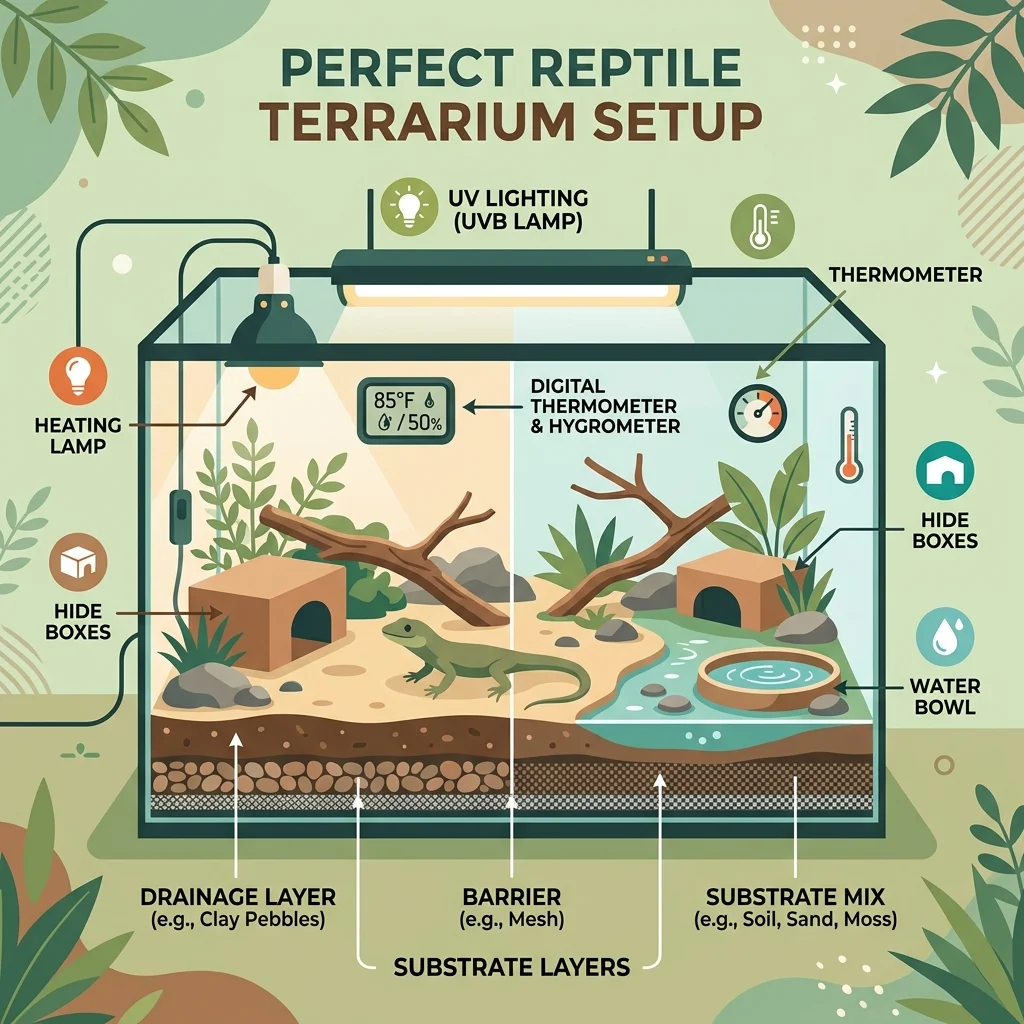
A properly set up enclosure is the foundation of every aspect of ball python health — including, critically, feeding behavior. The vast majority of ball python feeding problems that keepers bring to us at Loxahatchee Rodents are directly caused by enclosure deficiencies: temperatures that are too low, hides that are too large, humidity that is insufficient.
This guide covers every component of the ideal ball python enclosure from the perspective of a team with over 25 years of hands-on experience in reptile husbandry and zoological care.
1. Enclosure Size: The Most Misunderstood Variable
One of the most persistent myths in the ball python keeping community is that bigger enclosures are always better. This is false. Ball pythons are thigmotactic — they derive security from physical contact with their surroundings. An enclosure that is too large causes chronic stress, which directly suppresses feeding behavior.
Recommended Enclosure Sizes by Age
| Age | Minimum Footprint | Volume |
|---|---|---|
| Hatchling (0–6 months) | 12" x 12" | 10 gallons / 20-qt tub |
| Juvenile (6–18 months) | 24" x 12" | 20 gallons / 32-qt tub |
| Sub-Adult (1.5–3 years) | 36" x 18" | 40 gallons / 56-qt tub |
| Adult Female (3+ years) | 48" x 24" | 75–120 gallon / 105-qt tub |
| Adult Male (3+ years) | 36" x 18" to 48" x 18" | 40–75 gallon |
A simple rule: the enclosure footprint should be roughly equal to the snake's length squared, divided by two. A 4-foot snake needs approximately a 2 square foot enclosure footprint as a minimum.
Enclosure type matters too:
- Glass terrariums: Common and readily available. The main weakness is humidity retention — glass tanks lose moisture quickly through the screen top.
- PVC enclosures: Excellent for humidity retention and insulation. Preferred by professional breeders.
- Vision/plastic tubs: Most common in large breeding operations. Inexpensive, excellent humidity retention, easy to clean.
2. The Temperature Gradient: The Most Critical Variable for Feeding
Ball pythons cannot regulate their own body temperature. They depend entirely on their environment to provide a temperature gradient that allows them to thermoregulate — moving between warmer and cooler areas as needed for digestion, immune function, and metabolic regulation.
Required Temperature Ranges
Warm side (basking zone):
- Surface temperature: 88–92°F
- This is where digestion primarily occurs. A ball python that has just eaten will spend 48–72 hours primarily on the warm side.
Ambient warm side air:
- 82–86°F
Cool side ambient:
- 76–80°F
- The cool side provides a retreat for thermoregulation and represents the "safe zone" for a resting snake.
Night temperature:
- Can drop to 72–74°F — this mirrors the natural temperature drop in West African nights
- Should not drop below 70°F
Heating Equipment
Primary heating options:
Under Tank Heater (UTH) / Heat Mat:
- Heats the basking surface from below
- Must be connected to a proportional thermostat (not a simple on/off dimmer)
- Alone, it may not be sufficient to heat the ambient air in a large enclosure
- Best for smaller enclosures and tub systems
Radiant Heat Panel (RHP):
- Mounted inside the top of the enclosure
- Heats ambient air evenly
- Excellent for larger PVC enclosures
- Must be on a thermostat
Ceramic Heat Emitter (CHE):
- Produces heat without light — good for maintaining nighttime temperatures
- Does not produce beneficial infrared wavelengths for surface heating
- Use in combination with a heat mat for surface heating
Deep Heat Projector (DHP):
- Produces near-infrared (NIR) and mid-infrared (MIR) wavelengths that penetrate tissue like sunlight
- Considered the gold standard for daytime basking heating
- Mimics natural solar radiation more closely than any other artificial heat source
Thermostats: Non-Negotiable
Every heat source must be connected to a quality thermostat. A thermostat reads the actual temperature and adjusts heat output to maintain your target temperature. Without a thermostat, heat sources can overheat the enclosure — causing burns, stress, and appetite suppression.
Dimmer/pulse thermostat: For CHEs, RHPs, and DHPs On/off thermostat: For UTHs and heat mats Proportional thermostat: The most accurate type — adjusts output continuously
Set your thermostat probe at the surface of the warm hide to ensure the snake's core temperature is being regulated accurately.
3. Humidity: The Second Most Critical Variable
Ball pythons are native to the humid savanna and forest edges of West Africa, where relative humidity ranges from 50–70% in the dry season to 80–90% in the wet season. Captive environments should maintain:
Target humidity: 60–80%
Humidity below 50% causes:
- Respiratory tract irritation and infection risk
- Incomplete sheds (dysecdysis) — retained eye caps, retained shed on tail tip
- Feeding refusal (stress response to desiccation)
- Long-term health deterioration
Humidity above 90% consistently causes:
- Increased bacterial and fungal growth in the substrate
- Respiratory issues from inhaling moist air
- Scale rot risk if the belly is consistently in contact with wet substrate
How to Maintain Proper Humidity
Substrate selection (most important factor):
- Coconut fiber (coco coir): Excellent humidity retention, holds moisture without going sour quickly
- Bioactive substrate mix: Coco coir + topsoil + sand mix. Excellent humidity retention and allows naturalistic burrowing behavior
- Cypress mulch: Good humidity retention, natural look
- Aspen shavings: Poor humidity retention — not recommended for ball pythons
- Newspaper/paper towels: Minimal humidity retention — only for quarantine/medical situations
Technique adjustments:
- Keep a large, deep water bowl on the cool side — evaporation contributes significantly to ambient humidity
- Mist the substrate lightly (not the snake directly) 2–3 times per week
- Use a damp hide (plastic container with a wet sphagnum moss fill and a hole cut in the lid) on the warm side — this provides a high-humidity microclimate that the snake can access for shedding
4. Hide Setup: The Key to Feeding Success
As discussed in our ball python not eating guide, inadequate hides are one of the top causes of feeding refusal. The hide setup is not optional — it is the psychological foundation of a stable, eating ball python.
The Two-Hide Rule
Every ball python enclosure must have at least two hides:
- One on the warm side (over or near the heat source)
- One on the cool side
Both hides should be:
- Opaque — no see-through walls
- Snug — the snake should be in contact with the walls when coiled inside
- Placed at ground level — flat on the substrate, not elevated
- Stable — cannot be tipped or shifted by the snake
Hide Sizing
Match hide size to snake size as the snake grows. A hatchling in a 40-gallon tank hide will feel insecure. A large adult squeezed into a hatchling hide will be stressed from an inability to fully coil.
Practical test: Place the snake inside the hide. All sections of its body should be touching the interior walls. There should be no large empty spaces inside the hide.
5. Substrate Depth and Burrowing
Ball pythons are semi-fossorial — in the wild, they shelter in rodent burrows and other underground cavities. Providing adequate substrate depth allows them to express this natural behavior, which significantly reduces stress.
Recommended substrate depth:
- Hatchlings: 2–3 inches
- Adults: 4–6 inches
A ball python with enough substrate to partially bury itself will be demonstrably more secure, more likely to eat consistently, and easier to handle (because it has had the opportunity to destress naturally).
6. Lighting: What Ball Pythons Actually Need
Ball pythons are primarily nocturnal/crepuscular and do not require UVB lighting in the same way that diurnal lizards do. However, providing a natural light cycle is beneficial for maintaining their circadian rhythm and seasonal feeding patterns.
Recommended lighting approach:
- Use a low-output LED or fluorescent light on a 12-hour on/12-hour off timer to provide a natural light cycle
- Do NOT use hot incandescent bulbs as your primary lighting — they contribute to temperature spikes and humidity loss
- Avoid extremely bright or UV-heavy lights — ball pythons find intense light stressful and will hide rather than thermoregulate
- Never use red light or blue light as a "nocturnal" light — snakes can see these wavelengths, and constant lighting disrupts their rest
7. Water and Hydration
A large, heavy, stable water dish is an essential enclosure component. Ball pythons:
- Soak in their water bowl to aid shedding
- Drink from their water bowl (particularly in the 24–48 hours after a meal)
- Use the water bowl's evaporation to help regulate ambient humidity
Water dish guidelines:
- Large enough for the snake to coil in comfortably — this is particularly important for juveniles and adults approaching a shed
- Heavy ceramic or stainless steel (snakes will tip lightweight plastic dishes)
- Cleaned and refilled with fresh water at least every 3 days
- Placed on the cool side to prevent too-rapid evaporation
8. Cleaning and Maintenance Schedule
A clean enclosure reduces pathogen load, prevents mite infestations, and directly contributes to a healthy, eating snake.
Daily:
- Spot clean any waste (feces, urates) immediately — do not allow waste to sit in the enclosure
- Check and top off water bowl if needed
Weekly:
- Full water bowl clean and refill
- Check temperatures and humidity with instruments
- Check hide positions and substrate moisture
Monthly:
- Partial substrate change (remove top layer, replace with fresh)
- Wipe down enclosure walls and glass with a reptile-safe cleaner (dilute chlorhexidine solution works well)
- Inspect all equipment (heat sources, thermostat probes) for wear
Every 3–6 months:
- Full substrate replacement
- Full enclosure sanitization (empty the enclosure, clean with dilute bleach solution, rinse thoroughly, allow to air dry completely before adding new substrate)
9. The Connection Between Enclosure Setup and Feeding Success
Every parameter in this guide directly connects to your ball python's willingness to eat. Here's the summary:
| Enclosure Parameter | If Wrong | Effect on Feeding |
|---|---|---|
| Temperature (too low) | Cannot digest food | Refuses to eat |
| Temperature (too high) | Thermal stress | Refuses to eat, may become defensive |
| Humidity (too low) | Respiratory irritation, shedding issues | Refuses to eat |
| Hides (too large or missing) | Chronic insecurity stress | Refuses to eat |
| Enclosure (too large) | Exposed, no security | Refuses to eat |
| Substrate (too shallow) | Cannot burrow, increased stress | Feeding reluctance |
This is why our troubleshooting guide for ball pythons not eating always starts with a full enclosure audit. If the environment is wrong, no amount of prey scenting, different prey species, or feeding tricks will produce a consistently eating snake.
10. Common Setup Mistakes and Corrections
Mistake: Using a screen-top glass tank without additional humidity management Correction: Cover 60–70% of the screen top with a sheet of acrylic, glass, or a plastic humidity trap. This dramatically improves humidity retention.
Mistake: Placing the heat mat under the warm hide Correction: Place the heat mat off-center, not directly under the hide. The hide should be positioned over the edge of the heat mat so the snake can choose to be on or off the heat while remaining in the security of the hide.
Mistake: No thermostat on the heat source Correction: Install a thermostat immediately. This is not optional — a heat source without a thermostat is a burn and overheating hazard.
Mistake: Feeding in the main enclosure Correction: Feed in a separate container to prevent cage aggression and substrate ingestion. See our ball python feeding guide for the full protocol.
Conclusion
A correctly set up ball python enclosure is the single most powerful thing you can do for your snake's health, longevity, and feeding consistency. Every parameter in this guide is interconnected — temperature affects humidity affects behavior affects feeding.
For more expert guidance, explore our ball python guides and feeding guides. For questions about feeder selection and sizing, visit our home page to learn more about Loxahatchee Rodents and how our 25+ years of expertise can support your ball python keeping journey.
Written by Bill Galloway, Former Assistant Curator at Palm Beach Zoo and co-founder of Loxahatchee Rodents.