Key Takeaway
Stop guessing prey sizes for your ball python. This complete guide gives you the exact measurements, weight ranges, and girth-matching method to pick the perfect prey size every time.
Table of Contents
- 1. The Fundamental Rule of Prey Sizing
- 2. How to Measure Your Ball Python's Girth
- 3. Complete Ball Python Prey Size Chart
- Ball Python Prey Size by Age and Weight
- 4. Mice vs. Rats: Which is Right for Your Ball Python?
- 5. Transitioning Ball Pythons from Mice to Rats
- The Transition Protocol
- 6. Overfeeding and Its Long-Term Consequences
- 7. Underfeeding: The Other Extreme
- 8. Feeding Journal: Track Everything
- 9. Prey Quality and Its Impact on Ball Python Health
- 10. FAQ: Ball Python Prey Sizing
- Conclusion
One of the most common mistakes ball python keepers make is incorrectly sizing prey items. Feed too large, and you risk regurgitation, physical injury, and a snake that learns to associate feeding with discomfort. Feed too small, and you under-nourish a growing snake and create a picky feeder conditioned to tiny prey.
This comprehensive guide from the team at Loxahatchee Rodents — with over 25 years of experience in feeder production and reptile husbandry — gives you every tool you need to correctly size meals for your ball python at every life stage.
1. The Fundamental Rule of Prey Sizing
Before the charts, before the weights, before anything else — understand this rule:
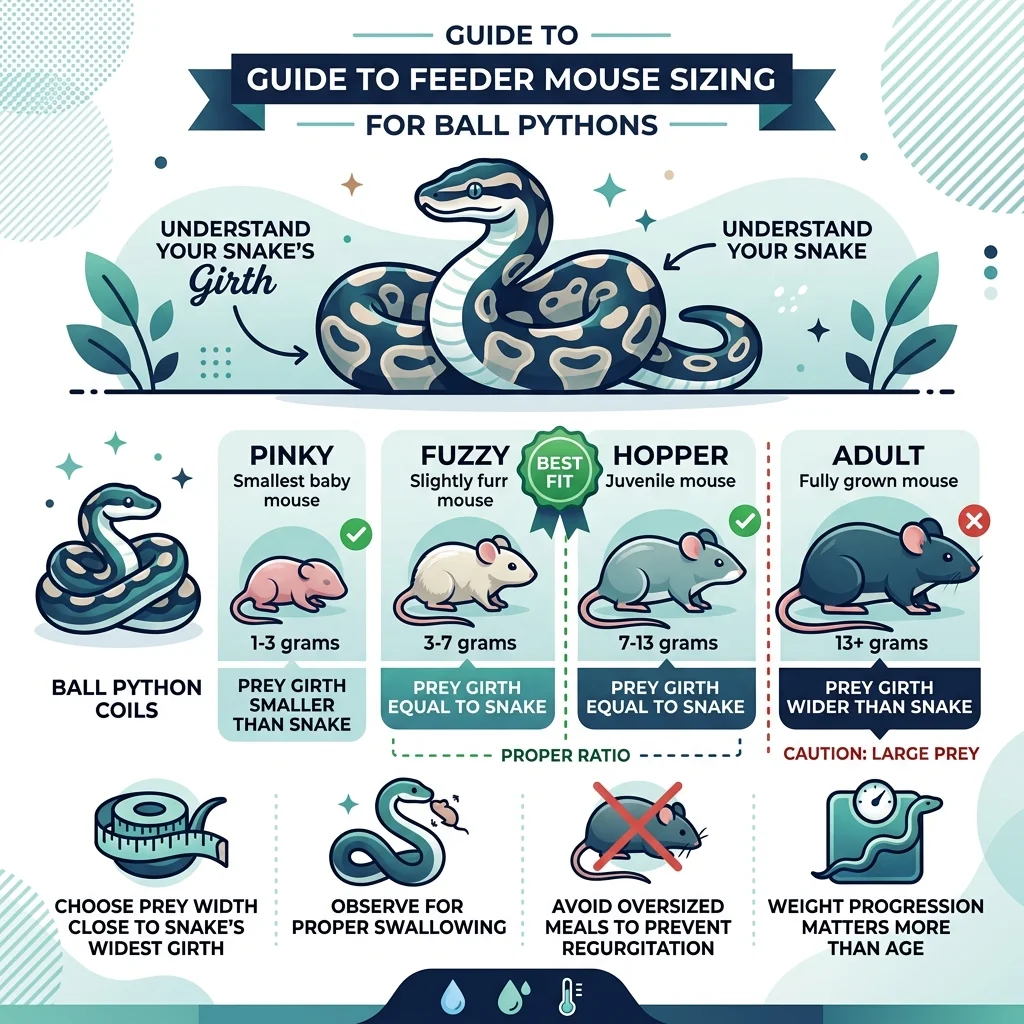
The prey item's diameter should be equal to or no more than 1.5x the diameter of the thickest part of the ball python's body.
This is the universal sizing principle taught by herpetological veterinarians, professional breeders, and zoological institutions. It applies regardless of the snake's age, the prey species, or the feeding frequency.
Why 1.5x maximum? Snakes swallow prey whole by expanding their jaw ligaments and esophagus in a process called cranial kinesis. The esophagus can stretch significantly, but beyond 1.5x the body diameter, the mechanical stress on the throat and esophageal muscles significantly increases regurgitation risk and potential injury.
Common mistake: Many keepers use the "one-third rule" they read online (prey should be no larger than one-third the snake's body length). This is wrong. Body girth (diameter) is the correct reference measurement, not body length. A 3-foot ball python with a thick body might eat an adult rat, while a 4-foot, very slender ball python might only be eating medium mice.
2. How to Measure Your Ball Python's Girth
To apply the sizing rule accurately, you need to know your snake's body diameter at its widest point.
Method 1: The Observation Method Hold the snake and identify the widest point of the body (usually around the mid-body, past the neck but before the cloaca). Look at the diameter of this section.
Now select a thawed prey item. Hold the prey next to the thickest part of the snake's body. The prey should be the same diameter or slightly smaller. Going up to 1.5x the diameter of the snake's body is the maximum safe size.
Method 2: The Photograph Method Take a top-down photograph of your snake fully extended on a flat surface. Identify the widest point. If you have access to a photo editing app, you can compare a measurement reference (like a coin or ruler in the photo) to the prey item.
Method 3: Weight-Based Estimation While not as accurate as girth measurement, prey weight as a percentage of snake body weight is a useful check:
- Hatchlings and juveniles: Prey should weigh 10–15% of the snake's body weight
- Sub-adults: Prey should weigh 8–12% of body weight
- Adults: Prey should weigh 5–10% of body weight
For example: A 500g juvenile ball python should eat a prey item weighing approximately 50–75g (10–15% of 500g).
3. Complete Ball Python Prey Size Chart
This chart integrates the girth-matching method with weight-based verification and links to specific feeder size categories.
Ball Python Prey Size by Age and Weight
| Snake Age | Snake Weight | Recommended Prey | Prey Weight | Frequency |
|---|---|---|---|---|
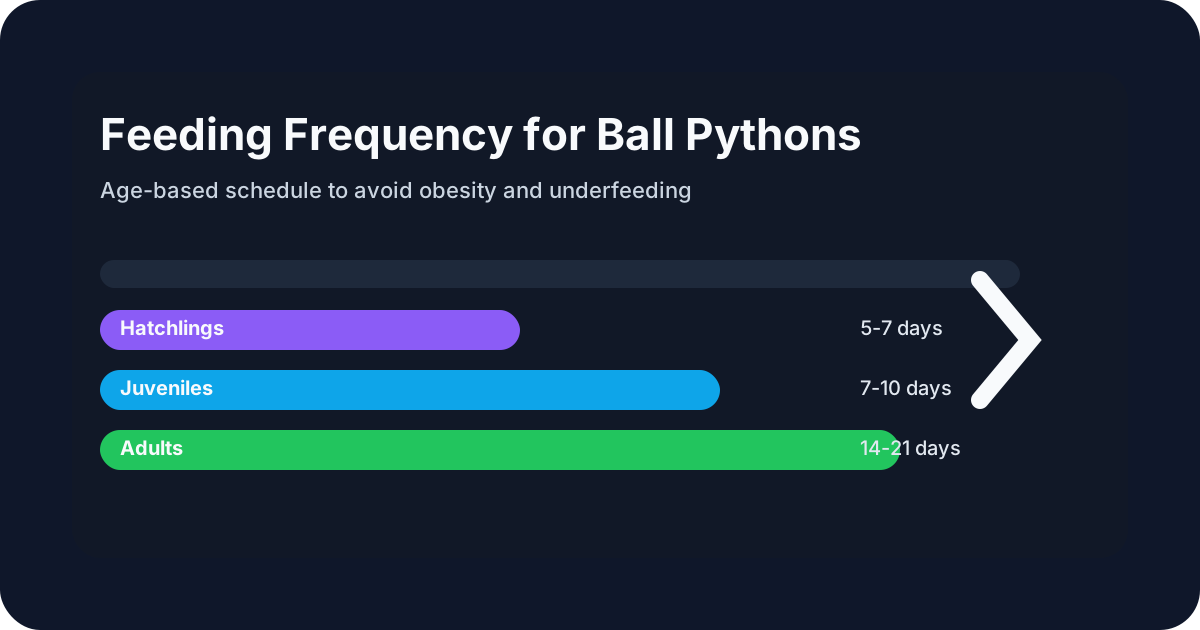
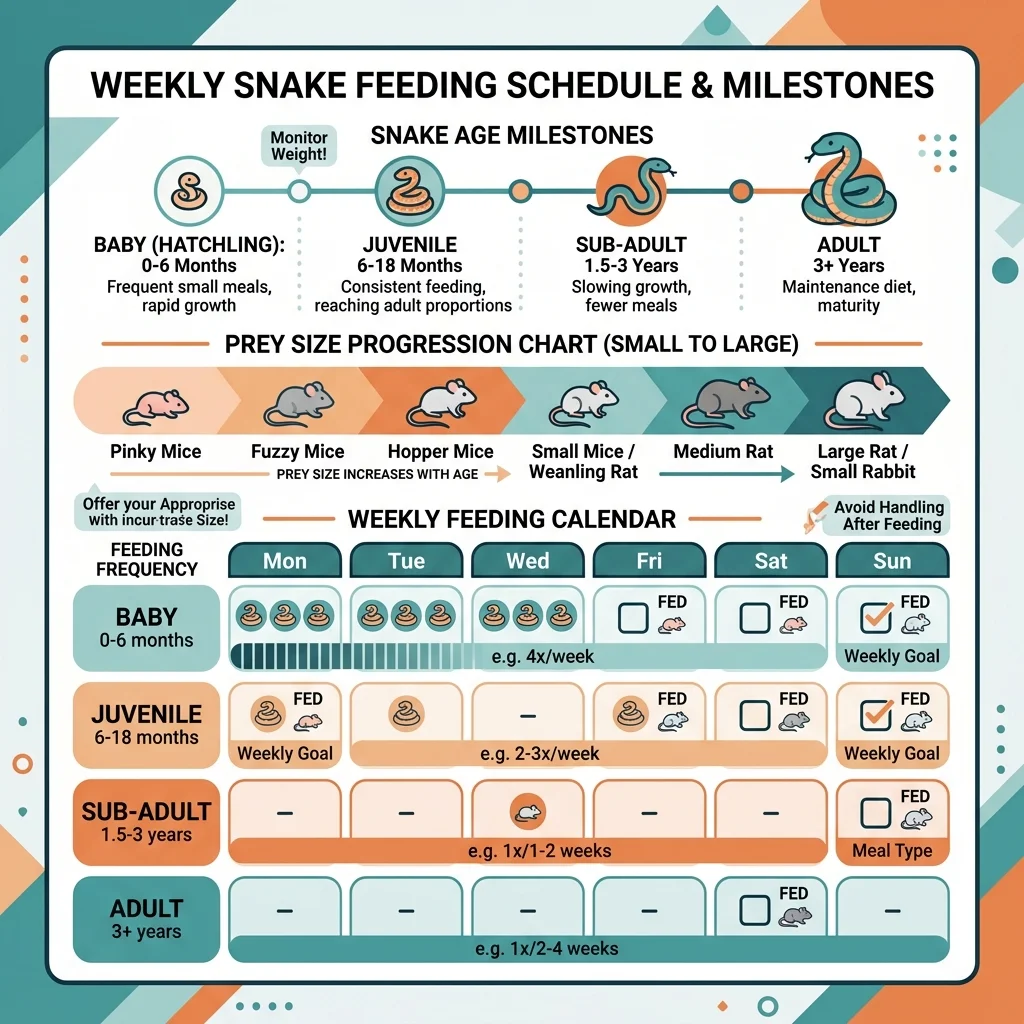
| Hatchling (0–3 months) | 50–100g | Pinky Mouse or Small Hopper | 3–8g | Every 5–7 days |
| Juvenile (3–6 months) | 100–200g | Hopper Mouse or Weanling Rat | 10–20g | Every 7 days |
| Juvenile (6–12 months) | 200–400g | Large Hopper or Small Rat | 20–40g | Every 7 days |
| Sub-Adult (1–2 years) | 400–800g | Small to Medium Rat | 40–80g | Every 7–10 days |
| Sub-Adult (2–3 years) | 800g–1.5kg | Medium Rat | 80–150g | Every 10 days |
| Adult (3–5 years) | 1.5–3kg | Medium to Large Rat | 150–250g | Every 10–14 days |
| Large Adult (5+ years) | 3–5kg | Large Rat | 200–350g | Every 14–21 days |
For reference sizing of individual prey items by weight and physical dimensions, consult our complete frozen rat size chart.
4. Mice vs. Rats: Which is Right for Your Ball Python?
Ball pythons in captivity are routinely offered both feeder mice and feeder rats. Here's how to decide:
Feeder Mice:
- More appropriate for hatchlings and small juveniles (under 200g)
- Higher fat content than comparably-sized rats — good for rapid juvenile growth
- Most ball pythons readily accept mice
- Become impractically small for adults (you'd need 3–5 mice per feeding for a large adult)
Feeder Rats:
- Leaner than mice of similar weight — better for long-term adult nutrition
- More efficient for large snakes — one prey item per feeding
- May require a scenting transition if the snake was raised exclusively on mice
- Available in a size range from 30g weanlings to 600g+ jumbo adults
African Soft Fur (ASF) Rats:
- The leanest option — 40–60% lower fat than domestic mice
- Natural prey of ball pythons in West Africa — excellent scent acceptance
- Particularly recommended for ball pythons with weight management concerns
- Limited to adult sizes of ~40–60g — appropriate up to large juveniles/smaller adults
For a complete nutritional breakdown of all three feeder options, see our feeder nutrition comparison guide.
5. Transitioning Ball Pythons from Mice to Rats
This transition is necessary as your ball python grows and requires larger prey than adult mice can provide. Most ball pythons transition easily; some are stubborn.
The Transition Protocol
Step 1: Scenting Rub the thawed rat with the bag or bedding from a mouse. The familiar mouse scent on an unfamiliar prey item bridges the scent recognition gap.
Step 2: Start Small Offer a weanling rat (30–50g) rather than jumping straight to a small rat. The size similarity to a large mouse makes initial acceptance more likely.
Step 3: The Drag and Drop Briefly drag a thawed mouse across the rat so the mouse scent is on the rat's skin. Then remove the mouse and offer only the rat. Many ball pythons will accept the rat immediately.
Step 4: Double Prey Offer Place both a small thawed mouse and a weanling rat in the feeding container at the same time. The snake may initially strike the mouse but then investigate and strike the rat — gradually shifting preference.
Step 5: Patience Some snakes take 4–6 transition feeding sessions before accepting rats without assistance. As long as the snake is not losing significant weight, time and patience are always the right answer.
6. Overfeeding and Its Long-Term Consequences
The correct prey size matters just as much as the correct feeding frequency. Together, they determine your ball python's total caloric intake.
Overfeeding in ball pythons is extremely common and is one of the leading causes of premature death in captive animals. Signs that you may be overfeeding:
Body condition signs:
- Heavy folds of skin along the sides (excess subcutaneous fat)
- Square-looking cross-section (healthy ball pythons are round, not square)
- Difficulty maintaining a normal coiled position
- Loss of neck definition (head should be distinct from the neck)
Weight trajectory signs:
- Gaining more than 10% body weight per month (in adults)
- Reaching 3kg or more before 3 years of age
Behavioral signs:
- Consistently refusing food (obesity causes anorexia in ball pythons)
- Reduced activity and exploration
If you suspect overfeeding, do not abruptly stop feeding — this creates stress and can trigger other health problems. Instead:
- Reduce prey size by one category (e.g., large rat to medium rat)
- Extend feeding interval by 3–5 days
- Reweigh monthly to track progress
- Consult an exotic vet if concerned
7. Underfeeding: The Other Extreme
Underfeeding is less common but occurs when keepers are afraid of overfeeding and overcorrect. Signs of an underfed ball python:
- Visible spine along the back (should not be prominent)
- Visible ribs, particularly after eating
- Sharp taper at base of tail (healthy tail should taper gradually)
- Weight consistently declining month over month
- Excessive activity and restlessness (searching for food)
If your ball python is losing weight, increase prey size by one category and/or increase frequency slightly. A vet visit to rule out parasites or illness is recommended if weight loss is rapid.
8. Feeding Journal: Track Everything
Professional reptile breeders maintain feeding journals for every animal. This practice is just as valuable for private keepers.
What to track in your feeding journal:
- Date of feeding
- Prey species and size category
- Prey weight (if you have a scale)
- Whether the snake accepted or refused
- Snake body weight (monthly is sufficient)
- Date of last shed
- Any health observations
Over time, your feeding journal will reveal patterns — seasonal feeding pauses, rapid growth phases, and responses to prey size changes — that make you a more effective keeper.
A simple phone note or spreadsheet works perfectly. Even a paper notebook is fine.
9. Prey Quality and Its Impact on Ball Python Health
Getting the sizing right is only half the equation. The quality of the prey matters just as much.
What defines prey quality:
- Source nutrition: Feeders raised on quality lab-grade diets have better vitamin and mineral profiles
- Flash-freezing: Preserves cellular structure, scent, and nutritional integrity better than slow-freezing
- Cold chain integrity: Proper storage at -18°C throughout the supply chain
- No freezer burn: Indicates proper packaging and storage
At Loxahatchee Rodents, our breeding colonies are maintained on premium lab chow, and our feeders are flash-frozen within hours of euthanasia. This ensures that the nutritional profiles in our products match the data in our sizing charts. To learn where to source quality feeders, see our where to buy frozen mice guide.
10. FAQ: Ball Python Prey Sizing
Q: My ball python struck but didn't eat. Was the prey too big? A: Not necessarily. A strike-but-no-eat often indicates the prey wasn't warm enough, the snake was disturbed during the feeding response, or the snake simply wasn't hungry. Check prey temperature first. If the snake struck, constricted, and then released without swallowing, that can indicate the prey is too large.
Q: My ball python swallowed a prey item that seemed too large. Should I be worried? A: Monitor the snake for 24–48 hours. A very visible, large bulge is not immediately dangerous, but if the snake shows any signs of distress or regurgitates within 24 hours, follow our regurgitation guide. Try a smaller prey item at the next feeding.
Q: I have a very obese ball python. How do I safely reduce feeding? A: Reduce prey size by one category. Do not eliminate feeding entirely — the stress of a complete fast in an obese animal can cause additional metabolic issues. Work with an exotic vet to develop a weight management plan.
Q: My hatchling is refusing food. Is my prey size wrong? A: Hatchling refusal is common and often related to stress (new environment) rather than prey size. Review our complete ball python not eating guide for the full troubleshooting protocol.
Conclusion
Prey sizing is a science, not a guessing game. By understanding the body girth principle, using the weight-based verification method, and tracking your ball python's growth and body condition over time, you can nail the correct prey size at every life stage.
At Loxahatchee Rodents, we make this easier by providing clearly sized, labeled frozen feeders in every category from pinky to jumbo. Explore our home page to learn more about our facility and our 25 years of commitment to the reptile keeping community. Browse our complete ball python feeding guides for more expert resources.
Written by Bill Galloway, Former Assistant Curator at Palm Beach Zoo and co-founder of Loxahatchee Rodents.